Overview and identification
The largemouth bass (Micropterus salmoides) is the black bass of still and slow water and of cover. The name is in transition: KDFWR and the U.S. Fish and Wildlife Service both use M. salmoides, while the USGS Nonindigenous Aquatic Species factsheet for the same fish is now headed Micropterus nigricans and uses salmoides in its own description a paragraph later. Nothing about catching them changes; we follow the Kentucky agency whose regulations you fish under. The Kentucky Department of Fish and Wildlife Resources (KDFWR) describes it as a large, slender fish with a large mouth: the upper jaw extends far beyond the rear margin of the eye in adults, and a broad black stripe runs down the side, often obscure or broken into a series of blotches. Most Kentucky adults run 12 to 20 inches and 1 to 5 pounds; KDFWR says the species can grow to at least 22 pounds. Ohio DNR's figures for its own waters are 15 to 18 inches and 1 to 5 pounds, with fish to 26 inches and 13 pounds. Animal Diversity Web puts the largest recorded specimen at 97 cm and 10.1 kg and gives a wild lifespan averaging 16 years.
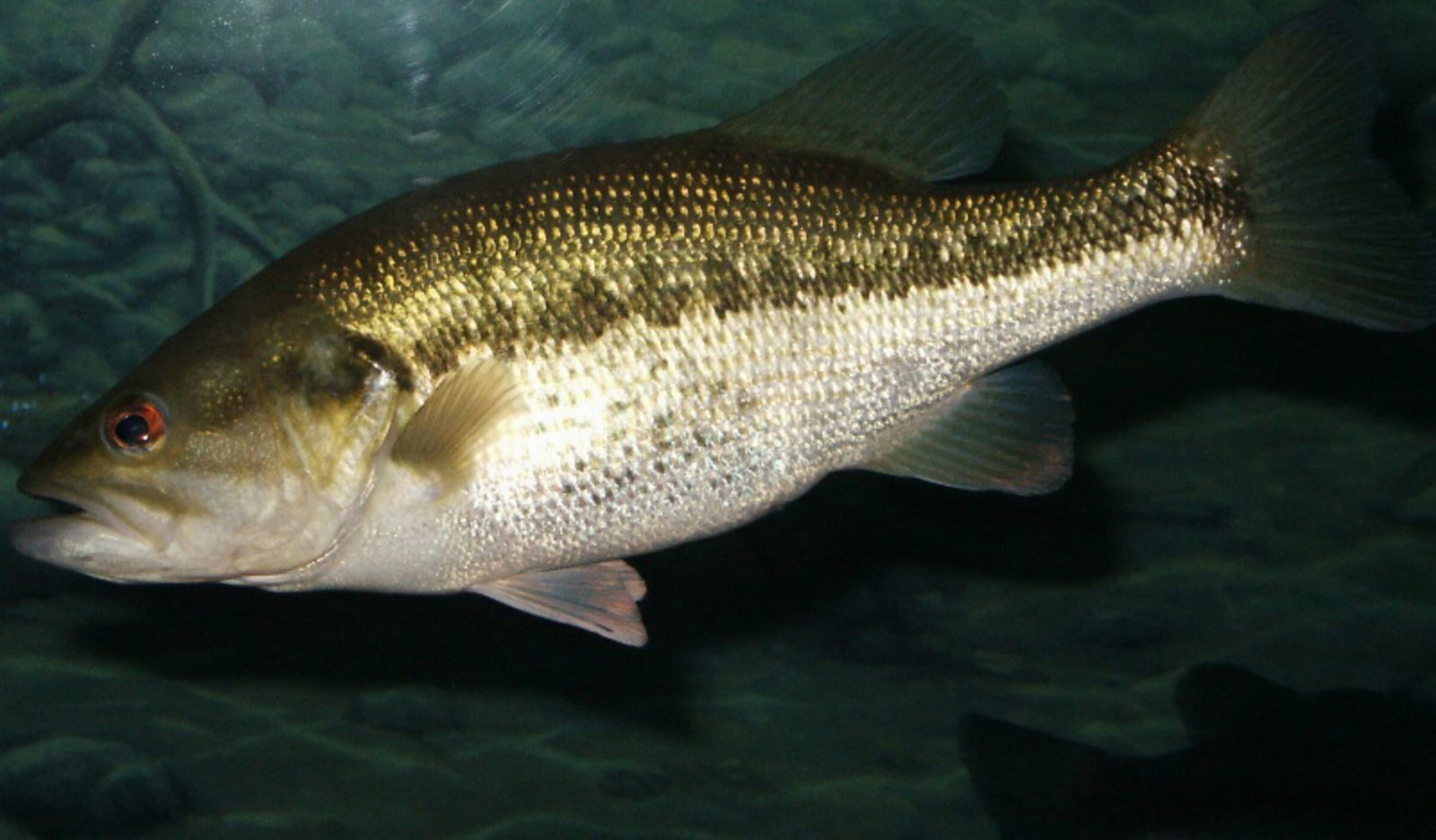
Three black basses overlap on every reservoir and most rivers in our region, and the largemouth is the one that regulations most often single out. The official marks, drawn from the KDFWR species pages for all three:
- Jaw. Largemouth: the upper jaw extends far beyond the rear margin of the eye. Smallmouth: it does not extend past the rear margin. Ohio DNR uses the same test and specifies the mouth closed. Spotted bass sit between and are the fish this mark does not settle on its own.
- Dorsal fin. Largemouth have a deep notch between the spiny and soft dorsal fins; spotted bass and smallmouth a shallow one. On a largemouth the two fins look almost separate.
- Side pattern. Largemouth and spotted bass carry a horizontal stripe. Smallmouth show 10 to 15 faint vertical bars, or none, on a bronze ground.
- Tongue. Spotted bass have a circular patch of teeth on the tongue; KDFWR says the largemouth lacks it. Run a thumb over the tongue of a striped fish with a shallow notch.
- Belly. Adult largemouth have a plain lower side. Spotted bass carry horizontal rows of small black spots below the stripe.
- Juveniles. Young largemouth have a dark band at the edge of the tail; young spotted and smallmouth have the three-colored tail (orange base, black middle, white edge). Ohio DNR notes young largemouth lack the orange tail.
Two-step check on a reservoir fish: a closed jaw ending well behind the eye plus a deep dorsal notch is a largemouth. A striped fish with a jaw ending near the eye, a shallow notch, belly spot rows and a rough tongue is a spotted bass, which KDFWR calls the Kentucky bass, reports statewide except the far-western coastal plain, and describes as less abundant than largemouth in reservoirs.
Range
Animal Diversity Web gives the native range as much of eastern North America, from Quebec south to northern Mexico and from the Atlantic coast west to Texas and North Dakota. Ohio DNR reports it native to Ohio and present in every county, in nearly every lake, reservoir and pond, and less common in flowing streams than the other basses. KDFWR calls it common throughout most of Kentucky and notes it has been widely stocked, in private ponds, reservoirs and major rivers, which is why it turns up in water it never occupied naturally.
Where you will find them in our region
Every reservoir we cover holds largemouth. The entries below are from KDFWR's 2026 Fishing Forecast, read in full on 22 September 2026, with the lake's published bass assessment added where it says more than the forecast does. Where a Limestone Drift waterway page exists, it is linked.
- Taylorsville Lake. Forecast: good spawns from 2022 through 2025, good numbers of 12- to 18-inch fish, and fish over 20 inches available. KDFWR's 2023 bass assessment rated the population "Excellent," with 15-inch-plus catch rates above average and rising since 2013 and a 2022 year class that sampled at more than double the lake average. The forecast landing page lists it among the central Kentucky lakes to head to.
- Rough River Lake. Forecast: stable population with a good number of bass over 15 inches, several over 20 inches seen annually, and relatively high numbers of 12- to 15-inch fish again in 2025 that should recruit to keeper size — with the note that the bass here have proven difficult to catch. KDFWR's 2021 assessment has rated the population "Good" since 2003 with an upward trend; the 12- to 14.9-inch class in 2021 was the highest recorded in more than two decades, and age-1 recruitment set a record.
- Cave Run Lake. Forecast: good numbers over 15 inches, but fish under 8 inches dominate the population and the forecast says harvesting them will help it; its 2022 assessment says excess recruits compete for limited food and slow growth. Both were written under the old protective slot, which the regulation replaced on 3 September 2026 with a 10-fish black bass limit in which no more than 5 largemouth may be 12 inches or longer.
- Lake Cumberland. Forecast: population stable, fish over 15 inches common, fish over 20 inches available.
- Kentucky Lake. Forecast: a fantastic 2016 year class has produced a large number of trophy bass in the system now, and above-average year classes in 2020 through 2022 with the best ever in 2023 bode well.
- Lake Barkley. Forecast: shallow-water fishing for spawning bass around buttonbush is very productive in spring; in post-spawn most bass move to main-lake drop-offs and the mouths of bays.
- Dale Hollow Lake. Forecast: population strong, with fish over 15 inches a good portion of it.
- Herrington Lake. Forecast: good numbers over 12 inches and many over 15.
- Green River Lake. Forecast: good numbers of 15-inch-plus fish and good numbers over 18 inches. Also on the forecast landing page's central Kentucky list.
- Barren River Lake. Forecast: good numbers overall and above-average numbers of 18-inch fish. Also on the central Kentucky list.
- Nolin River Lake. Forecast: stable population, good numbers of fish over 15 inches with several over 20 inches seen annually, high numbers of 12- to 15-inch fish, often hard to find in summer and often deeper on the lower end of the lake. KDFWR's 2021 assessment rates the population "Excellent" since 2012, with 20-inch-plus fish sampling at "Excellent" in 2021.
- Ohio River. Forecast: fishing is best in tributaries and backwater areas, and fingerlings are stocked annually in the Greenup, Meldahl, Markland and Cannelton pools.
- Barren River above the lake. Forecast: largemouth, spotted and smallmouth bass all present in fair to good numbers and good sizes, with largemouth best below the 100 bridge.
- Rivers and streams. The forecast's other river note for largemouth is the Kentucky River: cover just below the dams, creek mouths, bank slides, timber. KDFWR's Fishing and Boating Guide names largemouth in its entries for Elkhorn Creek, where a special black bass regulation covers both largemouth and smallmouth, and for the Cumberland River tailwater below Wolf Creek Dam. The forecast also lists dozens of small state-owned lakes, and its spring advice is to fish farm ponds and shallow public lakes first because they warm before the reservoirs.
Neither the upper Salt River nor the Licking River carries a largemouth entry anywhere in the 2026 forecast. KDFWR says largemouth avoid upland headwater creeks, so expect them in slow pools and backwaters rather than riffle water.
Habitat, structure and cover
KDFWR's habitat line is the whole species in a sentence: ponds, reservoirs, backwaters, oxbows and sloughs, usually associated with shallow vegetated areas, standing timber, stumps and other cover, and absent from upland headwater creeks. Ohio DNR adds relatively clear, non-flowing water with some aquatic vegetation. Animal Diversity Web calls dense vegetation essential, as refuge and as ambush cover, and gives a warm-season depth of 0.3 to 4 m (1 to 13 feet) with a winter move to 5 to 15 m (16 to 50 feet).
Reservoirs. Kentucky's flood-control lakes are largemouth water first. The fish relate to the cover KDFWR lists and to the structure under it: creek channels, points, flats, the old river channel. Wired2Fish's timber rule applies to every cover type on this page: location first, cover second. A stump on a channel bend outfishes a stump field on a featureless flat. The cover that matters on our lakes, in order: standing and fallen timber, stumps, docks, riprap and bridge rock, buttonbush and willow on flooded shorelines, and whatever vegetation the lake grows.
The drawdown. The Louisville District's published schedule takes Cave Run from 730 to 724 feet and Rough River from 490 to 470 between 15 October and 1 December, Taylorsville from 547 to 545 between 15 November and 1 December, and Nolin, Barren and Green River Lake down on the same October-to-December window. Bassmaster's drawdown coverage describes three phases: early in the drop, bass pull off the shallows and then follow shad back onto the creek mud flats; at bottom-out they school on the guts of creeks and main-lake pockets, 10 to 40 feet deep depending on clarity; on the spring rise they push onto hard bottom-contour structure near deep water. A falling pool concentrates fish on the cover that stays wet: the last laydowns, the creek-channel edges, the deep ends of points. Our Taylorsville and Rough River pages carry the dates and ramp caveats.
Rivers. Ohio DNR says largemouth are less common than smallmouth in flowing water and that spotted bass dominate southern Ohio rivers. Where they occur they behave like pond fish: the KDFWR Kentucky River note (cover below the dams, creek mouths, bank slides, timber) is a list of places with no current. Backwaters, wing-dam eddies, sloughs.
Ponds and small lakes. The species' home: still, warm, weedy, with a dam-end drop-off. KDFWR's forecast points anglers at ponds and shallow lakes in early spring because they warm first.
Tailwaters. Marginal, but KDFWR's guide names largemouth in the Cumberland River below Wolf Creek Dam. Fish the slack water behind islands and the warm creek mouths, and treat the generation schedule as the safety issue it is.
Forage and feeding
Ohio DNR lists frogs, crayfish, large insects and other fish for adults, with juveniles starting on microscopic animals and moving to freshwater shrimp and midge larvae at about an inch. Animal Diversity Web adds sunfish and other bass to the adult list and notes they feed all day with peaks in early morning and late evening. The reservoir forage that drives most of the year here is shad, which none of the species pages name because they are describing the fish's diet across its range, not a Corps lake in Kentucky; Bassmaster, In-Fisherman and Wired2Fish all treat the fall shad migration into the creeks as the organizing event of autumn.
Temperature runs the metabolism. Bassmaster's seasonal piece quotes a guide who ignores the thermometer between 55 and 85 F and watches it only above 85 or below 50; below 50, fish move deep and feed little, and a couple of warm sunny days are the trigger for a winter bite. Unlike a smallmouth, a largemouth is not a clear-water specialist. It hunts from cover, by ambush, and Orvis's bass-bug guidance is blunt about the consequence: largemouths are not leader shy at all. That changes the line section of this page.
The year, season by season
Ohio DNR puts the spawn between mid-April and mid-June, with the male building a nest in 1 to 6 feet of water and guarding the eggs until they hatch; a female lays 2,000 to 20,000 eggs across several nests. Animal Diversity Web says spawning starts when water reaches about 15 C (59 F), on hard-packed sand, pea gravel, clay or marl at 0.6 to 2 m, with eggs hatching in 1 to 5 days and fry guarded for 7 to 10 days. The angling consensus starts the spawn a little cooler: Wired2Fish at about 55 F, Bassmaster's six-season guide at 55 to 70. Take 55 as the point to start looking and 59 to 60 as the point most beds are occupied, and treat temperature, protected flats and the north side of the lake as the trigger, not the calendar. Kentucky runs earlier than Ohio.
Winter (water below about 50 F)
The Bassmaster six-season guide's winter is 48 F and down: main-lake, vertical, fast-sloping structure such as bluffs, channel drop-offs, standing timber and 45-degree banks, with fish suspending deep in clear lakes. In-Fisherman's coldwater period has reservoir bass on creek channels, moving off the flats to the drop-offs as water approaches the mid-40s. On a drawn-down Corps lake the fish are at bottom-out: schooled, predictable, deep.
- Reservoir. Channel swings, bluff ends and deep timber, 15 to 40 ft, on standing timber on the channel, chunk rock and 45-degree banks. Fish vertically or on the slowest drag, with long pauses — including long pauses on a jerkbait. Jig with a craw trailer, jigging spoon, blade bait, suspending jerkbait, drop shot, Ned rig. Shad whites and silvers up in the column, green pumpkin and black-blue on the bottom. 12 to 15 lb fluorocarbon on casting gear; 10 lb braid to 8 lb fluorocarbon on spinning.
- River and pond. The deepest slack water — sloughs, oxbows, below dams, the dam end of a pond, and sunny banks on warm afternoons — around timber, eddies and drop-offs. The slowest drag of the year, or deadstick it. Jig, Texas rig, blade bait, Ned rig. Dark in stain, natural in a clear pond. 15 lb fluorocarbon; 10 lb braid to 8 lb fluorocarbon for finesse.
- Fly. The same deep structure. Full-sink line, slow strip, long hangs. Weighted baitfish and crayfish streamers (streamer fishing) in olive, black or white. Sinking line, 4 to 6 ft leader, 0X to 12 lb.
Spring (pre-spawn, spawn, post-spawn)
Pre-spawn is the big-fish window. KDFWR's forecast says trophy largemouth, especially females, are at their heaviest weight of the year in late winter and early spring, and names Barkley, Kentucky Lake, Taylorsville, Barren River and Green River Lake for that window. Bassmaster's six-season guide puts pre-spawn at 48 to 55 F on vertical structure next to the spawning flats, the fish following ditches and contours shallow and the pace quickening around 52; Wired2Fish describes an early stage on mid-depth cover in the creeks and bays and an immediate stage on isolated cover (dock posts, stumps, boulders, reed clumps) and submerged grass beside the spawning areas. The spawn is on protected flats with hard bottom in 10 feet or less; Ohio DNR's 1 to 6 feet is where most of our beds will be, deeper where the water is clear. Post-spawn fish stay near the spawning grounds on vertical cover (dock pilings, bushes, trunks) and eat high in the column; the Barkley forecast entry has them moving to main-lake drop-offs and bay mouths. Whether to fish bedding fish is an ethics call; any protection rules live on the regulations page for the water.
- Reservoir, pre-spawn. Secondary points and channel swings leading into the spawning coves, 5 to 15 ft, north banks first — isolated stumps, dock posts, riprap and the first grass. Slow-roll and crawl, deflect a crankbait off cover, pause a jerkbait. Spinnerbait, lipless crankbait, squarebill, jig, bladed jig, swimbait. Crawfish reds and browns early, shad and chartreuse-white as the water warms. 15 to 17 lb fluorocarbon for moving baits, 15 to 20 lb for jigs.
- Reservoir, spawn. Protected flats, the backs of coves, buttonbush and willow lines, 1 to 6 ft, on hard bottom near cover and the shade side of a bush. Sight-fish, or blind-cast to likely beds and deadstick. Texas rig, wacky rig, drop shot, floating worm, soft jerkbait. White or bright when you are watching the take, natural for blind work. 15 lb fluorocarbon; 12 lb around sparse cover; 10 lb braid to 8 lb fluorocarbon for the drop shot.
- Reservoir, post-spawn. The same coves, on the first cover with vertical relief — dock pilings, bushes, trunks, laydowns — then the bay mouths. Keep it high: topwater and reaction baits, a frog around bushes, swim jig, wacky rig, or a light jig with a grub. Shad and bluegill patterns. 15 lb fluorocarbon; 50 to 65 lb braid for frogs; 10 lb braid to 8 lb fluorocarbon for the wacky rig.
- River and pond. The warmest protected shallows first, and a pond's north bank, on any wood or vegetation over firm bottom. As above, scaled down: Texas rig, wacky rig, spinnerbait, in natural and bluegill colours. 12 to 15 lb fluorocarbon; 10 lb braid to 8 lb fluorocarbon for the wacky rig.
- Fly. The same staging and spawning water. Strip-and-pause streamers pre-spawn, poppers post-spawn. Baitfish streamers, crayfish, poppers, in white, chartreuse or olive. Floating or intermediate line, 7.5 ft bass leader, 12 to 16 lb.
Summer
At 75 F and above the Bassmaster guide has reservoir bass on main-lake, channel-oriented structure (humps, points, drop-offs, ledges), holding at the bottom of the light-penetration zone, with topwater until the sun is up, frogs in weeds and worms flipped in grass. Bassmaster's temperature piece adds the ceiling: above 85 F fish go deeper and cooler, but only as deep as oxygen allows, and on fertile lakes that limit can be shallower than the structure. Animal Diversity Web's warm-season band of 1 to 13 feet is a reminder that a large share of summer largemouth are still in reach of the shallow cover, especially timber that stands next to a channel; Wired2Fish's timber coverage has summer fish within inches of the wood and often suspended in the horizontal limbs rather than at the trunk.
- Reservoir. Main-lake and creek-channel points, humps and ledges by day; shade under docks and timber; shallow cover at dawn, dusk and after dark. Standing timber on the channel, docks, riprap, grass edges. Deep crankbait and football jig by day, flip the shade, topwater early and late. Deep crankbait, football jig, a big Texas rig worm, shaky head, drop shot, walking topwater, frog. Green pumpkin and plum on the bottom, shad on cranks, black or bluegill on frogs. 15 to 20 lb fluorocarbon; 65 lb braid for frogs and for flipping timber; 10 lb braid to 8 lb fluorocarbon for the drop shot.
- River and pond. Shaded slack water, creek mouths and wing-dam eddies; in a pond, the deep edge and the shade by day, then the weed edges and the whole bank at dusk. Timber, weed lines, dam riprap, docks. Frog over mats, Texas rig and wacky rig in the shade, topwater at dark; buzzbait and swim jig. Black frog; green pumpkin and bluegill patterns. 50 lb braid for frogs, 12 to 15 lb fluorocarbon otherwise; 10 lb braid to 8 lb fluorocarbon for the wacky rig.
- Fly. Weed edges, docks and timber early and late; ledges with a sinking line. Popper: two or three chugs, then rest. Streamers along the edges. Poppers, sliders, weedless streamers, crayfish, in frog and bluegill, white, or black on dark days. Floating line, 7.5 ft bass leader, 12 to 20 lb tippet; sink-tip for ledges.
Fall
Cooling water and shad pull the fish into the creeks. Bassmaster's fall guidance is to fish the first third of the creek arms early in the season and follow the bait deeper as temperatures drop through the 50s, on flats, long tapering points and tributary arms; its fall-location piece has fish corralling bait on high spots (secondary points, gravel bars, flat banks) and notes that the drawdown exposes shallow cover and concentrates bass on what stays submerged. In-Fisherman's calendar has reservoir shad migration driving the fish shoreward until the low 50s, a turnover week in the low-to-upper 50s that fishes poorly, and a coldwater period after it that produces the biggest bass of the year on 4- to 10-foot flats before the fish slide to the drop-offs in the mid-40s. On a Corps lake the drawdown and the shad move overlap from 15 October; a kayak angler working the back of a creek is fishing a shrinking pond with the food in it.
- Reservoir, early fall. The first third of the creek arms, and any secondary point or flat holding bait, around the remaining laydowns, stumps on the channel edge and docks. Cover water, and throw topwater at schooling fish. Spinnerbait with willow blades, squarebill, lipless crankbait, bladed jig, walking topwater, buzzbait. Shad colours: white, chartreuse-white, chrome. 15 to 17 lb fluorocarbon; mono for topwater.
- Reservoir, late fall and drawdown. Creek-channel guts and main-lake pockets as the pool drops, 10 to 40 ft at bottom-out, on channel-edge timber, deep laydowns and the last docks still in water. Slow down: jerkbait, spoon, or a crankbait ticking the channel. Suspending jerkbait, jigging spoon, deep crankbait, jig, shaky head. Shad early, green pumpkin and black-blue late. 12 to 15 lb fluorocarbon.
- River and pond. Creek mouths and backwaters holding bait; the whole pond early, its deep edge late. Timber, riprap, dying weed edges. Reaction baits early, then Texas rig, jig and Ned rig as it cools; spinnerbait and squarebill. Shad early, crawfish and natural late. 15 lb fluorocarbon; 10 lb braid to 8 lb fluorocarbon for finesse.
- Fly. Creek arms and flats with bait. Strip and jerk-strip baitfish streamers; poppers on schoolers. Baitfish streamers, articulated patterns, poppers, in white and grey, or olive. Floating or intermediate line, 7.5 ft leader, 12 to 16 lb.
Conventional techniques
Ranked for a Kentucky reservoir first. The order reflects how much of the year and how much of the cover each presentation handles.
- Texas rig. A bullet weight, an offset or extra-wide-gap hook, a worm or creature bait with the point buried. Wired2Fish calls it the foundational technique because it fishes wood, docks and grass from a shallow creek to a deep reservoir; its guide runs 15 to 20 lb fluorocarbon on a 7-foot medium-heavy rod, drops to 12 lb in clear deep water, and pegs the weight with a bobber stop for tight cover. Weightless in spring, flipped through timber in summer, dragged on channel edges in fall.
- Jig. Wired2Fish lists five: casting, football (deep rock), swim (shallow cover and grass), finesse (spinning gear when bites are tough) and flipping (dense cover, stout hooks). Standard setup a 7-foot heavy casting rod and 15 lb fluorocarbon; in standing timber, 3/4 to 1 oz jigs with craw trailers on 65 lb braid. Jigs work every season from 0 to 100 feet, which is the whole argument.
- Spinnerbait and bladed jig. Wired2Fish's comparison: the spinnerbait wins in stained water and around wood, because the arm and blades act as a weed guard, and it is the pre-spawn slow-rolling bait; the bladed jig wins in cold clear water and sparse grass, skips under docks, and snags more on wood. Bladed jig weights: 3/8 oz shallow and cold, 1/2 oz in 4 to 5 feet, 5/8 to 3/4 oz for the fall feed. Both on 15 to 17 lb fluorocarbon.
- Crankbait. Squarebills for shallow cover contact (docks, riprap, pilings, wood) on 14 to 17 lb fluorocarbon, pre-spawn and fall; lipless crankbaits over grass and flats; deep divers to dredge channel edges and timber in summer on 12 to 17 lb fluorocarbon or mono, which Wired2Fish prefers for treble hooks because the stretch holds fish.
- Topwater and frog. Walking baits, poppers and buzzbaits from post-spawn to late fall, early and late and all day under cloud. The hollow-body frog is its own discipline: 7-foot medium-heavy or heavy rod, 7:1 reel, 50 to 65 lb braid, a walk in open water and a pull-and-rest over mats, and a hookset on pressure rather than sight, per Wired2Fish and Kayak Angler.
- Wacky rig. A stick worm hooked through the middle on an O-ring, fished around beds, docks and laydowns with almost no movement. Bassmaster and Kayak Angler both put it in and after the spawn on specific cover in clear water.
- Shaky head. A 5- to 6.5-inch finesse worm on a stand-up head, shaken and lifted on clean hard bottom at any depth; Bassmaster keeps it out of brush and grass. Summer ledges and post-frontal fish.
- Ned rig. The clear-water, sparse-cover, cold-water tool on a spinning rod. It is the winter pond and riprap presentation.
- Drop shot. Bassmaster's five tactics cover the reservoir uses: deadsticking locked-down fish, dropping through suspended fish on a 12-inch leader, pitching docks and pilings in 4 to 8 feet on 10 lb braid to a 10 lb leader, dragging a 10-foot leader across deep pockets. Summer timber and winter channel swings.
- Swimbait. A paddle tail on a jig head or weighted hook is a horizontal search bait that counts down to any depth, on 17 lb fluorocarbon in Wired2Fish's guide, with pre-spawn the headline window.
Fly approaches
Shorter than the smallmouth section because the water is simpler: cover, edges and surface. Orvis recommends an 8-weight as the all-round bass rod, because largemouth flies are large and air-resistant (hair bugs, big poppers, big streamers), and reserves the 6 or 7 for smallmouth. A weight-forward floating line turns the bugs over. We would start with an 8-weight and a 7.5-foot bass-bug leader built the Orvis way, a 40 lb butt to a short 35 lb transition to 25 lb, on the reasoning Orvis gives: largemouths are not leader shy, and 25 lb is light for heavy cover. Twelve to 16 lb is plenty for open-water poppers.
- Poppers and sliders. The core method. Orvis's three keys: smaller and subtler patterns outfish loud ones most days, the retrieve is two or three chugs and then a rest (fish often take the bug sitting still), and the big loud poppers come out for deep water on the outer edge of a weed bed or when the surface is choppy. See poppers and topwater flies.
- Streamers around cover. Weedless or weighted baitfish patterns stripped along timber, dock edges and grass lines, pre-spawn and fall; a sinking line on ledges in summer. The streamer fishing page carries the retrieves.
- Crayfish and worm patterns. Crawled on bottom around riprap and stumps when the fish will not come up. A jig-like presentation on a floating line with a long leader.
Fly to tippet with a non-slip loop for streamers, an improved clinch or Palomar for a popper that should sit straight, and a double surgeon's between leader sections. Sizes are on leaders and tippet.
Lure and fly selection and color logic
Color is the last decision, after location, depth and speed. For an ambush fish in cover the logic is contrast and silhouette rather than realism: Wired2Fish's soft plastic guide runs watermelon and translucent colors with flake in clear water under sun, green pumpkin and darker greens and browns in clear water under cloud, black and purple silhouettes in stained water with red or blue flake for sun, and black plus scent or rattles in stained water under cloud. Match the moving-bait color to the forage: shad up in the column, crawfish on bottom, bluegill around beds and docks.
- Clear water (3 ft plus), bright, crawfish and bluegill on the bottom — Texas rig, jig, shaky head, wacky rig. Watermelon, green pumpkin, translucent with flake; bluegill-pattern jigs.
- Clear water, bright, shad — swimbait, jerkbait, topwater, streamer. Translucent shad, chrome, bone; white streamers.
- Clear water, overcast, either forage — anything. Green pumpkin, plum, darker greens; white or chartreuse-white moving baits.
- Lightly stained (1 to 3 ft), crawfish — bottom contact. Green pumpkin with red or purple flake; black-blue.
- Lightly stained, shad — spinnerbait, bladed jig, squarebill. White, chartreuse-white, gold blades; shad-pattern crankbaits.
- Muddy (under 1 ft) — slow, loud or bulky, and a spinnerbait over a bladed jig. Black, junebug, black-blue; chartreuse; rattles and scent.
- Matted grass or bushes — frog or punch rig. Black or dark frog; bluegill patterns; white on bright days.
- Cold and clear (winter) — jerkbait, jig, spoon, Ned rig. Natural shad on jerkbaits; brown, green pumpkin and black on jigs.
Rigging, line and leader
Largemouth fishing is cover fishing, and cover is hard on line. The fish is not leader shy, so the trade-off is almost always strength and abrasion resistance against castability and sink rate. Three complete setups; a beginner rig catches the same fish.
Beginner
One casting rod, one line, two knots. A 7-foot medium-heavy casting rod, a 7:1 baitcaster, 15 lb fluorocarbon, and a Palomar to a 3/16 oz bullet weight, a 3/0 extra-wide-gap hook and a 6 to 7 inch worm — step up to a 4/0 if you swap the worm for a creature bait, per the sizing on the Texas rig page. That is the Texas rig on the line Wired2Fish's guide specifies, and it fishes wood, docks and grass edges in any season. Swap the plastic for a 3/8 oz jig with a craw trailer and you have the second-most useful presentation on the same rod. If you would rather start on spinning gear, a 7-foot medium spinning rod with 15 lb braid to an 8 to 12 lb fluorocarbon leader (Alberto) fishes a wacky rig, a shaky head and a light Texas rig well and casts farther.
Intermediate
Three rods, each with a line that suits its job, per the Wired2Fish line guide and the technique sources above:
- Casting, 15 to 20 lb fluorocarbon. Texas rigs, jigs, spinnerbaits and bladed jigs; single-hook baits that need a firm hookset and a line that sinks.
- Casting, 12 to 17 lb monofilament or fluorocarbon. Crankbaits and topwater. Mono floats for topwater and stretches for trebles; fluorocarbon for deeper cranks.
- Spinning, 10 to 15 lb braid to an 8 to 12 lb fluorocarbon leader. Wacky rig, shaky head, drop shot, Ned rig; the finesse setup on line systems.
Add a fourth, a 7-foot-3 heavy rod with 50 to 65 lb braid, the day you start throwing frogs or flipping timber. Properties behind the choices are on mono, fluoro and braid.
Advanced
Decide by depth, cover, clarity and current.
- Depth. Flats and beds: weightless or 1/8 to 3/16 oz on 12 to 15 lb fluoro or mono. Five to 15 feet: 1/4 to 3/8 oz, 15 lb fluoro. Channel edges and timber to 30 feet: 1/2 to 1 oz jigs and worms, 17 to 20 lb fluoro or braid.
- Cover. Sparse wood and riprap: 15 lb fluoro, exposed-hook finesse where it is clean. Laydowns and bushes: 17 to 20 lb fluoro, pegged weights, weedguard jigs. Standing timber and mats: 50 to 65 lb braid, per Wired2Fish's timber and frog coverage; the fish has to come up through the wood.
- Clarity. Clear: fluoro leaders, natural colors, lighter weights, longer casts. Stained: heavier line, spinnerbait over bladed jig, bulk and vibration.
- Current. River largemouth are in slack water, so the question is reaching it: enough weight to hold a Texas rig on an eddy edge, a spinnerbait slow-rolled through a wing-dam seam, braid for the wood a river deposits.
Knots you will use
- Palomar for fluorocarbon or braid to a hook, jig or bullet-weight rig. The default for everything single-hook.
- Alberto for braid to a fluorocarbon leader on spinning gear.
- Improved clinch for mono or fluorocarbon to a crankbait or topwater split ring.
- Non-slip loop for jerkbaits, swimbaits and streamers where a free-swinging loop improves the action.
- Uni as the braid-to-braid and general-purpose alternative, and uni-to-uni as the leader connection if the Alberto is not in your hands yet.
- Double surgeon's for tippet to leader on the fly rod; loop-to-loop for leader to fly line.
Kayak notes
A kayak reaches the water a largemouth lives in: the back of the cove, the inside of the buttonbush line, the pocket in the timber a bass boat cannot idle into. Five things change on a Kentucky reservoir.
- Wind is the first decision. A flood-control lake is a long open valley and a kayak drifts with whatever blows down it. Fish wind-protected creek arms in a blow, and use the wind when it helps: drifting a shad-blown point with a spinnerbait is a legitimate presentation. Stop the boat for anything that needs a stationary cast.
- Stake-out pole in the shallows, anchor in the deep. Kayak Angler's guidance: a pole holds in mud and sand to about 6 to 8 feet, deployed from the bow to fish into wind, with two poles (bow and stern) holding the boat broadside to a bush line; anchors take over in deeper water and over rock. It also warns that current can roll or submerge an anchored kayak, which is why anchoring in moving water is a paddling-safety subject rather than a fishing one.
- Reach into cover. Seated, pitching and flipping are short-range and accurate; Kayak Angler runs a 7-foot-6 heavy rod for pitching weighted lures in backwaters, a frog on 50 lb braid and a Texas-rigged creature bait yo-yoed beside timber. Standing, if the hull allows, adds the height to spot beds and bushes.
- Standing timber. The creek arms of Cave Run and Taylorsville are where a low profile earns its keep: thread between trunks and fish the limbs vertically, watching the line for the dead weight Wired2Fish describes as the timber bite. Braid, a short line and a rod that lifts. Leash the paddle before you drop a jig.
- Drawdown mud flats. From 15 October the pool falls on the big Corps lakes and the creek backs turn to mud. Shad and bass are on those flats early in the drop, but a kayak launched at a summer-pool ramp comes back to a long carry over silt, and the upper-end ramps go first. Dates are on the Taylorsville and Rough River pages; scout the takeout on foot.
Our waters that hold them
Taylorsville Lake and Rough River Lake are the model largemouth reservoirs in our coverage: both carry current KDFWR bass assessments rated Excellent and Good respectively, both are Corps lakes with the fall drawdown built into the year, and both fish as cover water (timber, laydowns, riprap, creek arms) rather than the rock-and-current water of the smallmouth pages. Cave Run Lake holds a large population of small largemouth that KDFWR wants thinned, which makes it the lake for numbers and a fish fry rather than trophies. Lake Cumberland, Kentucky Lake and Lake Barkley are the big-water fisheries, with Kentucky Lake carrying the strongest trophy note in the 2026 forecast. Elkhorn Creek holds largemouth in its slower reaches alongside the smallmouth, under a special regulation that covers both. The generator lists the current waterway pages below.
Regulations and official information
Black bass regulations in Kentucky vary by water, and most of the reservoirs on this page carry a special largemouth rule of one kind or another. Check the KDFWR Fishing and Boating Guide for the water you are fishing, the KDFWR largemouth bass species page for official species information, and KDFWR's Sportfish Assessments for the lake-by-lake population reports quoted above. For out-of-state water, start with Ohio DNR.
Sources and how confident we are
| Section | Basis |
|---|---|
| Overview and identification | Official (KDFWR species pages for all three basses; Ohio DNR; ADW on size and lifespan) |
| Range | Official (ADW, KDFWR species page, 2026 forecast and landing page, Fishing and Boating Guide, KDFWR bass assessments, Ohio DNR) |
| Habitat, structure and cover | Official on habitat and drawdown schedule; consensus on positioning and drawdown phases |
| Forage and feeding | Official on diet and activity peaks; consensus on shad and temperature thresholds |
| The year, season by season | Official on spawn timing, depth and substrate (Ohio DNR, ADW, KDFWR forecast); consensus on presentation; sources differ on spawn start (ADW about 59 F vs consensus 55 F) |
| Conventional techniques | Consensus; editorial ranking |
| Fly approaches | Consensus (Orvis); editorial on rod and leader |
| Lure and fly selection and color logic | Consensus |
| Rigging, line and leader | Consensus; editorial recommendations |
| Knots | Consensus |
| Kayak notes | Consensus; editorial |
| Our waters | Official |
Sources
- Largemouth Bass — Kentucky Department of Fish & Wildlife — jaw past the eye, broken lateral stripe, deep dorsal notch, plain lower side, no tongue tooth patch, juvenile tail band, size, distribution, habitat and stocking.
- Spotted Bass — Kentucky Department of Fish & Wildlife — belly spot rows, shallow dorsal notch, tongue tooth patch, three-colored juvenile tail, statewide distribution, abundance relative to largemouth in reservoirs, Kentucky bass name.
- Smallmouth Bass — Kentucky Department of Fish & Wildlife — jaw not past the eye, vertical bars, bronze color, juvenile tail.
- 2026 Fishing Forecast and Tips (PDF) — KDFWR — largemouth entries for Cave Run, Lake Cumberland, Kentucky Lake, Lake Barkley, Dale Hollow, Herrington, Green River Lake, Barren River Lake and the Kentucky River; late-winter trophy note.
- Fishing Forecasts — KDFWR — lakes to head to for largemouth by region, including Taylorsville, Barren River and Green River Lake; ponds and shallow lakes warm first.
- Kentucky Fishing and Boating Guide (PDF) — KDFWR — largemouth named in the entries for Rough River, Nolin, Taylorsville, Cave Run, Kentucky Lake, Barkley, Cumberland, Barren River, Dale Hollow, Elkhorn Creek and the Cumberland River below Wolf Creek Dam. Used for species presence only; no limits restated.
- Fishing and Boating Guide — KDFWR — regulations landing page (link-only).
- Sportfish Assessments — KDFWR — index of lake bass assessments.
- Taylorsville Lake Bass Assessment 2023 (PDF) — KDFWR — 3,050 acres, Salt River, early-1980s impoundment; "Excellent" rating, 15-inch-plus trend, 2022 year class.
- Rough River Lake Bass Assessment 2021 (PDF) — KDFWR — 5,100 acres; "Good" since 2003, record age-1 catch, 12 to 14.9 inch class highest in two decades.
- Nolin River Lake Largemouth Bass Assessment 2021 (PDF) — KDFWR — 5,790 acres; "Excellent" since 2012; 20-inch-plus class.
- Cave Run Lake Largemouth Bass Assessment 2022 (PDF) — KDFWR — 8,270 acres; excess recruits and growth; rationale for the former slot and harvest request.
- Taylorsville Lake — KDFWR waterbody record — species list, fish attractor map, existence of special bass regulations.
- Largemouth Bass — Ohio Department of Natural Resources — jaw mark with mouth closed, lateral stripe, juvenile tail, size, habitat, range, diet by life stage, spawn mid-April to mid-June in 1 to 6 feet, eggs and male guarding.
- Largemouth Bass (Micropterus nigricans) — USGS Nonindigenous Aquatic Species — fetched 23 September 2026; headed M. nigricans while its identification text reads M. salmoides, which is the disagreement the page notes.
- Micropterus salmoides — Animal Diversity Web, University of Michigan — native range, habitat and vegetation, seasonal depths, size and lifespan, spawn at about 15 C on hard bottom at 0.6 to 2 m, hatching and fry guarding, diet, feeding peaks.
- Louisville District Reservoirs Proposed Fill and Drawdown Schedules — USACE — summer and winter pools and drawdown windows for Cave Run, Taylorsville, Rough River, Nolin, Barren, Green River, Buckhorn and Carr Creek.
- Taylorsville Lake — USACE Louisville District — 3,050 acres; 15 November to 1 December drawdown; 15 March to 1 April refill.
- KVD's 6-Season Bass Guide — Bassmaster — temperature bands and structure for winter, pre-spawn, spawn, post-spawn, summer and fall; lure categories by season.
- How Seasons and Temperature Affect Bass — Bassmaster — 55 to 85 F comfort band, 85 F ceiling, oxygen limits on depth, sub-50 F behaviour.
- Fishing the Winter Drawdown — Bassmaster — three drawdown phases, shad on creek mud flats, bottom-out schooling 10 to 40 ft, cover types and lures by phase.
- How to Find Fall Bass — Bassmaster — high spots, secondary points and flat banks, turnover, drawdown concentrating fish, lure list.
- 6 Finesse Worm Techniques — Bassmaster — shaky head on clean bottom, wacky rig in and after the spawn, unweighted Texas rig in spring, finesse flipping weights.
- 5 Must-Know Drop Shot Tactics — Bassmaster — deadsticking, suspended fish, shallow docks on 10 lb braid to 10 lb leader, long-leader dragging.
- Bass Calendar Periods: Late Summer Through Fall Coldwater — In-Fisherman — shad migration into creeks to the low 50s, turnover, coldwater flats 4 to 10 ft, drop-offs in the mid-40s.
- Everything You Need to Know About Fishing the Pre-Spawn — Wired2Fish — early and immediate pre-spawn staging, isolated cover and grass near spawning areas, lures by stage.
- The Complete Guide to Fishing the Spawn — Wired2Fish — spawn from about 55 F, bed depth by clarity, protected hard bottom, bed baits, post-spawn move to 10 ft plus.
- The Texas Rig: How to Rig and Fish — Wired2Fish — hooks, weight selection, pegging, 7 ft medium-heavy rod, 15 to 20 lb fluorocarbon, cover types and retrieves.
- Jig Fishing for Bass: Basic and Advanced Techniques — Wired2Fish — jig types and uses, trailers, rod and line, slow retrieves.
- How to Dissect Standing Timber for Bass — Wired2Fish — location over cover, timber near depth changes, summer suspension in limbs, 3/4 to 1 oz jigs, 65 lb braid, dead-weight bites.
- ChatterBait vs Spinnerbait: When to Throw Each — Wired2Fish — clarity, wood vs grass, pre-spawn slow rolling, skipping.
- How to Fish Bladed Jigs and the Best Sizes — Wired2Fish — weights by depth and season, rod and 15 to 17 lb fluorocarbon, retrieve speed by temperature.
- Squarebill Cranking Basics — Wired2Fish — cover contact and deflection, docks, riprap, pilings, 14 to 17 lb fluorocarbon, pre-spawn.
- A Beginner's Guide to Paddle Tail Swimbaits — Wired2Fish — jig head matching, horizontal search bait, count-down depth control, 17 lb fluorocarbon, pre-spawn.
- Best Practices for Frog Fishing with Ish Monroe — Wired2Fish — 7 ft medium-heavy rod, 7:1 reel, 65 lb braid, mats vs open water retrieves, hookset on pressure.
- How to Choose Bass Fishing Line — Wired2Fish — line type and test by technique: jigs and spinnerbaits, frogs, crankbaits, topwater, finesse spinning.
- How to Catch Bass: Easy Bass Fishing Tips — Wired2Fish — technique roster, Texas rig as foundation, cover priorities, jigs in all seasons and depths.
- Choosing Soft Plastic Colors for Bass — Wired2Fish — color logic by clarity and light; flake, scent and rattles.
- Fly Rod Tackle for Fishing Bass — Orvis — 8-weight for largemouth, 6 or 7 for smallmouth, fly size not fish size, weight-forward line.
- How to Make a Bass Bug Leader — Orvis — 40/35/25 lb tapered bass leader; largemouth not leader shy.
- 3 Keys to Catching Bass on Topwater Bugs — Orvis News — subtle patterns, chug-and-rest retrieve, big poppers for deep edges and chop.
- Best Bass Fishing Rigs — Kayak Angler — Texas rig for cover, wacky rig at the spawn, drop shot for pressured fish, weightless Texas rig.
- 7 Tips for Catching Backwater Largemouth Bass — Kayak Angler — frog on 50 lb braid, Texas-rigged creature baits by timber, 7 ft 6 in heavy rod, stake-out pole, standing to fish.
- Hold Your Kayak Fast with a Stakeout Pole — Kayak Angler — pole depth limit, bottom types, bow deployment, two-pole positioning, anchoring danger in current.