What it connects
The Palomar ties the end of a line to something with an eye: a hook, a jig head, a swivel, a snap, or the split ring or line tie on a lure. It is a terminal knot only. It does not join two lines, and it should not be asked to; the double uni and the Alberto do that job.
What makes it different from a clinch-style knot is that the line passes through the eye doubled. Two strands share the load at the eye and two strands run through the overhand knot above it, so the knot has no single point where one strand is bent hard over an edge. Wired2Fish puts it as a double connection around the hook eye, small but very strong, and Animated Knots notes a side effect: the hook is left free to rotate in the knot.
Basis: consensus (NetKnots, Animated Knots, Wired2Fish)
Compatible lines
- Braid: yes, and this is the line type most tying guides pair with it. NetKnots says it performs particularly well with braided line, Berkley lists it as the knot for braided lines, and Animated Knots recommends it for braid. Wired2Fish's reason is that braid with a waxy finish slips and does not bite the way nylon does, and a knot that grips with a doubled strand rather than with coils is the answer.
- Monofilament: yes, no special handling beyond wetting.
- Fluorocarbon: yes, with one rule that matters more than any other in this guide: the two strands must never cross inside the knot. See the tying steps and the fluorocarbon note below.
- Fly tippet: works, but the non-slip loop and the improved clinch are the fly-side conventions for tippet to fly; most fly anglers only reach for a Palomar on heavy streamer tippet.
Basis: consensus; official on the line maker's listing
Best uses
- Braid direct to a hook, jig or lure with no leader: frog rods, flipping sticks, heavy-cover rigs.
- Fluorocarbon or mono direct to a jig head, worm hook or drop shot hook. The drop shot is tied with a Palomar for a second reason: the long tag end left after the knot becomes the dropper to the weight.
- The Ned rig, shaky head, Texas rig and wacky rig, where the hook or head is small enough to pass through the loop without a struggle.
- The fluorocarbon leader end of a braid-and-leader system to the hook. See line systems for how the pieces fit together.
Basis: consensus
Difficulty
Easy. Four moves, no counting of wraps, and Animated Knots says it can be tied in the dark with a little practice; Wired2Fish puts the practiced time at about 15 seconds. The only skill is keeping the two strands parallel, and that becomes automatic.
Basis: consensus; editorial
Strengths
- It holds in braid where clinch-style knots tend to slip. The doubled strand through the eye is the reason most guides give.
- No wraps to count and no wrap count to get wrong for a given line diameter.
- Fast: the standard retie when a knot has been through a fish and a rock.
- It is one of the most tested knots there is, so its limits are known rather than rumored.
Published strength tests do not agree on a single number, and the honest summary is that the Palomar is near the top on mono and fluorocarbon and mid-pack on braid, not the unbeatable knot it is often called. The numbers, with each test's method:
| Test | Method | Line | Result |
|---|---|---|---|
| Field and Stream (John Merwin) | Machine break tests; percentage is knot break load divided by the same line's unknotted break load; machine, pull count and tier not stated | 10 lb mono, terminal | Palomar 89%; 5-turn improved clinch and 6-turn clinch 96%; Trilene knot 96% |
| Field and Stream (same test) | as above | 10 lb fluorocarbon, terminal | Palomar 82%; non-slip loop 83%; 5-turn improved clinch 75% |
| Field and Stream (same test) | as above | braid, terminal | Palomar 63% |
| Field and Stream (same test) | as above | 30 lb braid to 10 lb mono leader, a Palomar each side of a small swivel | 96% |
| Sport Fishing Magazine reader challenge (2015) | IGFA's Instron 5543 tension tester; the unknotted line's break measured first (20 lb PowerPro broke at 41.45 lb); mean of three breaks; percent of the measured break | 20 lb braid, terminal | A doubled-loop Palomar was the strongest braid knot entered, at 79.08%; no braid knot of any kind reached 80% |
| Florida Sport Fishing (Diamond Fishing Products machine) | Calibrated line-testing machine, three pulls per knot, hand-tied | 60 lb mono | Improved clinch 67.2 lb; Palomar 66.7 lb; uni 50.3 lb |
| Salt Strong, Palomar vs. uni | One knot at each end of a single strand, tension increased on a testing machine until one broke | 10 lb braid | Palomar broke at 18.36 lb; the uni averaged 20.21 lb, about 8% higher |
| Salt Strong, three braid knots on two braids | Head-to-head pulls on a four-strand and an eight-strand 10 lb braid; pull count not stated in the text | 10 lb braid | The braid uni beat the Palomar on both lines when wetted before cinching; the Palomar slightly beat the Toit knot |
So: on mono and fluorocarbon the Palomar tests within a few points of the best terminal knots, sometimes ahead and sometimes behind depending on who ran the pull. On braid, one machine test scored it at 63% of line strength, another found a doubled version the best braid knot in the field at 79%, and two head-to-head tests had a uni tied with extra wraps beating it by a modest margin. The reason it is still the default braid knot is not that it wins every test; it is that it never slips, it is easy to tie right, and the braid it is tied in is usually rated far above what the rod and drag can apply.
Testing methods vary in ways that change the numbers: percentage of rated strength versus percentage of actual (usually higher) break strength, machine pull versus hand pull, number of repetitions, whether the knot was wet, and which brand of line was used. Treat any single percentage as a data point, not a law.
Basis: official on the test figures; editorial on the summary
Weaknesses
- The hook or lure has to pass through the loop. Animated Knots names it as the knot's disadvantage: with a bare hook that is nothing, but a big hard bait wearing trebles needs a loop made large enough, and the knot is sloppy until it seats. Most anglers tie a different knot on large hard baits for that reason alone.
- In fluorocarbon, a crossed strand inside the knot is a cut waiting to happen. Fluorocarbon is harder and less forgiving than nylon, and Wired2Fish's warning is that crossed fluorocarbon is apt to cut into itself on the hookset. This is the most common Palomar failure that gets blamed on the line.
- A hard, dry cinch heats fluorocarbon. Wired2Fish's second tip: without lubrication, tightening a fluorocarbon knot produces friction heat that weakens the line.
- Braid can slip in any knot if the tag is trimmed flush. Leave a longer tag in braid.
- It uses more line per tie than a clinch, which matters only when the leader is short.
Basis: consensus
When another knot is better
- Large hard baits with trebles, or any lure that will not fit through the loop cleanly: an improved clinch or a uni ties around the eye without passing the lure through anything.
- Jerkbaits, topwaters and swimming flies where the lure should swing freely: a non-slip loop. A Palomar cinches tight to the eye and can dampen the action of a lure meant to hunt.
- Sudden, violent loads on braid: Aaron Martens, in Bassmaster, argued that a Palomar's strength is nothing close to a uni or a snell when the pull is a jerk rather than steady, and tied a uni with 10 to 14 wraps in light braid instead. That is a preference backed by his own experience, not by a published test, and Salt Strong's braid pulls lean the same way.
- Very light tippet on a small fly: an improved clinch is the usual choice because the doubled strand of a Palomar bulks up the eye of a size 18 hook.
- Joining two lines: never a Palomar. Use the Alberto for braid to fluorocarbon, the double uni if you want one knot family for everything, or the double surgeon's for tippet.
Basis: consensus; editorial on the recommendations
How to tie it
The orientation below assumes a right-handed tyer holding the hook in the left hand with the eye pointing up and the hook point away from the body. The "standing line" is the line running back to the reel. The "tag end" is the free end you are working with. The "bight" is the closed end of the doubled line.
Watch it tied. Animated Knots' Palomar page steps through the same sequence frame by frame: the bight through the eye, the overhand, the bight passed over the hook, then lubricate and tighten. We read it alongside the steps below, and the two agree.
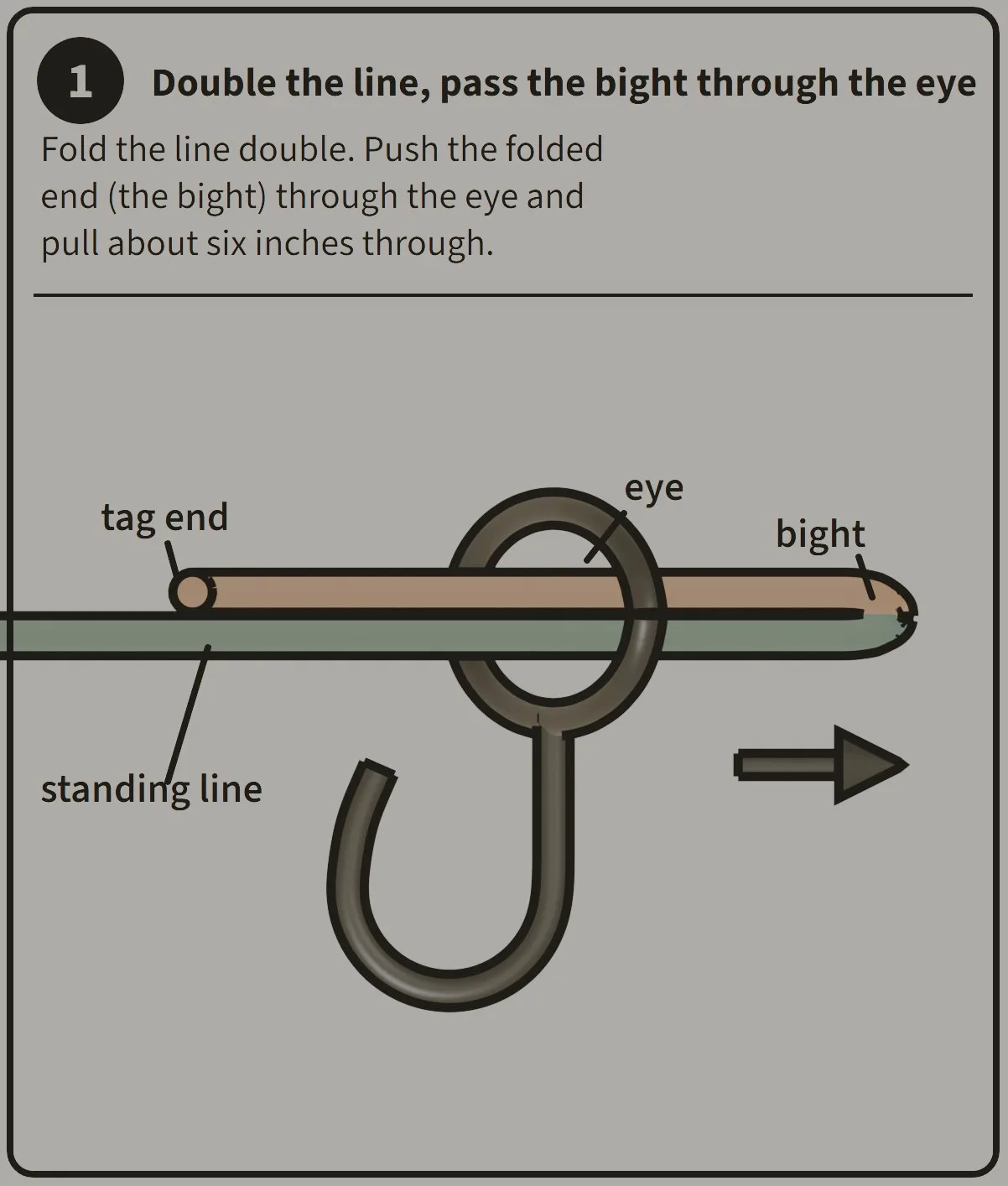
- Double the last 6 inches of line so it forms a long, narrow loop (the bight) with the tag end lying parallel to the standing line. Push the closed end of the bight through the hook eye, until 4 to 5 inches of doubled line are through. On your side of the eye you now have two strands, standing line and tag end, entering the eye together; on the far side, the bight. NetKnots adds that with a small hook eye you can instead pass the single line through the eye, double back and pass it through again from the other direction, leaving about 6 inches of doubled line outside the eye.
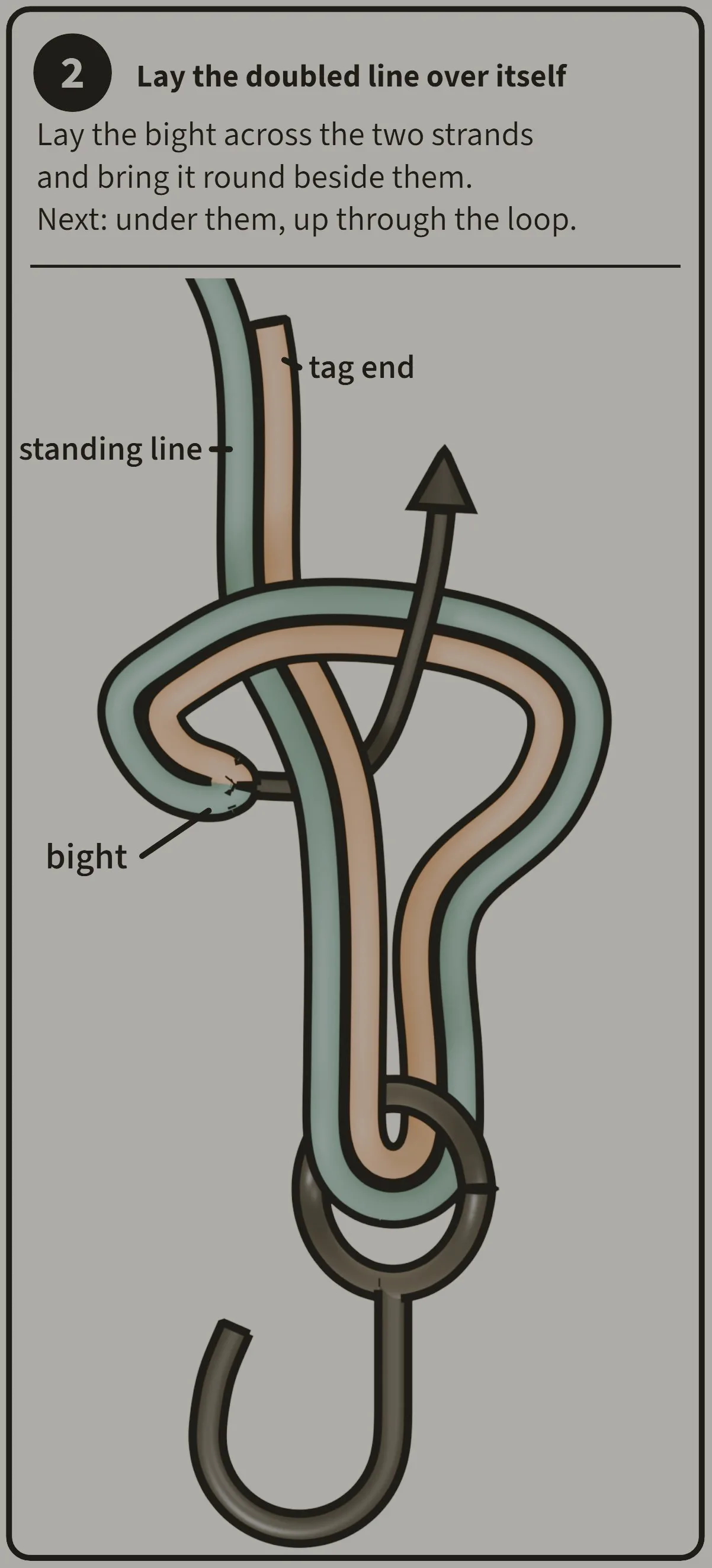
- Let the hook slide to the middle of the doubled line so it hangs from the bottom. Take the bight and tie a loose overhand knot around the doubled standing part: pass the bight over the two parallel strands, then down behind them and up through the circle you just made. Leave the overhand loose, with a circle about 2 inches across. Check that inside that overhand knot the two strands of the doubled line lie side by side and never cross each other; Berkley's one instruction for this step is to avoid twisting the lines. The hook must hang from the middle of the overhand knot, not from one side of it.
- Open the bight into a loop and pass the whole hook through it, point first, until the loop is above the hook eye. Slide the loop up so it sits above the eye, encircling the doubled line between the eye and the overhand knot. The loop must be above the eye, on the line, not resting against the bottom of the eye.
- Wet the knot. Hold the hook in the left hand and pull the standing line and the tag end together, slowly and evenly, with the right. The overhand knot and the loop should close down together into one compact knot seated directly against the top of the eye, with the two strands still parallel through every part of it.
- Pull once more on the standing line only, hard enough to be sure the knot has stopped moving. Trim the tag end to about 1/8 inch in mono or fluorocarbon, and 1/4 inch in braid.
The same sequence drawn, one picture per move. The line is one piece folded double: the standing line is teal, the tag end brown, and the colour changes exactly at the fold, which is the bight. Where a strand passes behind another it is interrupted.
Step 1 of 7. Step 1 of tying a Palomar knot: a line folded double runs left to right through a hook eye, the teal standing line and the brown tag end side by side on the near side and the folded end, the bight, out the far side, with an arrow showing the push
The folded end goes through the eye first.
The written steps above are the full instructions. This player shows the same drawings as the figures below, one move at a time: Back and Next step through them, Play advances every two seconds and stops on the last frame, and the left and right arrow keys step while the player has focus.
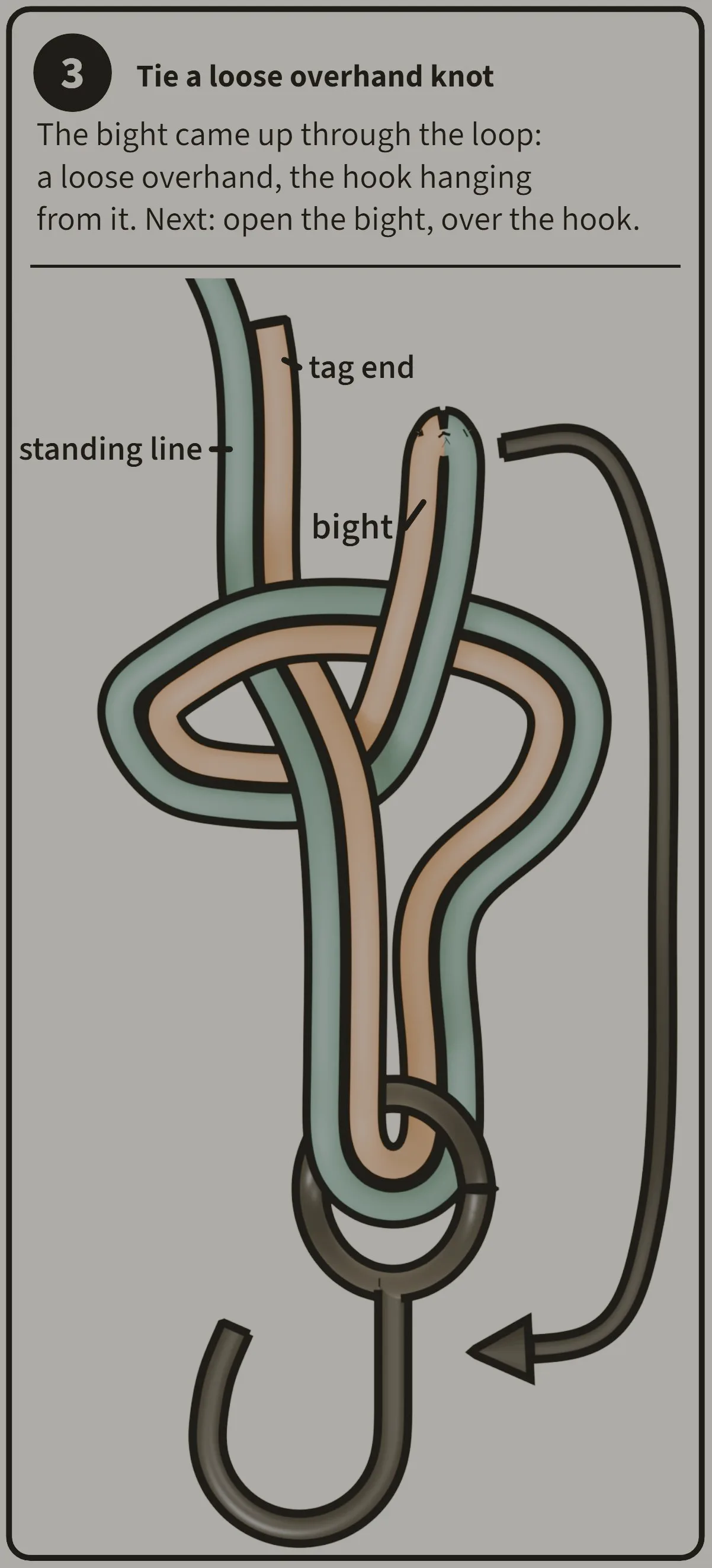
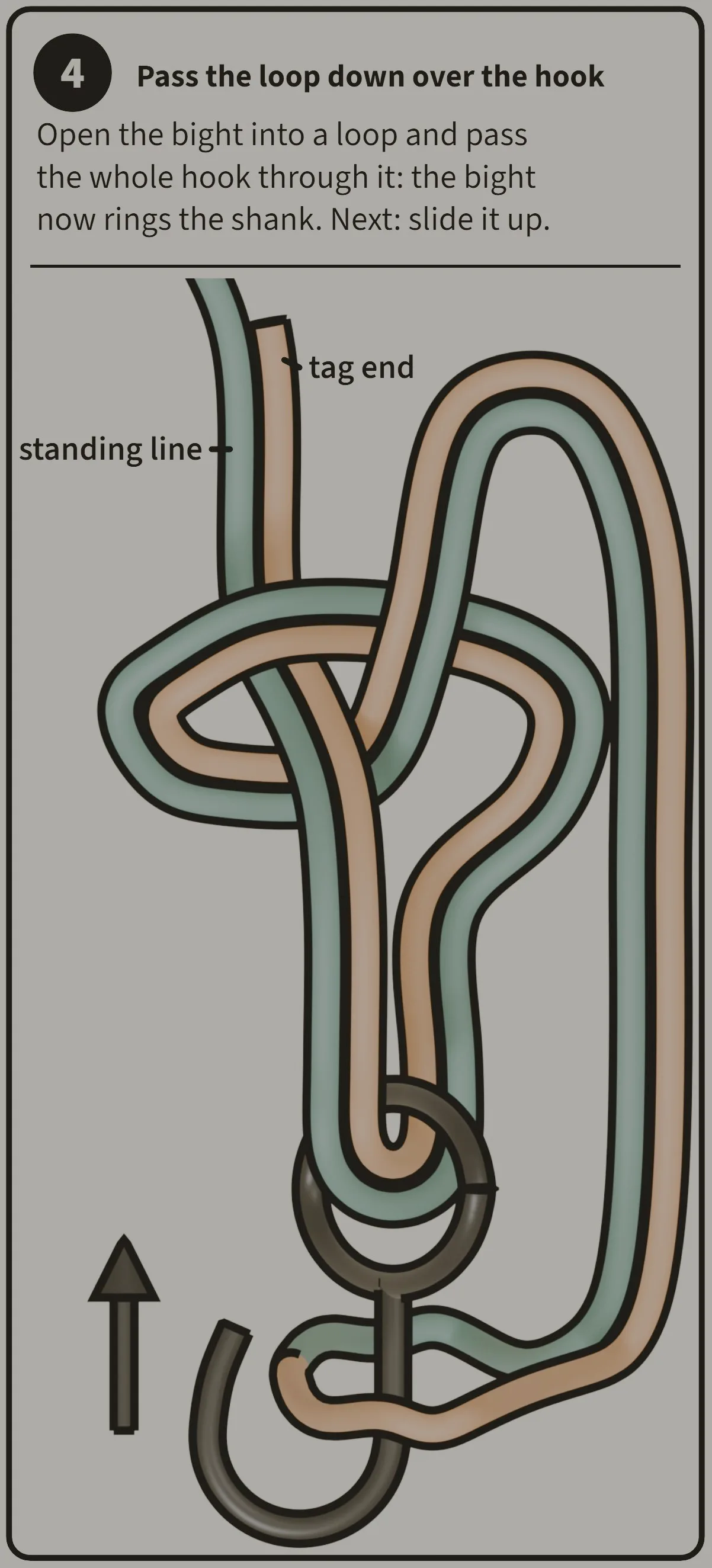
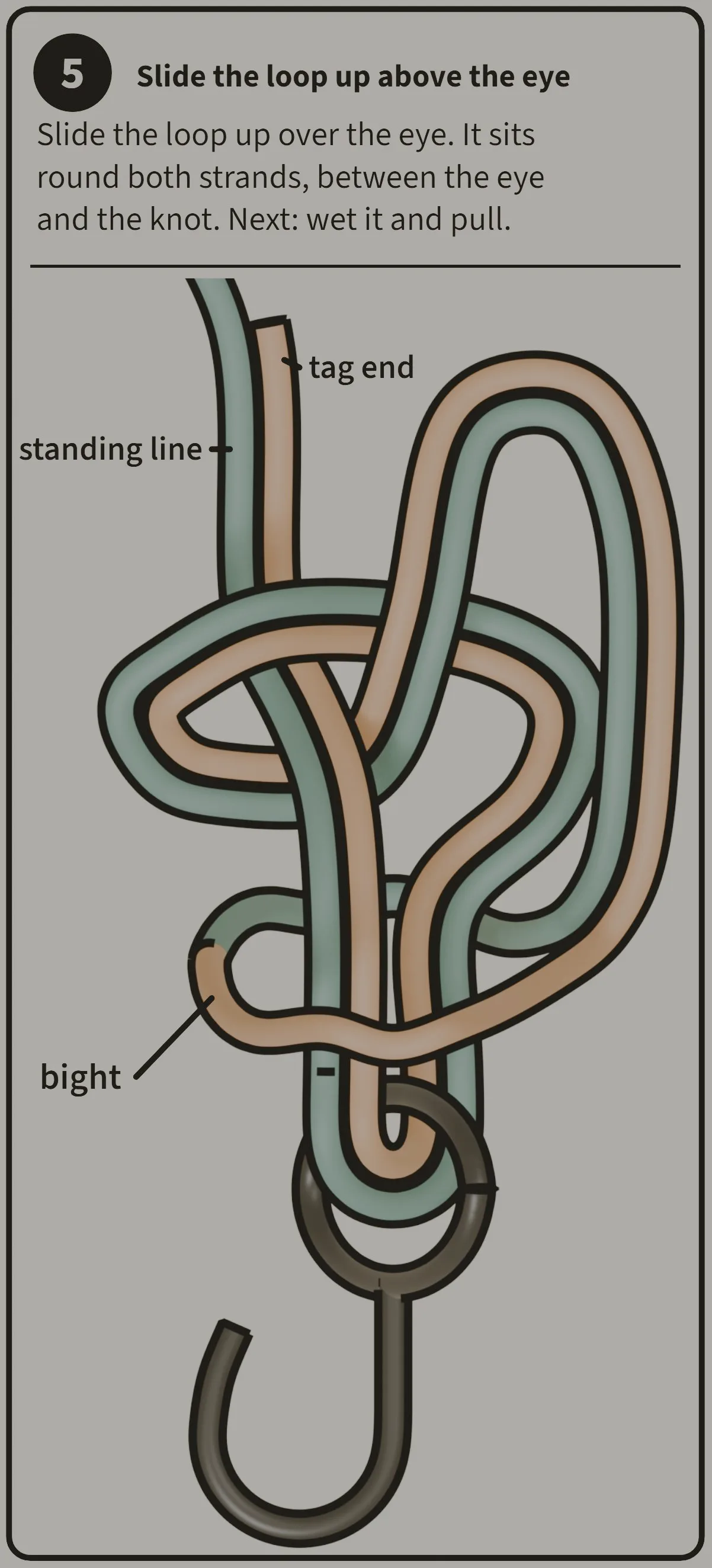
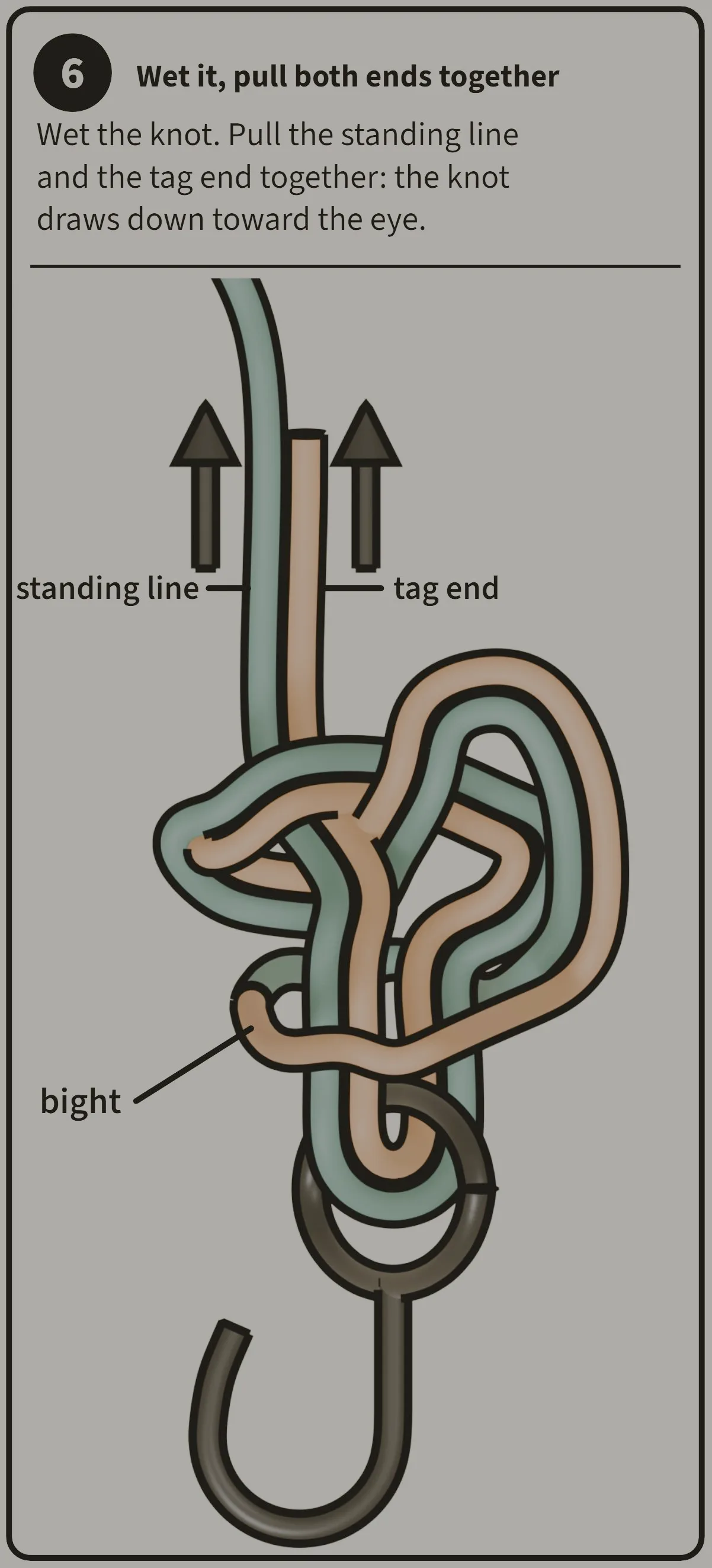
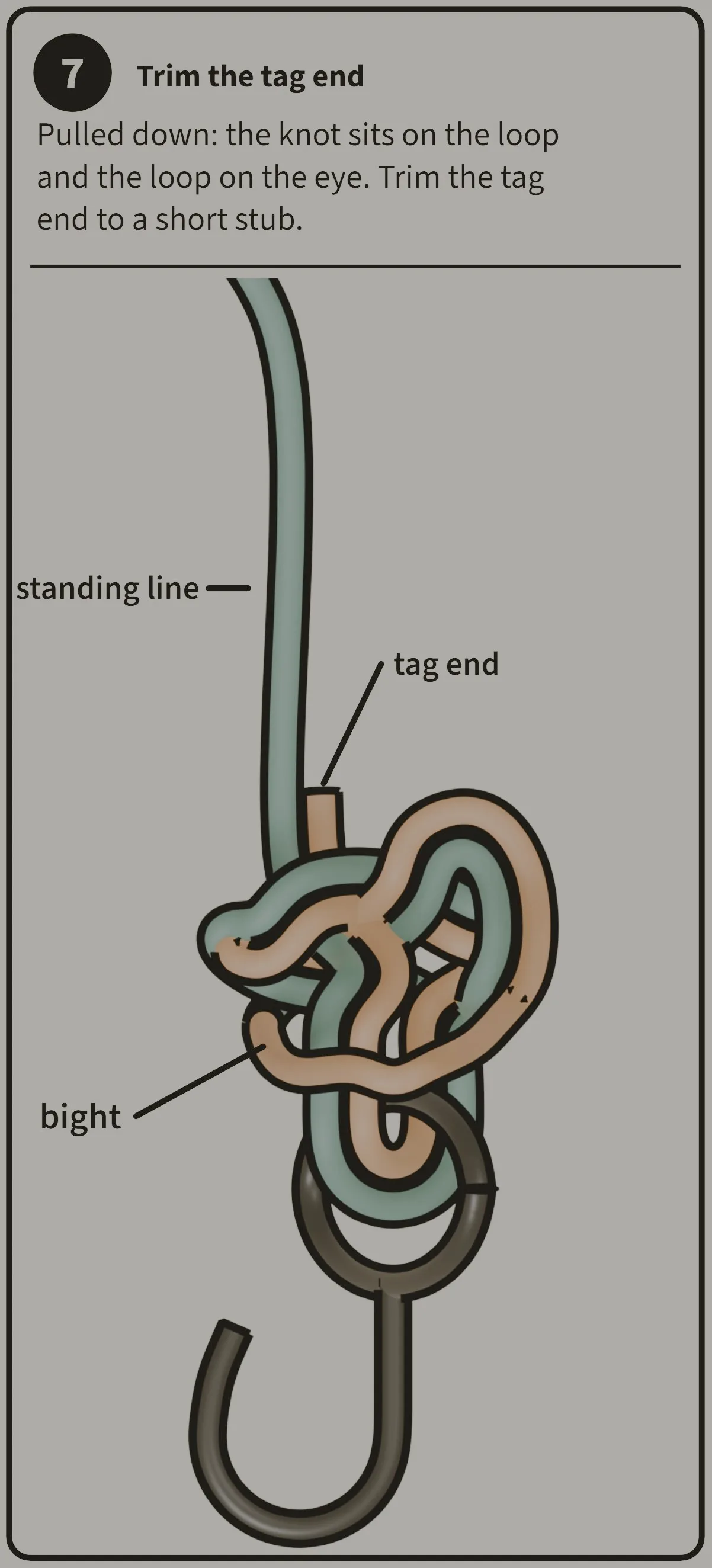
A note on step 3 from NetKnots: be sure that when the hook or lure is passed through the loop, all parts of the knot cinch up together. If the loop is left against the bottom of the eye rather than above it, the parts cinch separately and the knot can fail. That is the tying error to check for.
Basis: consensus (NetKnots, Animated Knots, Berkley, Wired2Fish); the tag lengths are editorial
The fluorocarbon rule
Fluorocarbon is where the Palomar earns its reputation for breaking "for no reason". Two things are usually behind it, and both are in the tyer's hands. Wired2Fish's two-tip piece, built around professional angler Bob Downey, who ties the Palomar almost exclusively in fluorocarbon, names them both.
First, crossed strands. In step 2, if one strand of the doubled line rides over the other inside the overhand knot, the finished knot has a point where a hard strand bears across a hard strand. Under the shock of a hookset the upper strand can cut the lower: fluorocarbon that is crossed is apt to cut into itself on the hookset, in Wired2Fish's words. Keep the two strands parallel from the eye through the overhand knot, and look before you cinch: an overhand tied with a doubled line should look like two rails, not a braid.
Second, heat. A dry fluorocarbon knot pulled tight fast generates friction heat in the line, and fluorocarbon does not tolerate that well. Wet it and pull slowly. This is standard advice from tackle editors and from the line makers; Berkley's step says moisten before drawing up, and Seaguar, a fluorocarbon maker, publishes its own Palomar tutorial for its line. It costs one second.
Basis: consensus; official on the maker guidance
The double Palomar for braid
Two variants travel under this name. Wired2Fish's double Palomar makes the overhand in step 2 a double overhand, passing the bight through the circle a second time, for braid and small-diameter lines that may slip. Salt Strong's "improved double" Palomar passes the bight through the eye twice before tying a double overhand. In Salt Strong's head-to-head pulls, 10 lb braid soaked for 15 minutes and tied to a circle hook, the improved double Palomar won all five against the standard knot, which broke in a 13 to 17 lb range; on 30 lb mono the standard Palomar won most pulls against a double-overhand version, four of five in one test and three of five in another. The usual explanation is that the extra turns bind rather than grip in stiffer line.
Our position: worth learning if you fish braid direct to the lure on heavy tackle. Not worth it on fluorocarbon or mono, where it adds bulk and a second chance to cross a strand.
Basis: consensus on the variants; official on the test figures; editorial on the recommendation
Testing and trimming
- After trimming, hold the hook and pull the standing line hard once. A knot that is going to slip usually does it now, on the bench, not on the fish.
- Look at the finished knot. Two parallel strands through a compact barrel above the eye is right. A strand crossing another, a loop caught against the bottom of the eye, or a knot that seated an eighth of an inch above the eye and stopped are all reasons to cut it and start again.
- Braid tag: 1/4 inch. Mono and fluorocarbon tag: 1/8 inch. Flush trimming is how braid knots start slipping; Wired2Fish says the tag can be cut short because the knot does not slip much, and we leave a little more in braid.
- Retie after any fish that took the lure deep, after any encounter with rock or timber, and after every few dozen casts with a bait that snaps at the end of the cast.
Basis: consensus; editorial on the tag lengths and the retie rule
Rigs and techniques that use it
- Drop shot: tie the hook with a Palomar leaving a long tag, pass the tag back down through the eye from the point side so the hook stands out, then tie or clip the weight on the tag.
- Ned rig, shaky head, Texas rig, wacky rig: direct tie to the hook or head.
- Jig: direct tie on braid or fluorocarbon; keep the strands parallel on fluorocarbon.
- Braid direct to a frog or a heavy-cover hook.
- The hook end of any braid-to-leader system described in line systems and mono, fluoro and braid.
Basis: consensus
Sources and how confident we are
Sources
- Palomar Knot — NetKnots — the four tying steps; the small-eye alternative; braid; the warning that all parts must cinch up together and that a loop left against the bottom of the eye can fail; "close to being a 100% knot" (no method given).
- Palomar Knot — Animated Knots by Grog — the tying sequence; recommended for braid; tying in the dark; the hook free to rotate; the disadvantage that the hook must pass through the loop.
- How to Tie the Palomar Knot — Wired2Fish (Jason Sealock) — the four steps; the double connection; braid with waxy finishes; crossed fluorocarbon abrading on itself; wet the line and cinch slowly; the double Palomar; about 15 seconds with practice.
- 2 Tips to Avoid Palomar Knot Failure with Fluorocarbon — Wired2Fish — Bob Downey: crossed fluorocarbon cuts into itself on the hookset; friction heat from a dry knot weakens the line.
- Fishing Knots 101 — Berkley — the four steps, "avoid twisting the lines", moisten before drawing up, best for braided lines.
- Seaguar 101: Tying a Palomar Knot — Seaguar — the fluorocarbon maker's own Palomar demonstration (video page).
- The Strongest Fishing Knots for Each Type of Line, Tested — Field and Stream (John Merwin) — machine test percentages: Palomar 89% on mono, 82% on fluorocarbon, 63% on braid, 96% braid to mono via a swivel; the comparison knots; percentage defined against unknotted line strength.
- The Strongest Fishing Knots You Can Tie — Popular Science (Field and Stream syndication) — the same test, used to confirm the figures.
- Winning Knots from Sport Fishing's Third Reader Knot Challenge — Sport Fishing Magazine (Doug Olander) — the IGFA Instron test; the doubled-loop Palomar at 79.08% as the strongest braid knot entered; no braid knot reaching 80%.
- Uni, Palomar or Improved Clinch? — Florida Sport Fishing — the Diamond machine test on 60 lb mono, three pulls each: 67.2, 66.7 and 50.3 lb; most knot failures are technique.
- Palomar Knot vs. Uni Knot with Braided Line — Salt Strong — 10 lb braid head-to-head: Palomar 18.36 lb, uni 20.21 lb average.
- What Is the Best Knot for Braid? PowerPro vs. J-Braid — Salt Strong — braid uni beat the Palomar on both braids when wetted; Palomar slightly ahead of the Toit.
- Palomar Knot: Fluoro and Braid Adjustments — Salt Strong — 30 lb mono and 10 lb braid to a circle hook, knots soaked 15 minutes, pulled on a scale until one broke; the improved double Palomar winning five of five on braid; the standard Palomar winning on mono; the 13 to 17 lb braid breaks.
- Tackle with Aaron Martens — Bassmaster — his view that a Palomar's strength is nothing close to a uni or snell under a jerk, and his 10 to 14 wrap uni in light braid.