
Start here
A Texas rig is three parts on the line: a cone-shaped bullet weight that slides freely, a worm hook tied below it, and a soft plastic threaded on so the hook point is buried back inside the bait. With no point standing out, the rig tends to come over limbs and through grass rather than stopping on them. When a fish takes the bait, the plastic has to collapse and the point has to drive out through it — which is why the rig asks for a firm, deliberate hookset rather than a flick of the wrist.
That is the trade. A buried point has to clear the bait before it reaches the fish, and that is the reason to accept one where there is cover worth fishing; in open water there is less to gain from it.
One setup that covers most of it
| Part | What to use |
|---|---|
| Rod | 7 ft medium-heavy casting rod with a fast tip |
| Reel | baitcasting reel, around 7:1 |
| Line | 15 lb fluorocarbon, tied straight to the hook — no leader |
| Knot | Palomar |
| Weight | 3/16 oz tungsten bullet weight, left free to slide |
| Hook | 3/0 offset extra-wide-gap hook, usually written EWG |
| Bait | 6 to 7 inch straight-tail worm |
Wired2Fish names the 7 foot medium-heavy rod and 15 to 20 lb fluorocarbon as the primary Texas rig setup; Kayak Angler names the same rod with a 7:1-or-faster reel.
Two of those choices are worth a sentence each. Tying the main line straight to the hook leaves no leader knot to be sawn through when you drag the rig across a limb — one fewer connection to worry about in cover. And an offset hook has a short Z-shaped kink just below the eye; that kink is what holds the bait's nose in place so the worm does not slide down the shank. An extra-wide-gap hook opens that gap out further, which is what lets a thick bait sit inside it with room left for the point to come through.
Rigging it
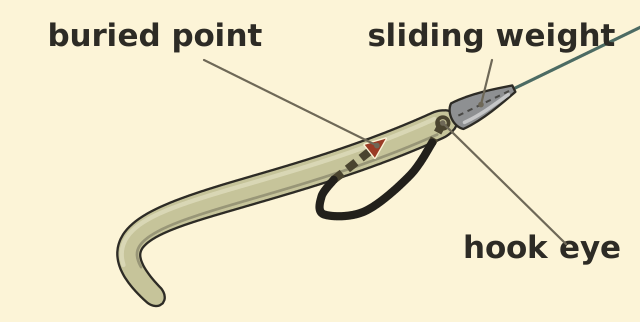
- Thread the line through the bullet weight narrow end first, so the cone's point faces up the line toward the rod and its flat base sits against the bait. If you are pegging the weight — the choice is set out under Peg it or let it slide, below — thread the rubber bobber stop on above the weight first and leave it loose for now.
- Tie the hook on. Palomar for fluorocarbon with a round-bend or EWG hook; a snell for braid with a straight-shank flipping hook. Wet the knot before you seat it, pull it down firmly, and trim the tag to about 1/8 inch.
- Enter at the very tip of the nose, dead centre. Push the point straight down the middle of the bait about a quarter of an inch, then turn it and bring it out through the underside — not the back, and not out the far side.
- Slide the bait up over the point, round the bend and up the shank until the nose sits flush against the hook eye, or against the keeper if the hook has one. The eye and the front of the shank are now inside the nose, and the weight rests against it.
- Let the hook mark its own spot. Turn the hook so the point faces the bait's back. Hold the bait alongside the hook in its natural shape — not stretched, not compressed — and mark where the point reaches on the underside; Wired2Fish describes the same move as seeing where the bend meets the worm. The spot is set by the hook in your hand, not by a fraction of the bait's length: a different hook or a different worm moves it.
- Push the point in at that mark. Bend the bait up to meet the point rather than forcing the point down into a straight worm, then let it settle back straight on the hook. Stop when the point is covered and the bait hangs straight — that is Wired2Fish's own test. The tip finishes inside the body, pointing forward toward the eye, with plastic over it and nothing through the far side.
Check it before you cast. Hold the rig up by the line and sight down the bait from the nose. The nose should sit flush at the eye; the plastic should be neither stretched nor bunched anywhere along the shank; and running a thumb over the back should find no part of the point standing out. If the bait hangs crooked, pull it off and start again — a crooked bait is a common reason one of these spins on the retrieve.
Tex-posing is the variation worth knowing. Instead of burying the point in the plastic, lay the flat of the point against the bait's back and push just a small part of it in. Wired2Fish states the trade plainly: the hookset is easier because the point clears the plastic sooner, and you will snag more because the hook is more exposed. It suits sparser cover — boat docks, bank grass.
Fishing it
Four deliveries. Learn them by name so that when the first one stops working you change on purpose rather than by accident.
- Pitch and flip. A pitch is an underhand swing that drops the bait ten to twenty-five feet away with almost no splash. A flip is shorter still — line pulled off by hand and swung to a target within a rod length or two. Let the rig fall on a semi-slack line and watch where the line enters the water; most of what you will detect happens there rather than in your hands. If nothing happens by the time it reaches bottom, shake it twice and move to the next target. Keep the rod at about ten o'clock in tight cover so the set is immediate.
- Drag. A very slow sideways sweep of the rod that moves the bait inches at a time, then reel up the slack and do it again. Wired2Fish calls dragging through cover an overlooked trigger, because most anglers hop instead. Pause every time you feel the weight touch something.
- Lift and fall. Lift the rod one to two feet, then lower it and take up line as the bait falls. A good share of bites come on the fall, which is the argument for watching the line rather than waiting to feel something. When the rig climbs onto a limb, pause, then pop the rod tip to jump it over — that jump is itself a trigger.
- Deadstick. Pitch it in and leave it, ten to thirty seconds, then one small twitch. This is the answer for spawning fish, cold-front fish and the finesse version of the rig.
The hookset
This is where a Texas rig differs from every finesse rig on the site. The point is inside the plastic and has to get out of the plastic before it can reach the fish. Wired2Fish is blunt about it: hit the fish hard, because you are driving the point out of the bait that makes the rig weedless in the first place.
Reel down until the line comes tight and the rod loads, then drive, and keep reeling. Fish frequently pick the bait up and move off with it, so you are usually setting on a fish that is already going somewhere. On fluorocarbon that is a fast, hard set. On braid with a snelled straight-shank hook it is different: reel into the fish and lean, letting the rod and the no-stretch line do the work — Brandon Palaniuk's conclusion, and the reason the snell exists, is that the knot makes a pivot between the eye and the pegged weight so the set kicks the point upward into the roof of the mouth.
Bites feel like a tick, a soft mushy weight, or the line simply moving sideways. When in doubt, set. A hookset costs you a cast; a missed fish costs you the fish.
Working a laydown
Fish a fallen tree from the outside in: the tip first, then along the trunk, then the root wad, pitching to the shaded side and letting the bait fall along each limb. A fish hooked at the tip comes out without disturbing the ones in the roots; a fish hooked in the roots comes out through everything else. In a creek, pitch above the wood from upstream or across, and let the current carry the bait down the shaded side of the trunk while the weight keeps it in contact.
When it goes wrong
A symptom rarely has one cause, and several of these look identical from the rod. Each entry gives the causes worth considering, something you can actually check on the water, and what to change once you have checked it.
- The bait spins on the retrieve and twists your line. A bait rigged crooked will do this; so will a ribbon or paddle tail fished faster than it wants to go. Check: hold the rig up by the line and sight down it from the nose — bunched, stretched or sitting off the shank's axis is what you are looking for. Change: re-rig until it hangs straight. If a straight bait still spins, slow the retrieve or move to a straight-tail worm.
- The rig sits on top of the grass, or hangs up in the outer limbs. Most often too little weight to get in, but a bulky bait or a wide-gap hook can catch on the way through and do the same. Check: watch where it stops — on top of the cover, or inside it. Change: if it never gets in, try more weight and peg it. If it gets in and then hangs, try a more compact bait or a straight-shank hook.
- You are not getting bitten. This is the hardest one to read, and on its own it tells you very little — the fish may simply not be there. Work through what you can observe rather than guessing at the rig. Check: are you making contact with cover at all? Is the rig landing where you aimed? Change: if you are not touching cover, you are not yet fishing it — move in or add weight. If the delivery is off, work on that before you change tackle. If you are in the cover, hitting it, and a dozen good presentations have gone unanswered, change one thing at a time: fall rate first, then profile, then the spot. A lighter weight is a reasonable first experiment on a slack-line fall in sparse cover. It is not a diagnosis.
- You feel the bite, set, and come back with nothing. Usually the point never cleared the plastic. A fish that had only the tail feels much the same. Check: look at the bait. Plastic pushed down the shank or marked usually follows a proper take; a chewed tail with an untouched head points to short strikes. Change: if the bait moved down the shank, work on the set first — reel down until the rod loads, then drive; a sweep will not do it. If the tail is the only part being hit, shorten or downsize the bait.
- Fish come off partway in. Several things do this and you cannot always tell which from the boat. Check: the hook first — a gap that has opened or a point turned over has usually been straightened on an earlier snag, and is likely to go again. Then where the fish was hooked: one held in the very front of the mouth comes off easily on slack line. Change: replace a bent hook rather than bending it back. Keep the rod loaded and keep reeling through the fight. If the hook is sound and it keeps happening in cover, look at whether the hook and the bait are matched — too much plastic for the gap leaves the point less room to work.
- The bait slides down the shank after a few casts. Either the nose was never seated flush against the eye, or the plastic is worn where the hook passes through it. Check: slide it back up. If it holds, it was seating; if it will not stay, the plastic is worn through. Change: re-seat it flush, or change the bait. A hook with a keeper gets more casts out of each worm.
- You lose the rig to the same limb again and again. A free weight and a bait can arrive separately and wrap opposite sides of a branch, which is the standard case for pegging. The angle you are pitching from can matter as much. Check: whether it is hanging on the way in or on the way out, and whether it is always the same limb. Change: peg the weight, and try the same target from a different side.
- The line breaks above the knot. Fluorocarbon dragged through wood gets scored; so does line pinched in a guide or buried on the spool. Check: run the last two feet between your fingers after every fish and every snag. Rough or cloudy line is done. Change: cut it back and re-tie. If it keeps parting in clean water with no snags behind it, look at the guides and the reel rather than the line.
Where it shines, and where it does not
Reach for a Texas rig wherever snag resistance decides whether you can fish a spot at all.
- Wood. Laydowns, brush piles, root wads, stumps, standing timber. KDFWR describes Kentucky largemouth as usually associated with shallow vegetated areas, standing timber, stumps and other cover — which is a description of Texas rig water.
- Grass. Holes in the grass, flooded willows, under docks: the presentations Wired2Fish says the Texas rig owns over a Carolina rig.
- Docks, riprap and shade lines. Anything a bait has to be placed into rather than pulled past.
- The spawn. It holds still, and it can be crawled back into a bed.
- A wide depth range. Wired2Fish puts it at inches of water to seventy feet, with the weight doing the adjusting.
Largemouth bass are the main quarry by a wide margin. Smallmouth take it when they are in wood — root wads and laydowns on the outside bends of a creek, timber in the lower ends of reservoirs — and Bassmaster's river smallmouth guide Texas-rigs tubes with a 1/8 to 1/4 oz weight tucked inside the bait so it skips under overhanging limbs. Spotted bass on the same wood and on riprap.
It is the wrong rig in four situations, and each has a better answer:
- Bare rock and gravel. A Ned rig or shaky head converts more bites where there is nothing to snag.
- Fish suspended off the bottom. Drop shot water.
- When a slow weightless fall is the trigger. Wacky rig.
- Covering open water fast. A Carolina rig on flats and points with scattered cover.
A jig is the close cousin — more bulk, better on rock and ledges, and it carries its own weedguard for wood.
Choosing the parts
Weight
The rule is the lightest weight you can still feel. Bassmaster's weight-selection article is the one source that puts numbers to it, sorted by fall rate, depth, cover density and — it argues, above all — wind:
| Situation | Weight |
|---|---|
| Skinny water, five feet or less | 1/8 oz |
| Around twenty feet | 1/4, 5/16 or 3/8 oz |
| Deeper than that | 1/2 oz |
| Sparse pads, reeds, shallow bushes | 1/2 oz |
| Punching matted grass | 1 to 2 oz |
| Behind a stick bait, for a slow fall | 1/32 to 1/8 oz |
| Dragging a larger worm | 3/8 to 1/2 oz |
| Stroking a worm up off the bottom | 1/2 to 3/4 oz |
Wind pushes every one of those heavier. In current, use enough to hold the bait behind the wood and no more — Bassmaster's river guide works in the 1/8 to 1/4 oz band, which is about right for a Kentucky creek.
Buy tungsten rather than lead. It is about 1.7 times as dense (19.3 against 11.3 grams per cubic centimetre), so a tungsten weight is physically smaller for the same mass: it slips through cover more easily, snags less, and transmits what the bottom is made of far better. Buy insert-free and matte rather than shiny. Strike King's tungsten line, for one example, runs 1/8 to 1 1/4 oz.
Peg it or let it slide
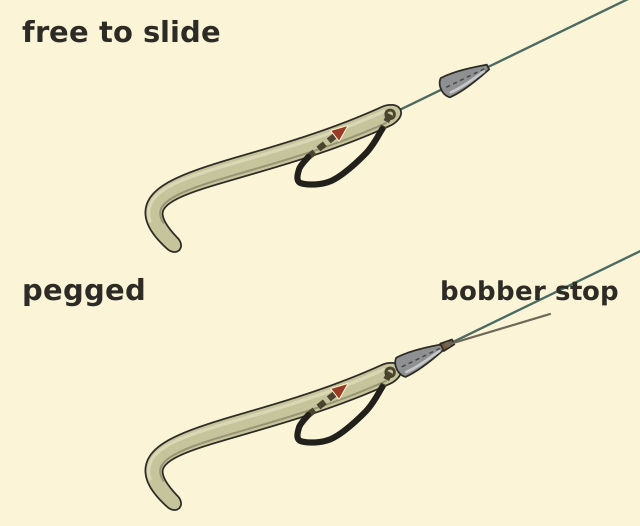
A free weight slides on the line above the hook, so on a slack line the bait falls away from the sinker and drifts down on its own. A pegged weight is stopped hard against the hook eye by a rubber bobber stop, so weight and bait arrive and stay together. (Use a bobber stop, not a toothpick — a toothpick nicks the line.)
Published advice splits on this, and it splits by delivery rather than by opinion. Bassmaster pegs in cover and grass; Kayak Angler pegs for flipping and pitching; Shaw Grigsby, writing for Wired2Fish, argues against pegging at all on the grounds that a free weight gives a higher hookup and landing rate, a more natural action, and nothing bulky to lever the fish's mouth open on the set. Read each one against the delivery it describes and the conflict mostly disappears: the pro-peg advice is about a short vertical drop into cover, where the two halves of the rig have to stay together; Grigsby is about a cast retrieved across open water, where the fall itself is the presentation.
So:
- Peg it for grass, for current, and for short pitches into thick wood — where the weight has to punch through something or stay put.
- Leave it free when the fall is the presentation: casting, dragging, sparse or open cover.
Hooks
Three styles, and the differences are real.
- Offset round bend. The traditional worm hook: a narrow gap and a conventional bend. Bassmaster's choice for thin worms in sparse cover.
- Offset extra-wide-gap (EWG). A wider gap for bulky plastics — craws, creature baits, beavers, stick baits. Bassmaster's stated advantage is the ease of threading a bait into a fish-ready position; its stated cost is that the barb sits directly in line with the eye, which it says gives a greater chance of losing fish. That is the trade you accept for a hook that is hard to rig wrong, and it is why the starting setup above uses one.
- Straight-shank flipping hook. The most compact gap of the three. Bassmaster puts its hookup ratio above the other worm hooks, and gives the reason: on a straight shank the eye and the barb are not in line. The straight shank also acts like a keel and comes through matted grass cleanly. Snelled to braid, this is the heavy-cover tool.
Published size runs: Gamakatsu's offset EWG in 4 through 5/0, Owner's Offset Shank Wide Gap 1/0 to 5/0 on an XX-strong shank, VMC's FL Flippin' 1/0 to 4/0, Z-Man's medium-wire ZWG 3/0 to 5/0.
Match wire to line: heavy wire with braid and heavy fluorocarbon, light wire with light line — and light wire from a kayak, where you cannot set as hard.
Match size to bait. Bassmaster's rule is the smallest hook you can get away with:
| Bait | Hook |
|---|---|
| 4 inch finesse worm | size 1 or 1/0 — but a straight-shank finesse hook, not an offset (Kayak Angler) |
| 6 to 7 inch worm, or a 5 inch stick bait | 3/0 |
| Craws and creature baits | 4/0 |
| 10 inch ribbon-tail worm | 5/0 |
Gamakatsu, who make the hooks, publish two of those anchors themselves, and they are worth quoting precisely: for a round-bend hook, 3/0 suits a seven-inch worm and 5/0 will cover ten-inch worms. Bassmaster and Kayak Angler land in the same place for the middle of the range. Gamakatsu's own reason for reaching for an extra-wide gap instead is that the wider gap stops a thick bait slipping on the hookset — the straight and offset shanks are what it recommends for long, narrow plastics.
The small end is worth reading carefully, because it changes hook style as well as size. Kayak Angler's finesse write-up says "a 1/0 or a 1-sized straight shank finesse hook is perfect for small, thin lures" and pairs it with four-inch shaky-head or cut-tail worms. That is a different hook from the offset and extra-wide-gap hooks in the rest of this table, and it belongs to the finesse setup further down rather than to the casting rig at the top of this page. For the offset and extra-wide-gap hooks, none of the sources listed at the foot of this page gives a size for a bait under six inches — so work down from 3/0 to the smallest hook that still clears the plastic.
Plastics
- Straight-tail and ribbon-tail worms. A ribbon tail moves on a lift; a straight tail moves on a drag.
- Craws and beaver-style baits. Compact, and the natural choice for pitching.
- Creature baits. Appendages that move water — for stained water and the spawn.
- Stick baits. A heavier fall, and a big-fish bait in wood.
Buoyant plastics such as Z-Man's ElaZtech float the tail up at rest and stand up to repeated fish. Whatever you use, rig it straight: a bait sitting crooked on the shank is the common reason one of these spins.
Colour
Thinner plastic and less weight as the water clears; more bulk, darker colour and more weight as it stains. Five combinations cover most days:
- Clear water, bright sun, sparse wood and docks. Light weight, left free, a straight-tail worm or a stick bait dragged slowly. Green pumpkin, watermelon, natural browns, with little flake.
- Clear water, overcast, wood and grass edges. 1/4 oz with a craw or creature bait, lift and fall. Green pumpkin with red or purple flake, or darker greens.
- Lightly stained water, laydowns and brush. A pegged 1/4 to 3/8 oz with a craw or beaver, pitched and hopped. Green pumpkin-blue, black-blue, brown-orange craw.
- Muddy water, thick wood and flooded bushes. A pegged 3/8 oz or heavier with a bulky creature bait, pitched to the same spot repeatedly. Black, black-blue, junebug, often with a chartreuse-dipped tail.
- Cold and clear, deep brush and channel timber. The lightest weight that will hold, a small craw or a 4 inch worm, deadsticked. Green pumpkin, brown, smoke.
Line and knots
| Where you are fishing | Line |
|---|---|
| Wood and docks, general | 15 lb fluorocarbon tied straight to the hook; 17 to 20 lb in heavier wood |
| Clear water, longer casts | 12 to 15 lb fluorocarbon |
| Grass | 30 to 50 lb braid, no leader, to a snelled straight-shank hook |
| From a kayak | 30 lb braid to about two rod lengths of 12 to 15 lb fluorocarbon, joined with an Alberto |
| Finesse version | 15 lb braid to a 6 to 8 lb fluorocarbon leader |
Fluorocarbon suits wood: it resists abrasion and sinks. Braid suits grass: it cuts through vegetation and has no stretch to absorb a hookset. Most Texas rigs need no leader at all; when you do run one it is fluorocarbon, about two rod lengths, joined with an Alberto or a uni-to-uni. More on the trade-offs in line systems, leaders and tippet and mono, fluoro and braid.
Two knots do nearly all the work. The **Palomar** — Bassmaster calls it the strongest and most used knot in fishing — on fluorocarbon to a round-bend or EWG hook. The snell on braid to a straight-shank flipping hook, where the wrapped shank turns the hook into a lever on the set. Flipping hooks with a resin-closed eye are built for it.
The heavy-cover and finesse setups
Two variations on the starting outfit, for when it does not fit.
Heavy cover. A 7 foot to 7 foot 3 inch heavy casting rod, 30 to 50 lb braid, a 3/8 to 1/2 oz pegged tungsten weight, and a 4/0 straight-shank flipping hook snelled on, with a compact beaver or craw. Short vertical pitches, point fully buried.
Finesse. Kayak Angler's version: a medium-power, extra-fast spinning rod, a 1000-size reel, 15 lb braid to a long 6 or 8 lb fluorocarbon leader, a size 1 or 1/0 straight-shank finesse hook, and a four-inch shaky-head or cut-tail worm — fished very slowly, almost deadstick. That article sizes the reel for casting 1/16 oz rigs, which is the weight band this setup lives in. It is the version that catches river smallmouth out of isolated wood in clear water.
Through the season
- Winter. Creeks and rivers: deep wood on the outside of bends, dragged slowly with long pauses. Reservoirs: channel-swing timber and brush in twelve to twenty-five feet, deadsticked. Ponds: the deepest brush. Use the lightest weight that will still reach bottom, and compact plastics.
- Spring, pre-spawn. Creeks and rivers: laydowns on the first banks to warm, and root wads at the heads of pools. Reservoirs: secondary points and staging wood and grass edges in four to ten feet. Ponds: wood on the north bank. Craws and creature baits. Wired2Fish calls spring the rig's dominant season.
- Spawn. Creeks and rivers: wood and grass in slack water near firm bottom. Reservoirs: timbered coves and grass flats in one to five feet. Ponds: any shallow cover. Pitch past the target, crawl the bait back into it, and leave it there. Check the regulations on the water page before fishing the spawn.
- Summer. Creeks and rivers: shade — root wads, laydowns, dock pilings, and the current edges beside wood. Reservoirs: deep brush piles, standing timber on channel edges, docks and grass lines. Ponds: deep edges and shade. Shallow early and late; drag the brush and timber through the middle of the day.
- Fall. Creeks and rivers: wood in the runs above the wintering pools. Reservoirs: shallow wood and grass in the creek arms, following the baitfish. Ponds: whatever wood the wind is blowing into. Speed up early in the season and slow down as the water cools.
From a kayak
- Pitch from the seat. From a low seat an underhand pitch is easier to control than an overhand cast and lands quieter. Kayak Angler works with a seven-foot medium-heavy rod for general Texas rigging and a seven-foot to seven-foot-three heavy rod for 3/8 and 1/2 oz weights; flipping and pitching are easier from a kayak you can stand in.
- Hooksets are weaker. Kayak Angler's reasoning is that a set from a kayak is not as solid as one from a boat because the hull gives and slides under you. Its answer is high-quality light-wire hooks, which penetrate with less force, and braid to a fluorocarbon leader for a more direct set.
- Plan for snags. Braid to a 12 to 15 lb leader means a hung rig breaks at the leader or the hook rather than costing you the whole rigging. The same article notes that straight fluorocarbon or mono stretches as you pull against a snag and then releases, which unsettles the boat — an argument for the braid-and-leader system, and for the heavy gloves it recommends for breaking off. It prefers tungsten partly on environmental grounds as well as for snag resistance.
- Positioning near a laydown. Stop upstream and off to the side, far enough out to pitch the length of the tree, and work it from the outside in.
- Standing timber. Published reporting points to flooded timber in Cave Run Lake's deep coves and to timbered coves as the bass cover on Taylorsville Lake. Work each tree as a vertical target: pitch to the shaded side, let the rig fall along the trunk, shake it at the base. See Cave Run Lake and Taylorsville Lake.
The fly counterpart
A weedguarded fly fished into the same cover: a deer-hair or foam bass bug over a laydown, or a weighted crayfish or sunfish streamer crawled through the branches. Cortland's bass guide puts a weedguard on nearly every bass fly because the forage lives in the cover, fishes fluorocarbon so the strip-set has no stretch in it, and says the fight with a big largemouth in cover is won or lost in the first three seconds — which is the Texas rig hookset in different clothes. Orvis's largemouth lessons cover the patterns: sunfish streamers with lead eyes, deer-hair frogs, poppers, and crayfish from one to four inches. See poppers and topwater flies and streamer fishing.
Where the rig came from
Nick Creme moulded the first plastic worm in his kitchen in Akron, Ohio, in 1949, and was selling it by mail from 1951. By the late 1950s — this is the account in both Bassmaster and Texas Parks and Wildlife magazine — an angler on Lake Tyler in East Texas was threading a sinker on the line, tying a single hook behind it, running that hook through the head of a Creme worm and burying the point so the whole thing would come through the flooded brush of the new East Texas reservoirs. Nobody recorded who, and the two accounts differ on whether the first sinker was a bell or a bullet.
How hard is it?
Beginner to rig, intermediate to fish well. The rigging takes two minutes to learn and a season to get consistently straight. The parts that take time are pitching accuracy, telling a limb from a bite through an ounce of tungsten, and the discipline of setting hard on a fish you cannot see.
Sources and how confident we are
How this page is sourced
Everything above is attributed where a specific figure or claim belongs to a particular source, and the full list is below. Where the sources disagree — pegging, and the sinker in the origin story — the page says so rather than picking a winner.
Four things here are our own reasoning rather than anyone's published advice: the note that most Kentucky creek and reservoir cover sits at the shallow end of Bassmaster's weight range; the order of working a laydown; the choice of the starting setup; and the When it goes wrong section, which is assembled from mechanics described across the sources rather than taken from any one of them. Treat those as reasoning to argue with, not as findings.
Sources
- The Texas Rig: How to Rig and Fish — Wired2Fish — components, offset vs EWG hooks, tungsten over lead, lightest weight for action, rigging steps, 7 ft medium-heavy rod, 15 to 20 lb fluorocarbon, lift-and-fall and slow drag, 10 o'clock rod position, hard hookset to clear the plastic, bobber stop, Tex-posing in sparse cover, inches to 70 ft of water.
- Why You Should NOT Peg Your Texas Rig Weight — Wired2Fish — Shaw Grigsby's case for a free-sliding weight: higher hookup and landing rate, more natural action, pegged weight levering the mouth open.
- 2 Essential Hook, Weight and Knot Setups for Texas Rigging Bass — Wired2Fish — snelled straight-shank hook and heavy tungsten on braid for short flips and pitches; EWG on fluorocarbon with a conventional knot for casting; sinker stops on both.
- Snell or Palomar Knot with Flipping Hooks? Palaniuk's Conclusion — Wired2Fish — snell with braid and a tight-line, rod-and-line hookset; Palomar with fluorocarbon and a fast, hard set.
- 5 Awesome Uses for Straight-Shank Bass Fishing Hooks — Wired2Fish — straight shank as the streamlined flipping, pitching and punching hook; keel effect; keepers.
- How to Fish Texas Rig Worms for Bass — Wired2Fish — rig straight to avoid spinning; dragging through cover as an overlooked trigger; thin natural worms in clear water, bulk in dirty water.
- Carolina Rig vs Texas Rig: When to Fish Each — Wired2Fish — Texas rig for vertical presentations into holes in grass, flooded willows and under docks; lightest weight you can feel; seasonal notes; standing timber, brush piles and docks as Texas rig cover.
- The Texas Rig: Part 1, Hook Style — Bassmaster — hook sizing, light vs heavy wire by line and rod, 5/0 for a 10 inch worm, 2/0 to 4/0 for smaller baits, smallest hook you can get away with.
- The Texas Rig: Part 2, Hook Selection — Bassmaster — straight shank for flipping, punching and pitching; offset round bend as the traditional hook; EWG for thick plastics with a higher fish-loss risk; most compact gap you can get away with.
- The Texas Rig: Part 3, Weight Selection — Bassmaster — four considerations (fall rate, depth, cover density, wind) and every weight figure in the table above.
- The Texas Rig: Part 4, Variable Changes — Bassmaster — tungsten and lead compared; beads; peg in cover and grass, unpegged for big worms in open water.
- The Texas Rig: Part 8, Knots — Bassmaster — Palomar as the strongest and most used knot; snell on braid with a straight-shank flipping hook, pivot point sending the hook upward.
- The Worm — Bassmaster — Nick Creme, 1949 Akron, late-1950s Lake Tyler origin of the Texas rig, inventor unknown.
- River Smallmouth — Bassmaster — Texas-rigged tubes with 1/8 to 1/4 oz bullet weights inside and a wide-gap hook; skipping under overhanging limbs.
- Legend, Lore and Legacy: Plastic Worm Inventor Changed Bass Fishing — Texas Parks and Wildlife magazine — Creme's 1949 worm, 1951 mail order, the unnamed Lake Tyler angler and the weedless rig, described with a bell sinker.
- How to Rig and Fish the Texas Rig — Kayak Angler — 1/8 to 1/2 oz weights, 3/0 and 4/0 hooks, rigging steps, three retrieves, pegging for flipping and pitching, medium-heavy 7 ft casting rod.
- 10 Expert Techniques to Master the Texas Rig — Kayak Angler — tungsten, matte weights, light-wire hooks from a kayak, 7 ft medium-heavy with a 7:1 reel, 7 ft 3 in heavy for 3/8 to 1/2 oz, 30 lb braid to 12 to 15 lb fluorocarbon leader with an Alberto, the spinning finesse version, gloves.
- Texas Rig vs Carolina Rig: When and How to Fish Each — Kayak Angler — Texas rig for heavy cover, sight fishing, bedding fish, flipping and pitching from a kayak you can stand in.
- Largemouth Bass — Kentucky Department of Fish & Wildlife — habitat: shallow vegetated areas, standing timber, stumps and other cover.
- Worm, Extra Wide Gap (EWG) — Gamakatsu — sizes 4, 2, 1, 1/0, 2/0, 3/0, 4/0, 5/0; forged; named on the page for stick baits, creature baits and 10 in worms.
- Key worm hook styles you must have — Gamakatsu — the maker's own hook-size-to-bait anchors: 3/0 for a 7 in worm, 5/0 to cover 10 in worms.
- Offset Shank, Wide Gap — Owner — sizes 1/0 to 5/0; worm-holding 90° bend shoulder, extra wide gap, XX strong shank.
- FL Flippin' — VMC — sizes 1/0, 2/0, 3/0, 4/0; double spike baitholder, resin closed eye, space above the baitholder for a snell.
- Tour Grade Tungsten Bullet Weight — Strike King — sizes 1/8 to 1 1/4 oz; insert-free.
- Texas Rigging Reimagined — Z-Man — ElaZtech buoyancy, baits recommended for Texas rigging, ZWG medium-wire EWG in 3/0 to 5/0.
- Introduction to Fly Fishing for Bass — Cortland Line — weedguards on nearly all bass flies, fluorocarbon leader for the strip set, first three seconds in cover.
- Fly Patterns for Largemouth and Smallmouth Bass — Orvis — sunfish streamers, poppers, deer-hair frogs.
- Flies for Summer Bass — Orvis — crayfish flies one to four inches fished on bottom.
- Art Lander's Outdoors: Taylorsville Lake — NKyTribune — timbered coves as the bass cover on Taylorsville Lake (published reporting, not an agency source).
- Art Lander's Outdoors: At Cave Run Lake — NKyTribune — deep coves with flooded timber among Cave Run's cover types (published reporting, not an agency source).