What it connects
The improved clinch ties the end of a line or tippet to something with an eye: a hook, a fly, a lure or a swivel. Animated Knots calls it one of the most widely used fishing knots and a good method of securing a line to a hook, lure or swivel, and says it is commonly used to fasten the leader to the fly. Orvis calls it a staple in fly fishing for securing the fly to the tippet. It is a terminal knot only; it joins nothing to anything else.
The "improved" part is one extra tuck. A plain clinch passes the tag end through the eye, wraps it around the standing line, and brings it back through the small loop just above the eye. The improved clinch then passes the tag through the big loop that move has just made. Berkley describes it as the version with an extra tuck under the final turn.
Basis: consensus (Animated Knots, Orvis, Berkley, NetKnots)
Compatible lines
- Monofilament: yes. This is the line it was made for.
- Fluorocarbon: yes, wetted and seated with care. It tests lower in fluorocarbon than in mono in the one published comparison we found on both; see the strength section.
- Fly tippet: yes. Animated Knots says it is particularly suited for attaching a small diameter tippet to a heavy wire hook.
- Braid: no. NetKnots says plainly that it is not recommended for braided line, and in Field and Stream's test a regular eight-turn clinch tied in 14 lb FireLine would not hold at all, slipping out and coming untied at about 10 pounds of force. That test was of the plain clinch, not the improved one; no published test we could read put the improved clinch in braid. Tie braid to the hook with a Palomar or a uni, or tie the clinch in a mono or fluorocarbon leader instead (see line systems).
- Heavy line: the guides set a ceiling, and they do not agree on where. NetKnots says it can be difficult to tie in lines testing greater than 25 lb; Animated Knots and Berkley say it is not recommended over 30 lb test because it is harder to tie; Lefty Kreh, in Fly Fisherman, says it often does poorly in line testing more than 20 lb. Read those three together as: past about 20 lb, use something else.
Basis: consensus; official on the line maker's listing (Berkley); the 20 lb reading is editorial
Best uses
- A fly to light tippet, especially a dry fly or a small fly, where a loop knot would be too big. Kreh, who preferred the non-slip loop for most flies, wrote that he does not use the loop on dry flies or on flies smaller than size 12.
- Mono or fluorocarbon to a hook, small lure or swivel on light spinning tackle: a slip float rig, a bluegill or crappie hook, a small inline spinner on a swivel.
- A lure that will not pass through a Palomar's loop. The improved clinch ties around the eye, so a big hard bait with trebles never has to go through anything.
Basis: consensus on the fly use (Animated Knots, Orvis, Fly Fisherman); editorial on the conventional-tackle list
Difficulty
Easy to tie, harder to tie well. There are only four moves, but the turn count matters, the coils have to lie in a neat spiral, and the knot has to be wetted and seated firmly. Field and Stream's test is the clearest statement of what that care is worth: in 10 lb mono the improved clinch tested at the top of the field only when tied with extreme care, and otherwise broke at a much lower percentage. MidCurrent says the same in plainer words: it demands a bit more attention to tie correctly, and if the coils overlap or the knot is not cinched neatly, the strength advantage is lost.
Basis: consensus (Field and Stream, MidCurrent)
The turn count
This is the part most people get wrong, and the sources agree on the direction even where they differ on the numbers: more turns in light line, fewer in heavy line.
- NetKnots: 5 or more turns.
- Animated Knots: about five complete turns; five or more are recommended, and with heavier lines this may be reduced to four.
- Berkley: twist five to seven times.
- Orvis (fly tippet): five to seven wraps.
- U.S. Fish and Wildlife Service: 5 turns.
- Art Scheck's tests on light nylon tippet, in MidCurrent: a six-turn clinch always beat a five-turn clinch, and a seven-turn clinch beat the six-turn knot in 80 percent of his tests. His tests were of the plain clinch, but the wraps are the same in both knots.
None of the sources we read gives a turn table by line test or diameter for this knot, the way Kreh's table does for the non-slip loop. The working rule from the figures above, which is ours: seven turns in fine tippet and light line, five in mid-weight mono and fluorocarbon, four as the heavy end allows, and past about 20 lb a different knot.
The guides give one reason at the heavy end: Animated Knots says the knot is not recommended over 30 lb test because it is harder to tie in heavier lines. At the light end, Scheck's evidence is strength, not slipping: more turns broke at a higher load in light nylon.
Basis: consensus on the counts (NetKnots, Animated Knots, Berkley, Orvis, USFWS, MidCurrent); editorial on the working rule
How to tie it
The steps assume a right-handed tier holding the hook or fly in the left hand, eye up. The "standing line" runs back to the reel. The "tag end" is the free end you are working with.
Watch it tied. Animated Knots' Improved Clinch page steps through the same sequence frame by frame. We read it alongside the steps below, and the two agree on every move. One note from NetKnots: its own animation finishes with the tag end at the back of the knot, but in reality the tag end will be at the front by the eye.
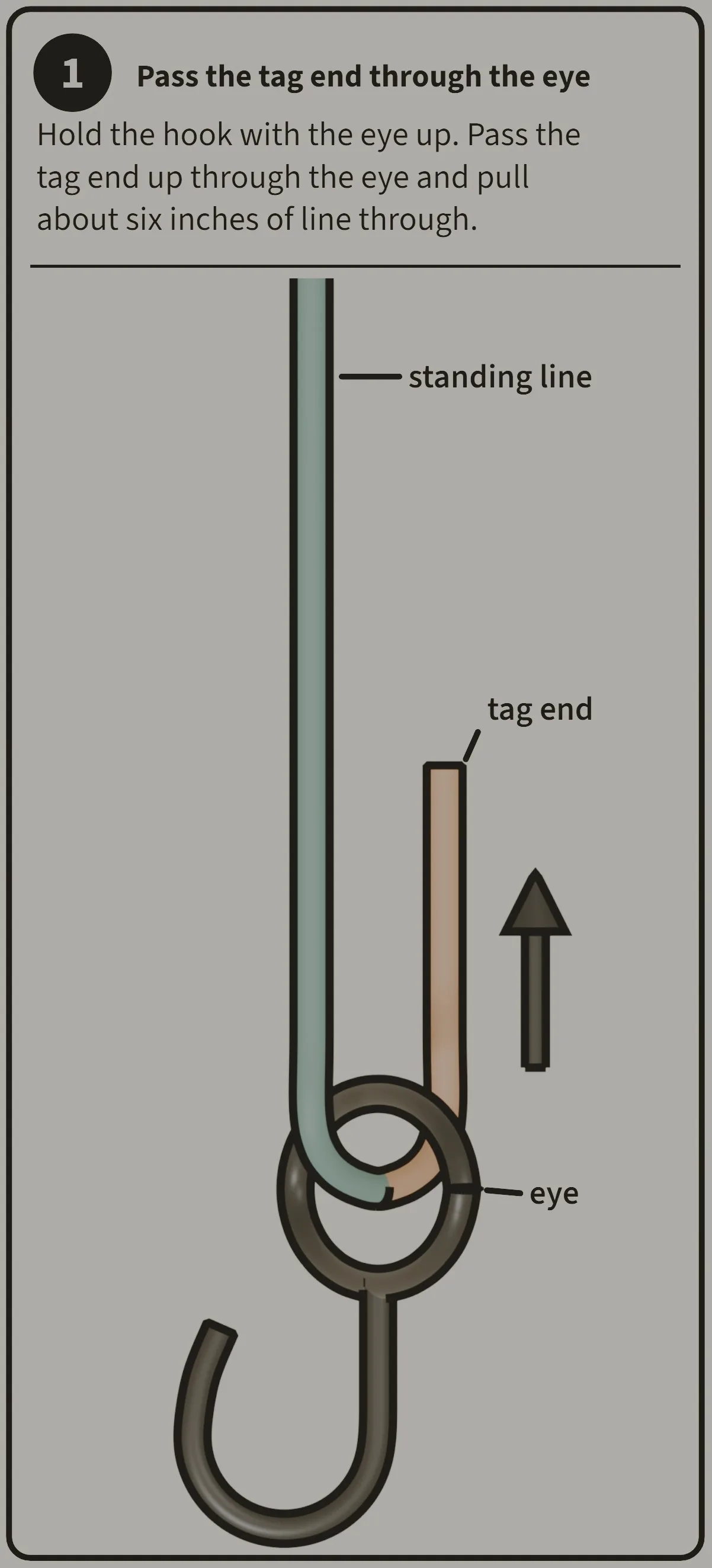
- Pass the tag end through the eye and pull about 6 inches through, the figure Berkley gives.
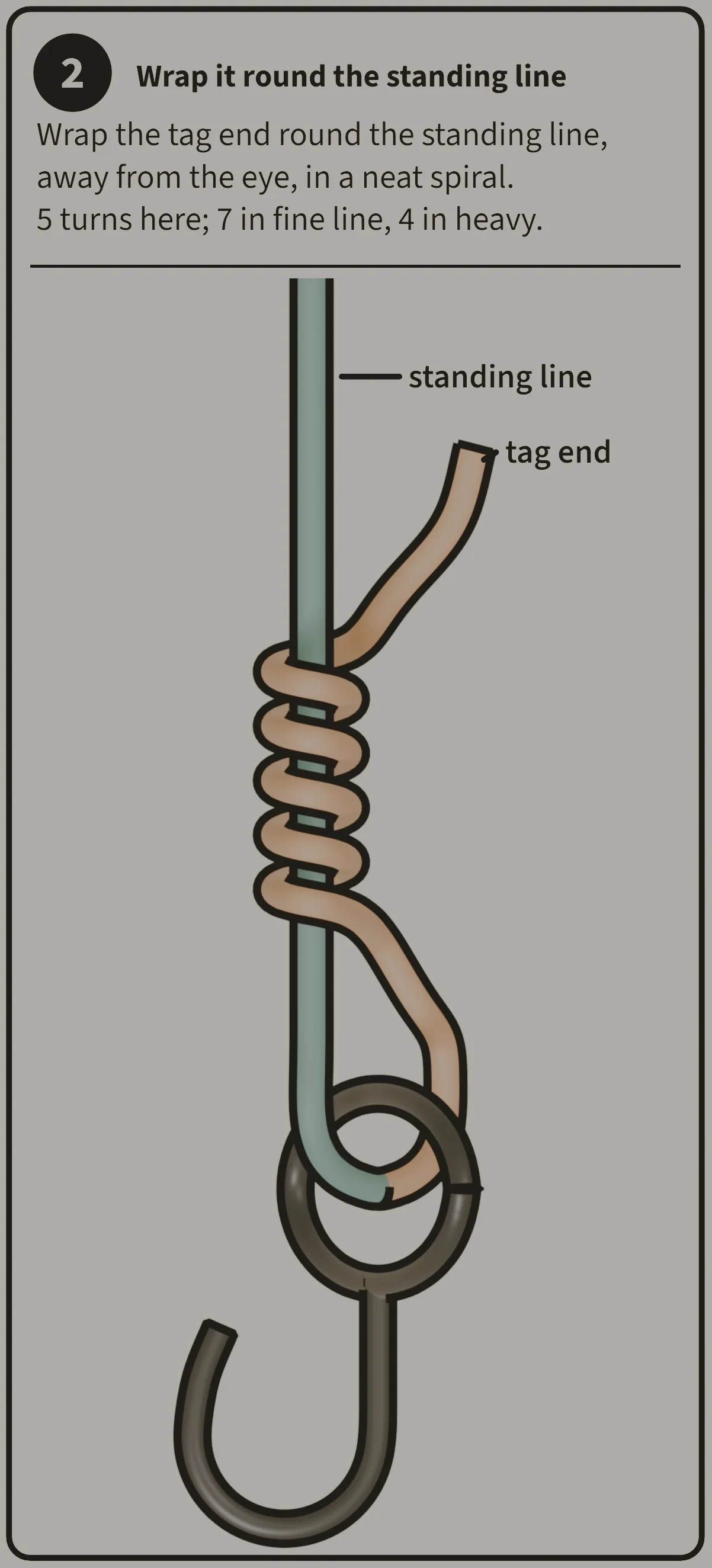
- Pinch the tag and standing line together just above the eye and wrap the tag around the standing line, moving away from the eye, for the number of turns you chose above. Animated Knots: wind the loops in a neat spiral round the standing line and hold the loops under your fingers as you wind. Berkley's caution for this step is that the coils must not overlap. Animated Knots also gives a second way: hold the line and the tag in one hand and rotate the hook or lure with the other to put the twists in.
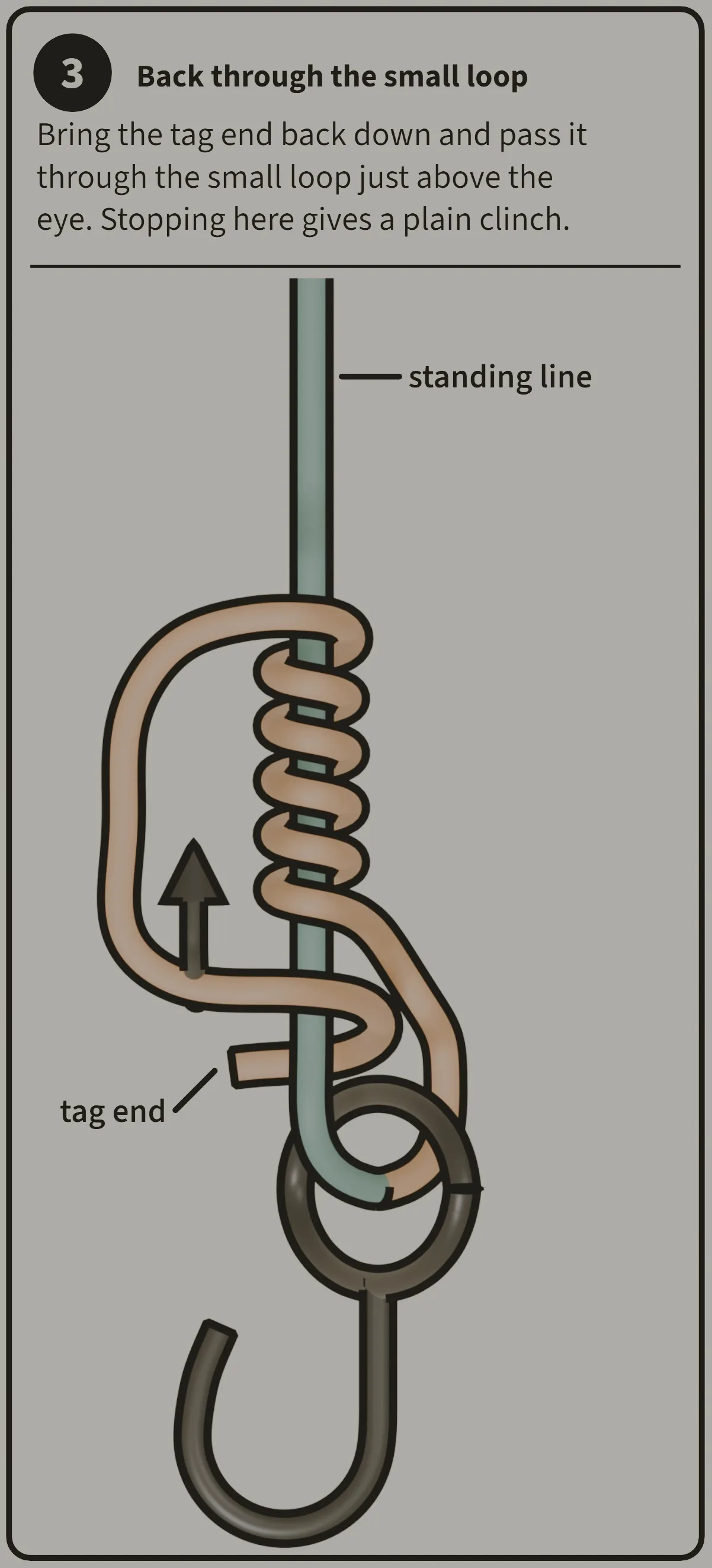
- Bring the tag end back down to the eye and pass it through the small loop just above the eye, the first loop the wraps formed. Stopping here and tightening gives the plain clinch.
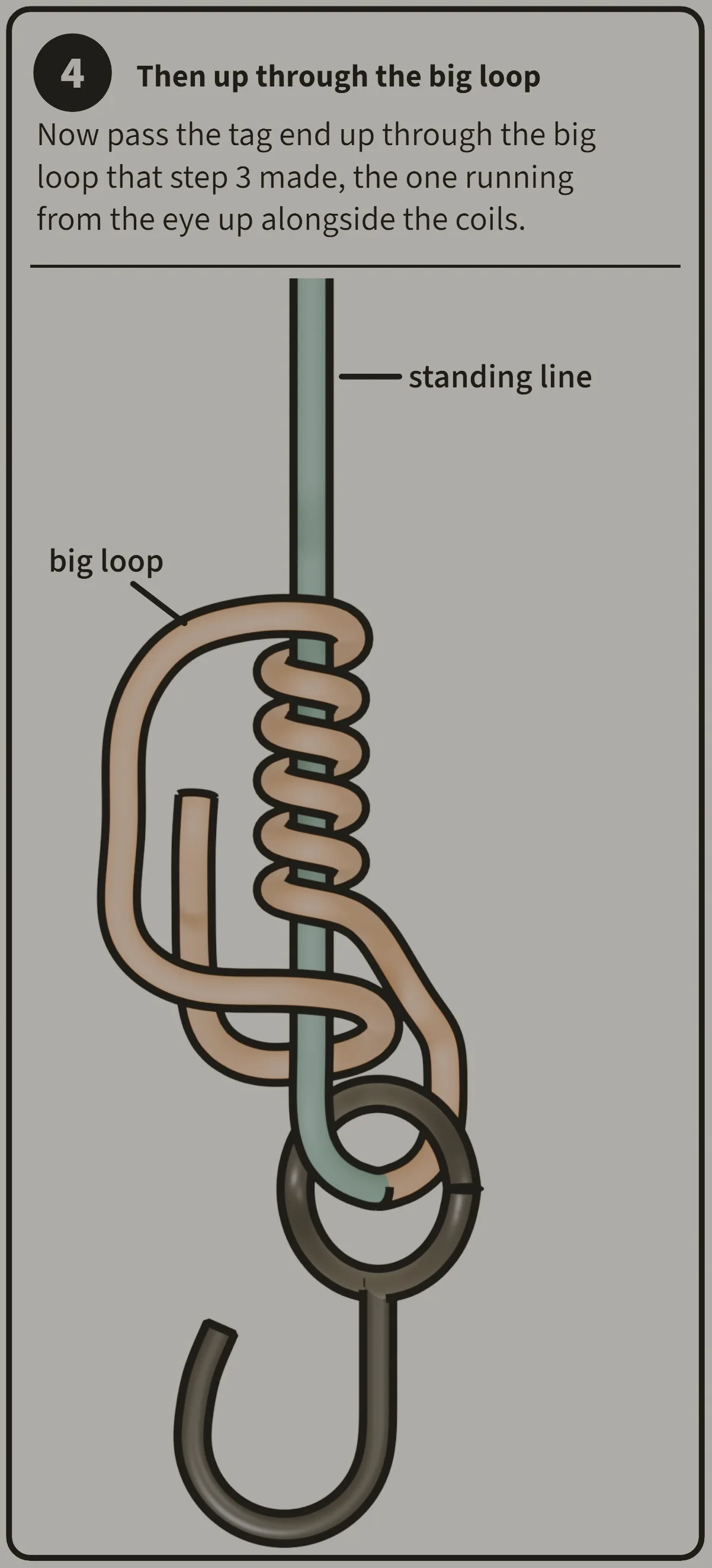
- Now pass the tag end through the big loop that step 3 just made, the loop running from the eye back along the wraps. That is the improvement.
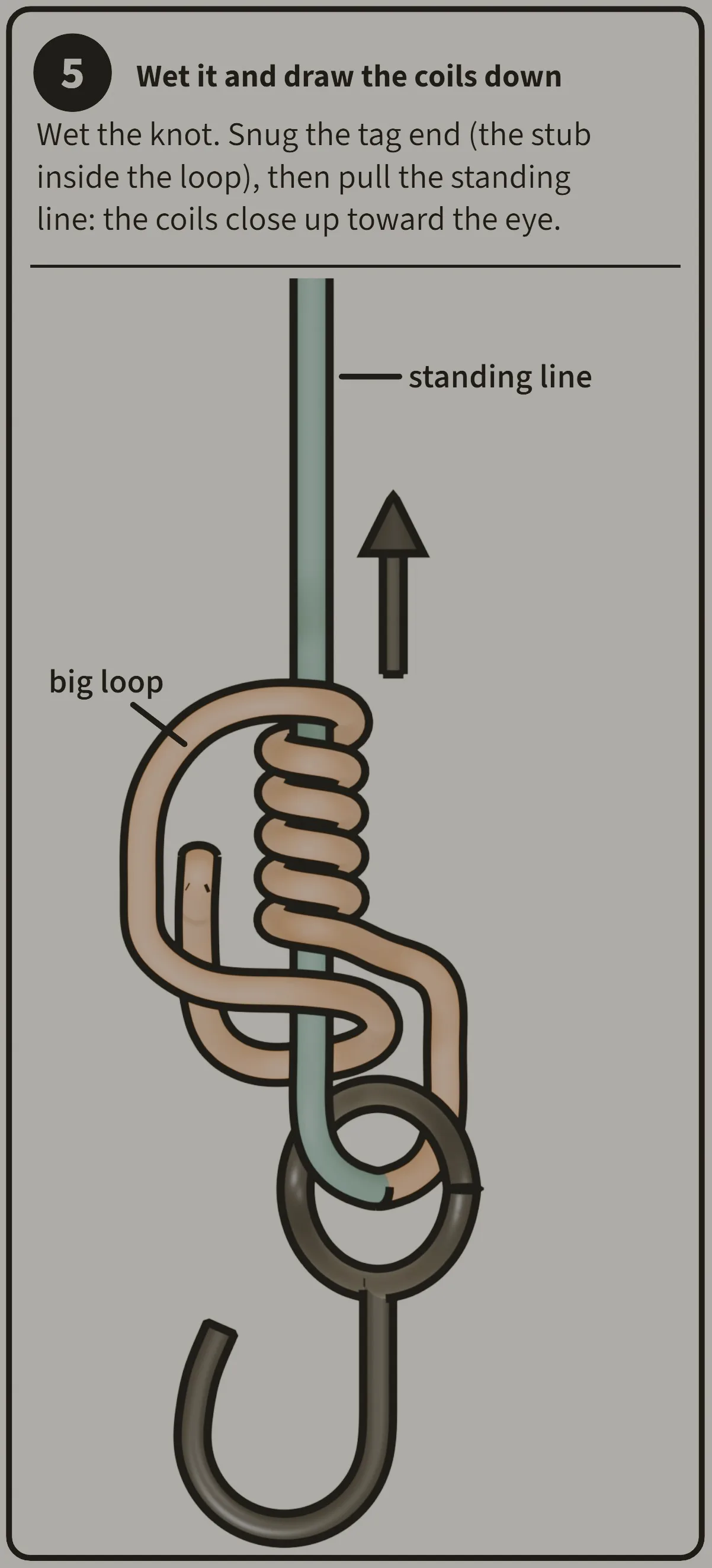
- Wet the knot. NetKnots, Berkley, Orvis and the Fish and Wildlife Service all say it, and Scheck's version is "always lubricate a clinch before drawing it tight." Then pull gently on the tag end to draw the coils down; NetKnots' instruction is to pull on the tag end to tighten down the coils. Kreh's advice for any clinch is the same idea from the other side: draw the tag down so it lies against the spirals before tightening.
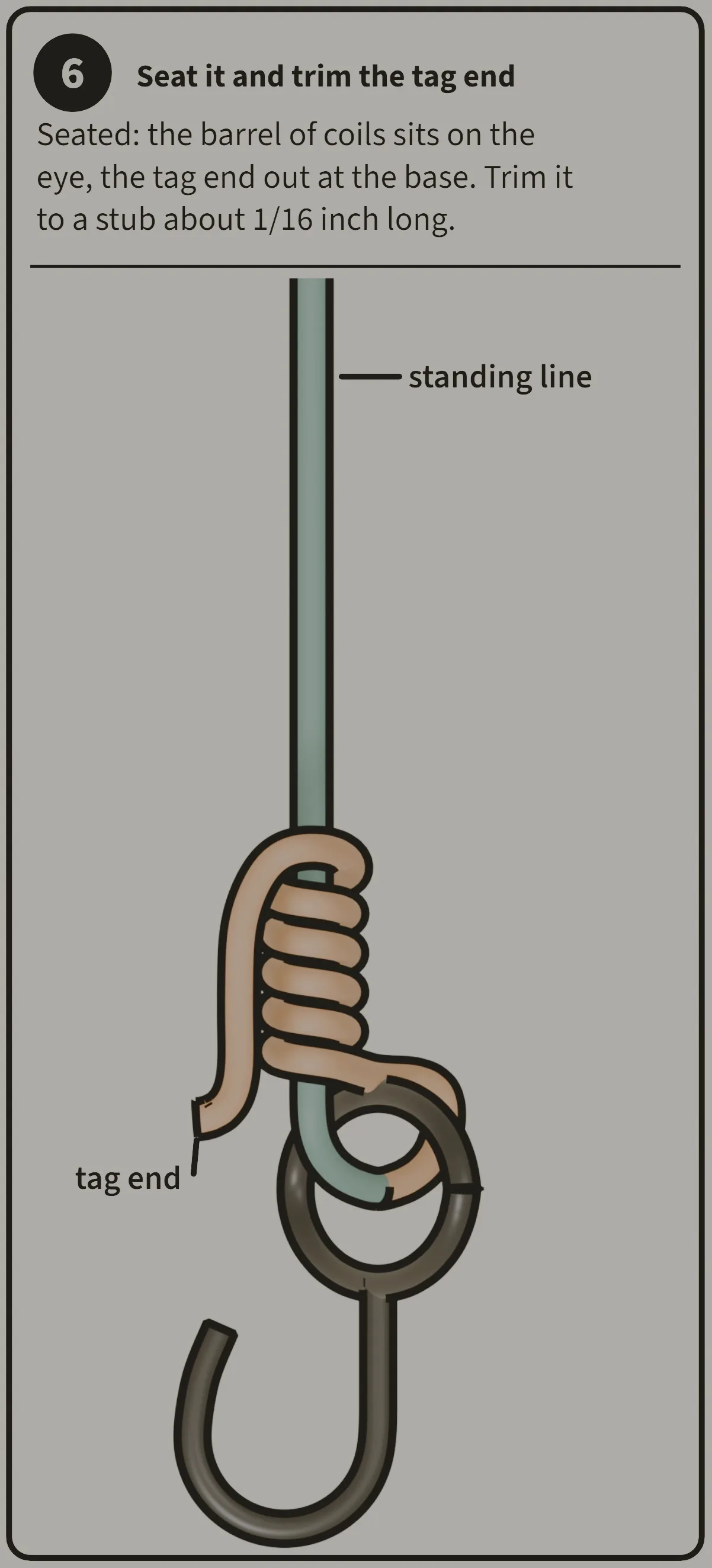
- Seat it. Hold the hook and pull the standing line until the coils slide tight against the eye. Scheck: pull it up smoothly, not with a jerk, and pull only on the standing line, not on the tag end; pull hard to seat the knot. Berkley's step pulls the tag end and the main line together. Our steps finish with the firm pull on the standing line, as Scheck does. The Fish and Wildlife Service puts it as wet the line and tighten the knot slowly.
- Trim the tag. NetKnots says clip it close; Scheck says don't clip it flush and leave a little room for slippage. We leave a short stub, about 1/16 inch, which is ours.
When the knot is pulled tight, it changes shape. Animated Knots describes it: pulling on the line forces the wrapped turns to redistribute so that the inner strand becomes an outer wrap, and the tag end ends up gripped closely against the hook. So the finished knot does not look like the loose one, and that is normal.
Step 1 of 6. Step 1 of tying an improved clinch knot: the hook hangs eye-up; the standing line comes down into the eye and the tag end rises out of it beside the standing line, with an arrow showing the tag end going up through the eye
Pass the tag end up through the eye and pull about six inches through.
The written steps above are the full instructions. This player shows the same drawings as the figures below, one move at a time: Back and Next step through them, Play advances every two seconds and stops on the last frame, and the left and right arrow keys step while the player has focus.
Basis: consensus (NetKnots, Animated Knots, Berkley, Orvis, USFWS, MidCurrent, Fly Fisherman); the tag length is editorial
How it fails
- Pulled up dry. Every tying guide we read says to wet it first, and the Fish and Wildlife Service adds to tighten slowly. Orvis gives the reason: moistening reduces friction and helps the knot slide smoothly into place, and excessive friction during tying can damage the line and reduce its strength.
- The wrong turn count for the line. In light nylon, Scheck's six- and seven-turn clinches beat five turns. In heavy line, Animated Knots drops to four turns and every guide sets a ceiling because the knot gets harder to tie.
- Overlapping coils. Berkley's caution and MidCurrent's: overlapped coils lose the knot's strength.
- Not seated. Scheck says pull hard to seat it, and that it pays to deliberately break a few dozen clinch knots to get a feel for how hard you can pull.
- Light tippet on a big hook. Scheck found that a clinch in 6X tied to ever-larger, heavier-wire hooks reaches a point where it won't pull up and simply slips until it comes undone, or seems okay but is much weaker than you expect. His rule of thumb for a seven-turn clinch: double the X size of the tippet for the largest wet-fly or nymph hook, so 5X to a size 10 and 6X to no larger than a size 12, and at least 3X if you insist on a clinch for a size 6 streamer. That was tested on the plain clinch; we apply it to the improved one as well, which is our judgment.
- Braid. See above. It slips.
- Trimmed flush. Scheck leaves a little room for slippage.
Basis: consensus (USFWS, NetKnots, Berkley, Animated Knots, Orvis, MidCurrent); editorial where marked
What the published tests show
One named test gives the improved clinch a number (Field and Stream); a second (Art Scheck's) compares it head-to-head with the plain clinch.
| Test | Method | Line | Result |
|---|---|---|---|
| Field and Stream (John Merwin) | Machine testing; percent of the line's actual unknotted strength; machine and pull count not stated | 10 lb Trilene Big Game to a Rapala | 5-turn improved clinch 96%, and a 6-turn clinch 96%, but only if tied with extreme care; otherwise much lower. Trilene knot 96%, Palomar 89% |
| Field and Stream (same test) | as above | 10 lb InvizX fluorocarbon to a small Rapala | 5-turn improved clinch 75%; non-slip loop 83%; Palomar 82% |
| Field and Stream (same test) | as above | 14 lb FireLine superline to a Rapala | Plain 8-turn clinch slipped and came untied at about 10 lb of force; Palomar 63% |
| Art Scheck, MidCurrent | Hand pulls on two-knot rigs, stretched and then broken with a sudden tug | Light nylon tippet | Clinch consistently the weakest knot he broke in freshwater tippets (the Duncan loop occasionally weaker); in one small set, 6X clinches failed at 81% of the material's baseline. Improved clinch: no improvement; when the two differed, the plain clinch won 60% of the time |
The two fly-side sources disagree on the improvement. Scheck found that the improved clinch seems to offer no improvement. MidCurrent's Ask MidCurrent answer, by its staff, says improved clinch knots in general test a bit stronger than standard clinch knots, that the extra tuck definitely makes it less prone to slipping, and that the plain clinch can be the better option with very small flies, especially dry flies. Both are MidCurrent; the second runs no test of its own, and the Field and Stream figure it cites does not match the Field and Stream test we read, so that figure is not used here. We print both and do not pick one.
So: in mono, tied carefully, the improved clinch is as strong as anything in Field and Stream's test. In fluorocarbon it came in seven to eight points behind the Palomar and the non-slip loop in that test. In braid, do not use it. The care matters more than the knot: the same Field and Stream test says the clinch knots dropped sharply when not tied with extreme care.
Testing methods vary in ways that change the numbers: percentage of rated versus actual break strength, machine versus hand pulls, the number of pulls, wet or dry, and the brand of line. Treat any single percentage as a data point.
Basis: official on the test figures; editorial on the summary
When another knot is better
- Braid to the hook: the Palomar, or a uni. NetKnots does not recommend the improved clinch for braid, and Field and Stream's plain clinch slipped out in it.
- Fluorocarbon to a jig or hook: the Palomar, which tested 82% against the improved clinch's 75% in Field and Stream's fluorocarbon pull and does not depend on a turn count.
- Streamers, nymphs, poppers, jerkbaits and topwaters, where the fly or lure should swing free: the non-slip loop. Kreh, in Fly Fisherman: the non-slip loop has replaced the improved clinch knot for flies he wants to look lively in the water. It also tested at 83% in fluorocarbon in Field and Stream.
- Line heavier than about 20 lb: a Palomar or a uni. The improved clinch's own tying guides cap it at 20 to 30 lb.
- Joining two lines: never a clinch. The Alberto, the double uni or the double surgeon's.
When the improved clinch is the right knot: a small fly or a dry fly on fine tippet, and mono or light fluorocarbon to a hook, small lure or swivel when you want the hook held snug, or the lure will not go through a Palomar loop.
Basis: consensus; editorial on the recommendations
Testing and trimming
- Pull hard once on the standing line with the hook held. Orvis's general advice is to give a knot a strong pull to test its security after tying it.
- Look at the coils. A neat, tight barrel of wraps against the eye is right. Coils crossed over each other, or a knot that stopped short of the eye, are reasons to cut it and retie.
- Leave a short stub, not a flush trim.
- Retie after a good fish, after any rock or wood, and whenever the coils have visibly loosened. That is our rule, not a source's.
Basis: consensus (Orvis, MidCurrent); editorial on the retie rule
Rigs and techniques that use it
- Dry flies and small flies on tippet, where Orvis calls it a staple. See leaders and tippet.
- Dry-dropper and indicator nymphing rigs, for the small flies; mind Scheck's tippet-to-hook-size rule on the nymphs.
- A slip float hook in mono, and small hooks and swivels on light spinning tackle.
- The leader end of a braid-to-leader system, tied in the mono or fluorocarbon leader, never the braid. See mono, fluoro and braid.
Basis: consensus on the fly use; editorial on the rest
What we don't know yet
- A turn table by line test or diameter from a maker or a named test. The counts above are what each tying guide states; none of the sources we read publishes a table for this knot. Status pending.
- A published strength test of the improved clinch in braid. Field and Stream's braid result is for the plain clinch. Status pending.
- Seaguar's and Sufix's own instructions for this knot. We looked for both makers' knot pages for the improved clinch and did not find one; Berkley's is the line maker's instruction on this page. Status pending.
- Whether the improved clinch is stronger than the plain clinch. Art Scheck's tests say no; MidCurrent's staff answer says a bit stronger in general. We could not find a published test settling it.
- Florida Sport Fishing's machine test on 60 lb mono, which compares the improved clinch, Palomar and uni, refused our fetch twice, so its figures are not on this page. Status pending.
Sources and how confident we are
| Claim | Basis | Confidence |
|---|---|---|
| Tying sequence | NetKnots, Animated Knots, Berkley, Orvis, USFWS | High |
| Not for braid | NetKnots; Field and Stream (plain clinch) | High |
| Turn counts | Each guide's own figure; the working rule is ours | Medium |
| Strength figures | Field and Stream; MidCurrent (Scheck) | Medium: methods differ |
Sources
- Improved Clinch Knot — NetKnots — the three tying steps, 5 or more turns, wet and pull the tag to tighten the coils, slide tight to the eye, clip close; not recommended for braided line; difficult over 25 lb; the tag finishing at the front by the eye.
- Improved Clinch Knot — Animated Knots by Grog — the tying sequence, about five turns, four in heavier line, the neat spiral held under the fingers, rotating the hook to make the twists, the knot changing structure when tightened, small tippet to heavy wire hooks, leader to fly, not recommended over 30 lb.
- Fishing Knots 101 — Berkley — the extra tuck, about 6 inches through the eye, five to seven twists, coils must not overlap, moisten and pull, not recommended over 30 lb.
- Fly Fishing Knots: Mastering the Essentials — Orvis UK — fly to tippet, five to seven wraps, moisten before tightening because it reduces friction, a strong test pull.
- The Improved Clinch Knot — U.S. Fish and Wildlife Service — 5 turns, the two tucks, wet the line and tighten the knot slowly.
- Lefty's Fishing Knots 101 — Fly Fisherman — the improved clinch doing poorly over 20 lb; drawing the tag down against the spirals; the non-slip loop replacing it for lively flies, but not for dry flies or flies under size 12.
- Fly Fishing Knots: The Last Link — MidCurrent (Art Scheck) — hand-pull test method; the clinch weakest in light tippet; 6X at 81%; six and seven turns beating five; no improvement from the improved version, plain clinch winning 60% when they differed; tippet size to hook size; lubricate, pull smoothly on the standing line only, pull hard, don't clip flush.
- Ask MidCurrent: Is an Improved Clinch Knot Always Better Than a Regular Clinch Knot? — MidCurrent — improved clinches testing a bit stronger in general; less prone to slipping; the plain clinch for very small dry flies; overlapped coils losing the advantage.
- The Strongest Fishing Knots for Each Type of Line, Tested — Field and Stream (John Merwin) — 96% in mono only with extreme care, 75% in fluorocarbon, the plain clinch slipping in FireLine at about 10 lb; the Palomar, non-slip loop and Trilene figures; percentages against unknotted line strength.
- The Strongest Fishing Knots You Can Tie — Popular Science (Field and Stream syndication) — the same test, used to confirm the figures.