
What it is
The wacky rig is a soft-plastic stick bait, usually 4 to 6 inches, with a single hook run crosswise through its middle so the point rides exposed and both ends hang free. No weight, no buried point, no jig head. On the fall the bait sinks horizontally and the two ends curl toward each other and straighten. Kayak Angler's description is the whole method: shove a hook through the belly of a stick bait, cast it out, and let the rig do the work.
Three variations share the idea:
- Weightless. The standard. The plastic's own density sets the sink rate, and Wired2Fish, Kayak Angler and Bassmaster all treat weightless as the reason the rig exists.
- Weighted wacky head. A 1/16 to 3/16 oz jig head with the eye on top and the bait still hung through the middle, for depth, current or wind; Kayak Angler notes it makes the bait look more like a crayfish on bottom. Owner's and VMC's heads both carry a weedguard.
- Neko rig. The nose-weighted cousin. Wired2Fish's definition: a neko rig is simply a nose-weighted wacky rig. A 1/32 to 3/32 oz nail weight goes into the head of the bait, the hook goes wacky-style through the middle, and the rig falls faster and stands nose-down with the tail up. Bassmaster reports the name came over with the Japanese anglers who brought the rig. It is a section here, not a separate page, because only the fall changes.
Two accessories matter. An O-ring over the bait's middle lets you hook under the ring instead of through the plastic, so one bait survives many fish; every source here recommends it, and a wacky tool (a hollow tube or pliers) makes fitting it simple. Weedguard hooks take the exposed-hook rig into brush and grass; Gamakatsu, Owner and VMC each make one.
When it wins
The wacky rig wins when bass are shallow, can see, and will not chase.
- Shallow cover and docks. Wired2Fish's summary is shallow, clear water, and its wacky-vs-neko comparison calls the weightless rig the tool for fast, shallow dock fishing. Kayak Angler's list is spawning flats, docks, overhanging limbs and sighted fish.
- Bedding fish. Kevin VanDam's Bassmaster column calls the spawn the time bass are most fickle about presentation and the wacky rig the answer around beds, docks, overhanging trees and light current. Field & Stream puts the window at late pre-spawn through early post-spawn.
- Post-spawn. Brent Ehrler (Bassmaster) singles out post-spawn bass chasing bream around docks and bushes; Outdoor Life points to lethargic post-spawn fish on the first cover in 8 to 12 feet.
- Pressured, clear water. VanDam again. The bait is small, natural and slow, and an exposed light hook lets it fall the way nothing on a jig head does.
- The slow fall on a slack line. The rig's only trick, and enough. Kayak Angler says most strikes come on the fall; Wired2Fish says most bites come within the first 15 seconds.
It loses in wind (you cannot keep a slack line straight enough to read), in depth (Field & Stream, Kayak Angler and Wired2Fish all rule it out for deep water and covering ground), in heavy grass or wood without a weedguard, and in current, which sweeps a weightless bait off the target before it falls. Those are the jobs of the weighted head, the neko, and the Texas rig, Ned rig or drop shot.
Species
Largemouth bass first. KDFWR describes the largemouth as a fish of ponds, reservoirs, backwaters and sloughs, associated with shallow vegetated areas, standing timber, stumps and other cover, which is a description of wacky-rig water. Smallmouth bass second, in the slow pools and gravel edges of a creek and on reservoir gravel: KDFWR puts stream smallmouth in cool, clear, flowing pools over rocky bottoms, and the wacky rig fishes the slow part of that sentence, not the flowing part. Spotted bass take it wherever they share the rock and the docks. Big bluegill and crappie pick at the fluttering ends, a nuisance in a bream bed and a bite indicator everywhere else.
Season and environment
- Winter. Creek and river: rarely the tool — a wintering pool wants a Ned rig or a hair jig. Reservoir: rarely the tool; a neko on deep rock if anything. Pond: deep water near the dam, neko. Sources call it a year-round rig, but it is at its weakest in cold water.
- Spring, pre-spawn. Creek and river: wherever the current slackens near spawning gravel. Reservoir: secondary points, dock rows and cover in the spawning pockets, 2 to 8 ft. Pond: the first warming banks and their cover. Late pre-spawn is when it starts to matter.
- Spawn. Creek and river: slack gravel edges — check the water's regulations page. Reservoir: beds, dock posts and bushes in the pockets. Pond: shallow firm bottom with cover. Bedding fish are the classic target; the ethics call is yours.
- Summer. Creek and river: shade and slack water, early and late. Reservoir: docks, laydowns and grass edges, with a neko on deeper docks and ledges. Pond: shade, weed edges, pier shade. Weightless shallow; neko or a wacky head for 8 to 15 ft of cover.
- Fall. Creek and river: slack water off the feeding runs. Reservoir: docks and cover on the path back to deep water. Pond: weed edges as they thin out. Heavier gear and tighter cover, per Wired2Fish's fall coverage.
Structure, cover, clarity and current
Exposed hook versus weedguard. The plain hook hooks better and is the standard in open water, around dock posts, on gravel and along grass edges. Brush, laydowns, matted grass and stump fields need a weedguard hook or a weedless wacky head or the rig fouls every cast. Wired2Fish and VanDam both describe home-made guards; the manufacturer versions under terminal tackle do the same job without fly thread.
Docks. The cover the rig is built for, and the one every source here leads with. A horizontal bait skips well because it lands flat, and the fish are in the walkway shade where nothing else reaches. Wired2Fish adds that a 4 inch bait fits tight dock gaps and a small nail weight adds skipping distance.
Clarity. Wired2Fish's rule: it works in stain, but your chances are better when a fish can see it from a distance. In stain, a 6 or 7 inch bait or added weight; in clear water, 4 to 5 inches and a longer leader.
Current. Current kills the fall. A weightless stick bait in a creek run is pushed downstream and up in the column before it sinks, and the slack line you need to read becomes a belly you cannot. Look for the slack water rather than the run. In moderate current the sourced move is to add weight: Ehrler uses a 3/32 oz nail weight on a neko for current or anything past seven to eight feet, and a 1/8 oz wacky head does the same job. In real current this is Ned rig water.
Rod, reel and line
The slow fall is the point, and the line system either preserves it or ruins it. Heavy fluorocarbon sinks the bait faster and drags it toward you; thick braid catches wind; a short leader hangs floating braid over a clear-water fish. Every source says the same thing in different numbers: light, thin, long.
Beginner
A 7 foot medium or medium-light spinning rod with a fast tip, a 2500- or 3000-size reel, 10 lb braid to about 8 feet of 8 lb fluorocarbon leader with an Alberto, a Palomar to a size 1 wacky hook, and a 5 inch stick bait on an O-ring. Outdoor Life and Ehrler describe this setup within a pound or two (10 lb and 12 lb braid respectively to an 8 lb leader on spinning gear), and it is our finesse default on line systems. Cast to cover, let it fall on slack line, watch the line. That is the whole page in one rig.
Intermediate
Three situational moves. Straight 8 lb fluorocarbon, which Wired2Fish and Bassmaster's natural-lakes coverage both endorse; it removes the leader knot at the cost of some slack-line visibility and a slightly faster sink. A longer leader: Brandon Palaniuk, quoted in In-Fisherman, runs about 10 feet of 6 or 8 lb fluorocarbon on braid, and around bedding fish that length matters more than the pound test. And a cover rod: Wired2Fish's guide runs a 6 foot 10 inch to 7 foot baitcaster on 12 lb fluorocarbon for docks and brush, and VanDam runs 15 lb braid to a 10 or 12 lb leader on spinning tackle, the leader long enough for the sink rate.
Advanced
Decide by depth, cover, clarity and current, and let the leader carry most of the decision.
- Depth. Under 5 feet: weightless, 8 lb leader, 8 to 10 feet long. Five to 12 feet: neko with a 1/32 to 3/32 oz nail or a 1/16 oz wacky head. Deeper docks and ledges: 1/8 to 3/16 oz head or a heavier neko weight, 10 lb leader.
- Cover. Open water and dock posts: exposed hook, 8 lb. Brush and grass: weedguard hook, 10 to 12 lb leader, or straight 12 lb fluorocarbon on a casting rod. Wired2Fish's fall piece has James Niggemeyer at 8 to 10 lb in cover where he would otherwise throw 16 to 20; even the upper bound is light.
- Clarity. Ultra-clear: 6 lb leader, 10 feet, 4 inch bait. Stained: 10 to 12 lb, 6 to 7 inch bait.
- Current. Neko or wacky head, 10 lb leader, upstream cast; or change rigs.
Rod power stays medium-light to medium. A medium-heavy rod gives a light hook and a light leader very little margin on a close hookset.
Leader
Fluorocarbon, 6 to 12 lb, 8 to 10 feet, joined to braid with an Alberto or uni-to-uni. Eight pound is the default; 6 lb for clear water and bedding fish that have seen everything; 10 to 12 lb for docks, brush and the neko on ledges. Longer than for most rigs because the bait spends its working life 6 to 10 feet from the braid, the point the Bassmaster and In-Fisherman sources keep returning to. Cox's case (Wired2Fish) for a fluorocarbon-infused copolymer leader, for a little stretch and abrasion resistance, is reasonable in cover. Properties on leaders and tippet and mono, fluoro and braid.
Terminal tackle
- Wacky hooks, size 2 to 2/0. Short shank, wide gap, light to medium wire, straight or slightly offset point. Kayak Angler gives 2 through 2/0 for 3 to 5 inch plastics; Field & Stream calls 1/0 the all-round size; Cox uses a size 1; Wired2Fish's guide prefers a size 2 neko-style hook with a 3-degree offset and warns off the small circular wacky hooks that rotate under the ring. Gamakatsu's Finesse Wide Gap runs 4 to 6/0; VMC's Neko hook (also fished weightless) runs 6 to 2/0. We would start at size 1 for a 5 inch bait and go to 1/0 for 6 inch baits and fish over 4 pounds.
- Weedless wacky hooks. The same hook with a nylon guard: Gamakatsu Finesse Wide Gap Weedless (4 to 6/0), Owner's Wacky Hook with the flex nylon guard (4 to 2/0), VMC Weedless Neko. For wood and grass only; the guard costs hookups in open water.
- Wacky jig heads, 1/32 to 1/4 oz. Owner's Wacky Jig Head runs 1/32, 1/16, 1/8 and 3/16 oz with a weedguard and a V-bend saddle; VMC's Wacky Weedless Jig runs 1/16, 1/8, 3/16 and 1/4 oz on a 1/0 hook with a 3-degree offset point and a stainless wire guard. Owner does not publish a hook size for theirs. The 1/16 oz is the one to carry.
- Neko and nail weights, 1/32 to 3/32 oz. Wired2Fish's neko guide gives the range; Bassmaster's neko column starts at 1/32 or 1/16; Ehrler uses 3/32 in current. Bassmaster's natural-lakes piece describes headless finishing nails about 1/8 inch behind the nose as the original.
- O-rings and a wacky tool. Rings sized to the bait; a tube or wacky pliers to fit them. Two crossed rings (In-Fisherman) hold better on big fish and in cover.
- Stick baits, 4 to 6 inches. The soft, salt-heavy straight stick bait is the category and the 5 inch is the standard across every source here. Four inch for pressured fish and tight docks; 6 to 7 inch for stain and a faster fall (Wired2Fish). Softer, denser plastics shimmy more; buoyant plastics stand up well on a neko but fall slower and flatter weightless. Straight-tail finesse worms rig the same way, with more action on the twitch and less on the fall (VanDam).
Knots
Palomar from the leader to the hook. It is strong in light fluorocarbon and holds the hook square to the line, which matters when the hook sits under an O-ring and a fish rolls on it. A non-slip loop is a legitimate option if you want the bait to pivot more freely on the twitch. Braid to leader is the Alberto, re-tied when it fuzzes; Cox is right that the leader knot is the weak point on a hard cast.
Lure, bait or fly choices and color logic
Color matters less here than on most rigs, because the bait's job is to fall slowly in front of a fish that has already seen it. Wired2Fish reduces the box to three: watermelon red for clear and sunny, green pumpkin for clear and cloudy, junebug or black-blue for dirty water.
- Clear water, bright sun — bluegill and crayfish on gravel. Weightless, a long fall, deadsticked. Watermelon red, or watermelon with light flake; 4 to 5 in.
- Clear water, overcast — bluegill and shad. Weightless, twitch-fall. Green pumpkin, or green pumpkin with purple or blue flake.
- Clear water, bedding fish — nest raiders. Deadstick beside the bed. Natural, or a white or pink bait you can see well enough to watch the take.
- Lightly stained — bluegill and crayfish. Weightless or a 1/16 oz head, twitch-fall. Green pumpkin, black-blue flake; 5 in.
- Muddy — either forage. Neko or a 1/8 oz head, bigger profile. Junebug, black-blue, black; 6 to 7 in; scent-infused plastic.
- Deep docks and ledges — bluegill and shad. Neko, dragged and hopped. Green pumpkin, watermelon; straight-tail worms 5 to 7 in.
How to rig it
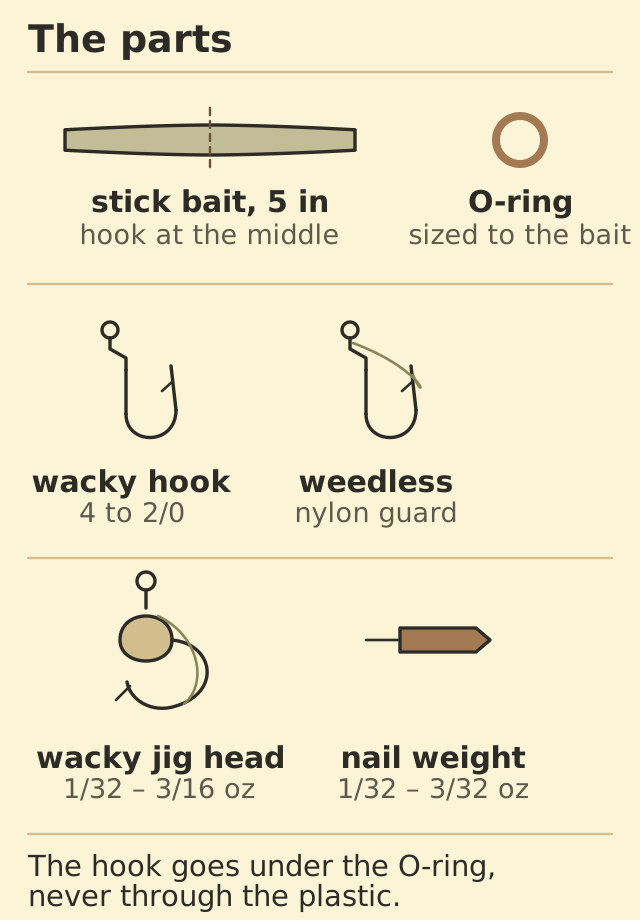
- Find the bait's midpoint by balancing it on a finger; on a tapered stick bait it sits a little toward the fat end, the egg-sac area Ehrler hooks about a third of the way down.
- Fit the O-ring: slide it onto the tube of the wacky tool, push the bait in halfway, roll the ring off at the midpoint. Without a tool, stretch the ring over a fingertip and work it down.
- Pass the hook under the ring, crosswise to the bait, so point and eye both stand clear of the plastic. Wired2Fish's guide takes the point just into the plastic under the ring to lock it; hooking the ring alone is the other common way. The point rides up and the bait hangs level from the bend.
- Check the hang. Both ends should droop evenly; if one hangs low, move the ring.
- A weedless hook or a wacky head rigs identically: guard on the point side, eye straight up, bait level beneath it.
- Tie on with a Palomar, wet, seat, trim.
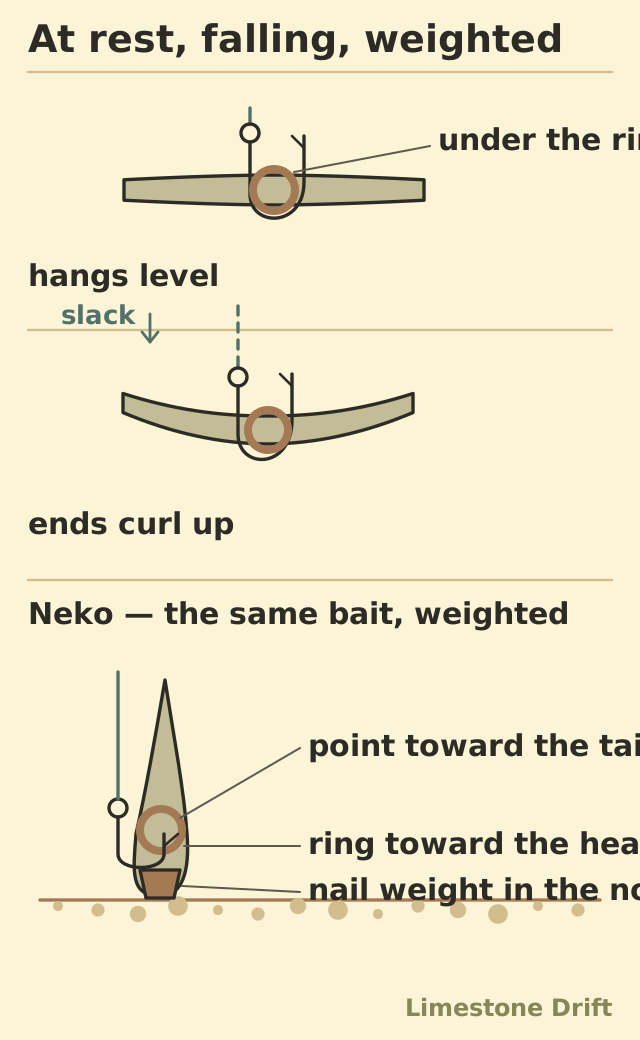
Neko variation. Push a 1/32 to 3/32 oz nail weight into the fat end until flush, set the ring a fraction toward the weighted end (Wired2Fish's placement), and hook under it with the point facing the tail. The nose sits down and the tail stands up, so a point aimed at the tail is aimed at the fish's mouth. Bassmaster's neko column starts at 1/32 or 1/16 oz and goes heavier for depth and wind.
How to fish it
The core retrieve is a controlled fall and then very little.
- Cast and let it fall on slack line. Pitch or skip to the target, close the bail and give slack so the bait falls straight down on the spot instead of pendulum-swinging back to you. Kayak Angler: let it fall without working it; most strikes come on the fall. Do not tighten up to feel for the bait; you will move it and miss the bite.
- Twitch-fall. On bottom, Wired2Fish's guide gives three short pops on a semi-slack line, then slack for another fall. Two or three cycles per cast is plenty; Wired2Fish's mistakes piece calls too much action the most common error. The bite comes on the slack fall after the lift.
- Deadstick. Beside a bed, a dock post or a laydown, let it lie 5 to 10 seconds after the fall. Then move: most bites come within about 15 seconds, and four minutes on one post is three docks you did not fish.
- Watch the line. This is the technique. Wired2Fish describes the bite as a quick line jump or lateral movement in the slack; Kayak Angler as any pause, twitch or change of direction; the fall stopping early or the line easing off to one side count too. Index finger on the line, eyes where it enters the water.
- Hookset. Reel down until the line comes tight and sweep, or as Wired2Fish puts it, pull-set into the fish. A hard set on a light hook and 8 lb leader loses fish three different ways.
- Skipping. Sidearm, tip low, the bait travelling flat a foot off the water, first touch about halfway to the target (Field & Stream) so it skips rather than dives. A 4 inch bait skips easier than a 5; a small nail weight adds distance. Underhand pitches, per Cox, are kinder to the leader knot.
On a neko the retrieve is the same fall on a faster clock, then Wired2Fish's slow drag and twitch along bottom, where every pebble the nose catches makes the tail whip as it breaks free. Bassmaster's column adds slight twitches on a slack fall and a bounce or two after it settles. It is the version for deeper docks, gravel bars and ledges, and no more a search bait than the weightless one.
Common mistakes
- Line too heavy. Fifteen pound fluorocarbon or a short leader on 20 lb braid turns a slow flutter into a fast sink toward the boat. Eight pound leader, long.
- Fishing it fast. Lifting the moment it lands, or shaking it constantly. Cast, slack, wait.
- Hookset too hard. The light hook tears out or straightens and the leader parts. Reel down and sweep.
- Not watching the line. A wacky bite you can feel is one the fish has already had for a while, and it is about to let go of it.
- No O-ring. Every cast tears the bait a little and every fish tears it a lot. A bag of rings and a tool pay for themselves in an afternoon.
- Wrong hook. Small circle-style wacky hooks that rotate under the ring and will not seat a bass over 4 pounds. Short-shank wide gap or neko-style, sizes 2 to 2/0.
- Fishing it where it does not belong. Wind, depth, current, heavy grass. Go weighted, neko, or another rig.
Kayak notes
The wacky rig suits a kayak by temperament: quiet, close, shallow, and well served by a boat that can sit in two feet of water under a limb.
- Dock skipping seated. Sidearm is the natural cast from a seat and a low tip is already where your hands are. Approach from the shade side and down-wind, stop a cast-length out, skip to the walkway shadow first, then the posts.
- Slow-fall boat control. The fall only works if the boat is not moving the line. Hold the boat still in pockets you want to fish slowly; on a creek, sit in the eddy on the slow side of a pool. A drifting kayak turns a slack-line fall into a slow drag.
- Wind. The rig's weak point and the kayak's. Fish the lee bank, keep the bow into the wind so the line lies along the boat, keep the tip low and to the side, and switch to a neko or a 1/16 oz head as soon as you cannot see the line.
- Sight fishing. The low seat and quiet approach suit sight fishing in clear water. Watch the fish, not the line, and set when it turns away with the bait.
- Storage. One box: two sizes of wacky hook, a weedless version, a few 1/16 oz heads, nail weights, rings and the tool, and 5 inch stick baits in green pumpkin and watermelon red.
Fly counterpart
There is no honest fly analogue for the weightless horizontal fall, but the deadstick beside cover has one: an unweighted or lightly weighted worm or leech-style fly on a floating line and a 9 foot leader, cast to a dock post or bed, left to sink on slack line, then twitched once. Drop it in the fish's face and let it sit. Poppers and topwater flies covers the same cover from above; streamer fishing covers the strip-and-pause the twitch-fall imitates.
When another presentation is better
- Heavy cover. A Texas rig with a pegged weight goes through laydowns, matted grass and stump fields that fold a weedguard.
- Rock and current. A Ned rig or tube keeps bottom contact in a creek run and on reservoir gravel where the wacky rig's fall never reaches the fish.
- Deeper cover fish that still want a worm. A shaky head covers 8 to 20 feet of gravel, points and docks on a faster clock; the neko is the wacky family's own answer to the same water.
- Suspended or deep fish. A drop shot holds the bait at the fish's depth; Ehrler runs a wacky-hooked 4 to 5 inch stick bait on a 14 inch drop-shot leader for smallmouth.
- Active fish and covering water. Anything that moves. The wacky rig is not a search bait.
Skill level
Beginner to rig; intermediate to fish well. The rigging takes 30 seconds with a tool. The skill is casting accuracy around cover, keeping a slack line straight enough to read, resisting the urge to move the bait, and knowing when the water is wrong for it. Skipping docks cleanly is its own project.
Sources and how confident we are
How this page is sourced
Everything above is attributed in the text where a figure or a claim belongs to a particular source, and the full list is below. Where the sources differ — hook sizes, leader pound test, how much of the point to bury under the O-ring — the page gives the range rather than picking one.
Three things here are our own reasoning rather than anyone's published advice. The creek and river column of the seasonal list is the largest: no source we found fishes this rig in Kentucky creeks, and what is there follows from one fact — current defeats a slack-line fall — rather than from a report. The starting hook size (size 1 for a 5 inch bait, 1/0 for 6 inch baits and bigger fish) is a synthesis of ranges that run from size 2 to 2/0. And the kayak section applies the rig's mechanics to a kayak rather than repeating a source that fishes it from one.
Sources
- The Wacky Rig: How to Rig and Fish Guide — Wired2Fish — O-ring and wacky-tool rigging, hooking under the ring, size 2 neko-style hook with 3-degree offset, avoidance of small circular hooks, weedless option, 6 ft 10 in to 7 ft casting rod on 12 lb fluorocarbon or medium spinning on 8 lb fluoro or braid-to-leader, three short pops on semi-slack line, line-watching cues, pull-set hookset, shallow clear water, weighted wacky heads.
- 5 Wacky Rig Mistakes You Should Avoid — Wired2Fish — too much action, watching the line not the rod tip, line jump and lateral movement, bites within 15 seconds, wrong hook, three-color box.
- Wacky Rig vs Neko Rig: Which One Is Better and When — Wired2Fish — neko as a nose-weighted wacky rig, horizontal vs vertical fall, shallow docks and spawning largemouth for wacky, deep docks and ledges to 25 ft for neko, 7 to 10 in straight-tail worms.
- Neko Rig: Complete Rigging and Fishing Guide — Wired2Fish — 1/32 to 3/32 oz nail weights, O-ring set toward the head, hook point toward the tail, drag-and-twitch retrieve, medium-light to medium rods.
- Change Up Your Wacky Rig for More Bites — Wired2Fish — weedguard hooks, nail weights for skipping distance, wacky jig heads for depth, 4 in for pressured fish and tight docks, 5 in standard, 6 to 7 in for stain and a faster fall.
- Wacky Rig Bass: Cox's 4 Tips to Improve Success — Wired2Fish — size 1 short-shank wide-gap hook, 8 lb braid to 8 to 10 lb copolymer leader, underhand pitches to protect the leader knot, scent for pressured fish.
- Beef Up Your Wacky Rig Bass Fishing — Wired2Fish — 8 to 10 lb line in cover where 16 to 20 would be normal, 1/0 straight-shank hook, home-made wire weedguard, sweep-and-pressure hookset, grass, brush and docks.
- How to Rig and Fish the Wacky Rig — Kayak Angler — hook through the mid-section, O-ring, hook sizes 2 to 2/0 for 3 to 5 in plastics, weighted wacky hooks for depth, current and wind and a crayfish look, fall on a slack line, line-watching cues, reel-down-and-sweep, kayak uses (spawning grounds, docks, overhanging branches, sighted fish), poor in deep water and for covering water.
- Best Bass Fishing Rigs — Kayak Angler — hook through the belly of a stick bait, O-ring, weightless sink rate, spring and pressured shallow fish, let the rig do the work.
- The Power of the Wacky Rig — Bassmaster (Kevin VanDam) — spawn as the fickle season, docks, overhanging trees and light current, clear water and pressure, 15 lb braid to 10 or 12 lb fluorocarbon leader long enough for the sink rate, O-rings, home-made fluorocarbon weedguard, finesse worm vs stick bait action.
- Brent Ehrler's 5 Favorite Senko Rigs — Bassmaster — 1/0 hook through the egg sac about a third down the bait, 12 lb braid to 8 lb fluorocarbon leader on spinning gear, docks and bushes in post-spawn, neko with 3/32 oz nail weight for current and depths past 7 to 8 ft, wacky-hooked drop shot for smallmouth.
- Learn the Neko Rig — Bassmaster — hook in the middle plus a nose weight, 1/32 or 1/16 oz to start, 12 lb braid to 8 or 10 lb leader on a spinning rod, slight twitches on a slack fall, Japanese origin of the name, not a rig for covering water.
- Wacky Worms for Natural Lakes — Bassmaster — 1/0 or 2/0 straight-shank hooks, 8 lb fluorocarbon, nail weights 1/8 in behind the nose, 4 to 8 in straight-tail worms, docks, beds and post-spawn, midday summer, plumbing O-rings, early-1970s Texas origin story.
- Wacky Rigging Refined — In-Fisherman — Helderberg rig and 1980 Florida Invitational origin account, East Texas naming, crossed O-rings, weighted collars and jig heads, neko and nail rigs, Palaniuk's 6 to 8 lb leader of about 10 ft on braid, twitch and deadstick descriptions, smallmouth shoals.
- How to Fish a Wacky Rig: A Beginner's Guide — Field & Stream — 1/0 as the all-round hook, O-ring at the centre of gravity, 15 to 20 lb braid to 8 to 12 lb fluorocarbon leader, pause-and-fall retrieve, skipping delivery, late pre-spawn through early post-spawn, not for deep water.
- How to Fish a Wacky Rig — Outdoor Life — 10 lb braid to 8 lb fluorocarbon leader, 7 ft 2 in medium rod, O-ring optional but prolongs bait life, post-spawn fish on the first cover in 8 to 12 ft.
- Finesse Wide Gap — Gamakatsu — wacky hook sizes 4 through 6/0, forged.
- Finesse Wide Gap Weedless — Gamakatsu — nylon weedguard, sizes 4 through 6/0, for pitching the wacky rig into cover.
- Wacky Hook — Owner — with or without a Flex Nylon weedguard, sizes 4, 2, 1, 1/0, 2/0; sharp-angle saddle bend, Super Needle Point, for wacky and drop shot.
- Wacky Jig Head — Owner — 1/32, 1/16, 1/8 and 3/16 oz, weedguard, V-bend to centre the bait, weedguard.
- NK Neko — VMC — sizes 6, 4, 2, 1, 1/0, 2/0; offset point, long shank, wide gap, forged, resin-sealed eye, used weightless wacky as well.
- VMC WWJ Wacky Weedless Jig — Rapala/VMC — 1/16, 1/8, 3/16 and 1/4 oz on a 1/0 hook, 3-degree offset point, wire weedguard.
- Largemouth Bass — Kentucky Department of Fish & Wildlife — habitat in ponds, reservoirs, backwaters and sloughs; shallow vegetated areas, timber, stumps and cover; avoids upland headwater creeks.
- Smallmouth Bass — Kentucky Department of Fish & Wildlife — stream smallmouth in cool, clear, flowing pools over rocky bottoms; reservoir fish on rocky shores, ledges, stumps and submerged cover.