Overview and identification
Kentucky has three fish that the regulations count as catfish, and in KDFWR's words the channel cat is "the most widely distributed of those." KDFWR's Fishing and Boating Guide defines the word plainly: "A catfish means a blue, channel or flathead catfish. Bullheads are not included in this definition." Those are the three you have to tell apart, because the trophy rule and several lake limits treat them differently.
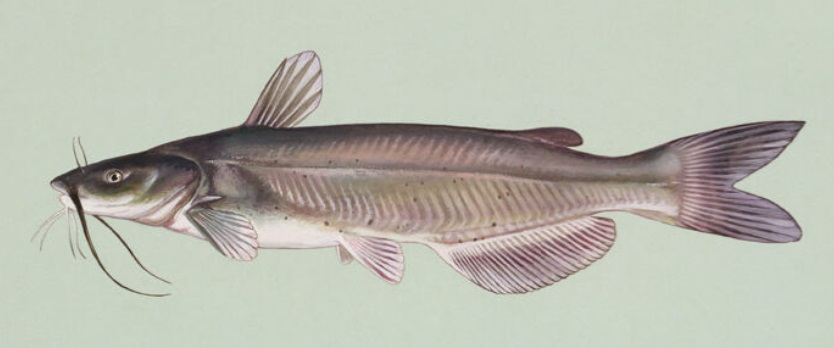
KDFWR's species page describes the channel catfish as "a long, slender-bodied catfish with a deeply forked caudal fin," olive to pale gray on the back and sides, often with small black spots, and a white belly. It resembles the blue catfish, the page says, but has a rounded anal fin margin and dark spots on its sides. The Guide's identification panel gives three field marks for each fish, and they are the ones to check with the fish in your hand:
- Channel catfish: outer margin of the anal fin rounded, with 24 to 29 rays; dark spots usually on the body; tail fin deeply forked.
- Blue catfish: outer margin of the anal fin straight, with 30 to 35 rays; body without dark spots; tail fin deeply forked. KDFWR's blue catfish page describes "a large, heavy-bodied catfish," pale blue to gray on the back and sides, fading to white below, with a long, straight-edged anal fin where the channel cat's is shorter and rounded.
- Flathead catfish: lower jaw projects far beyond the upper jaw; tail fin not deeply forked; head compressed. KDFWR's flathead page adds a broad, flattened head, yellow to brown color with dark brown and black mottling, and "a white tip on the upper lobe of the caudal fin," usually visible except in very large fish.
The forked tail rules out a flathead at a glance. Between a channel and a small blue, the anal fin is the honest test: rounded edge, channel; straight edge, blue. Spots help on a channel cat but the Guide says "usually," not always, so count on the fin before the spots.
Size, in KDFWR's words: channel catfish adults "can grow to about 4 feet and weigh up to 60 pounds, but typically range from 12-32 inches and 1-15 pounds." For comparison, the agency puts blue catfish at up to about 5.5 feet and 150 pounds, most between 20 and 50 inches, and flatheads at least 5 feet and 120 pounds, most 15 to 50 inches. Distribution and habitat: the channel cat is "common statewide in medium-sized streams to large rivers, but adaptable to a variety of habitats," valued as a sport and food fish, and routinely stocked in ponds and reservoirs statewide. The "most widely distributed" line is from a KDFWR column by Kevin Kelly, comparing it with Kentucky's other major catfish species.
The state record channel catfish weighed 32 pounds, caught by Kyle Estep of South Point, Ohio, in the Ohio River on 26 May 2004. KDFWR's online record page and the 2026–27 Guide print the same weight, angler, water and date. The other catfish records, for scale: blue catfish 106.9 pounds (Glynn Grogan, Ohio River, 20 October 2018) and flathead 97 pounds (Esker Carroll, Green River, 6 June 1956).
Basis: official (KDFWR Channel Catfish, Blue Catfish and Flathead Catfish pages; 2026–27 Fishing and Boating Guide definitions and identification panel; KDFWR State Record Fishes page and the Guide's record table; KDFWR column "Late spring begins prime time for catfish")
The rules
Statewide, under 301 KAR 1:201 Section 2(1)(l): "Catfish daily limit is unlimited; no size limit, except that only one (1) trophy catfish of each species may be harvested daily." The Guide defines the trophy: "Trophy catfish is a blue or flathead catfish 35 inches or longer or a channel catfish 28 inches or longer." Its statewide table puts it in numbers: channel catfish 28 inches and above, daily limit 1, possession limit 2; channel catfish below 28 inches, no daily limit, no possession limit, no size limit. The season is open all year. The text quoted here is the regulation's current version, effective 3 September 2026.
So on most Kentucky water you may keep as many channel cats under 28 inches as you like, plus one that is 28 inches or longer, and a blue and a flathead of 35 inches or longer on the same day if you are lucky enough to need the rule. Measuring, from the Guide: tip of the closed lower jaw to the tip of the tail, fish laid flat on the rule with the tail lobes squeezed together.
Waters where the regulation changes the catfish rule, every one quoted from Section 3 or Section 7 of 301 KAR 1:201:
| Water | Catfish rule | Regulation |
|---|---|---|
| Barren River Lake | Blue and channel catfish, 15 a day combined, only 1 longer than 25 inches | §3(3)(c) |
| Taylorsville Lake | Blue and channel catfish, 15 a day combined, only 1 longer than 25 inches | §3(67)(b) |
| Carr Creek, Dewey, Fishtrap and Yatesville lakes | The same 15-fish rule, word for word | §3(12)(c), 3(22)(b), 3(28)(c), 3(71)(b) |
| Ohio River | Channel catfish unlimited, no more than 1 of 28 inches or longer | §3(56)(c) |
| Golden Pond, Land Between the Lakes visitors' center | Channel catfish 5 a day, 15-inch size limit | §3(30) |
| Doe Run, General Butler State Park, Lake Shelby, Lincoln Homestead, New Haven Optimist lakes | Channel catfish 4 a day | §3(24)(b), 31(c), 48(b), 50(d), 54(b) |
| Rockcastle River WMA ponds; Willisburg Park Pond | Catfish 4 a day | §3(61)(c), 69(b) |
| Lakes on KDFWR's List of Special Lakes and Ponds, and FINs lakes | Catfish 4 a day | §7(2); Guide, FINs regulations |
On the Ohio River the regulation's words are: "The channel catfish daily limit shall be unlimited, except that no more than one (1) fish in the daily limit shall be twenty-eight (28) inches or longer." The blue and flathead lines read the same with 35 inches. Read side by side, that is the statewide trophy rule restated for the river (our reading). The Ohio River rules in 301 KAR 1:155, including its "Lower Ohio River Trophy Catfish" permits, sit in the regulation titled "Commercial fishing requirements" and govern licensed commercial fishermen, not sport anglers, so they are not reproduced here.
At Barren River Lake and Taylorsville the 15-fish limit applies to blue and channel catfish together. Flatheads are not named in those lines, so they stay under the statewide rule. Barren River Lake's boundaries in the Guide run from the dam to the KY 100 bridge, Long Creek to the KY 100 bridge, Beaver Creek to the KY 1297 bridge, Skaggs Creek to the Matthews Mill Road bridge and Peter Creek to the Peter Creek Road bridge; Taylorsville's upper boundary is Dry Dock Road on the Salt River. Below either dam the statewide rule applies.
Every other Kentucky water on this site has no catfish line of its own in the regulation, so the statewide rule applies there: Kentucky Lake, Lake Barkley, Lake Cumberland, Nolin River Lake, Rough River Lake, Green River Lake, Cave Run Lake, Dale Hollow Lake, Herrington Lake and the rivers and tailwaters.
On the Ohio, check which bank you are on. The Guide's bordering-waters section lets Kentucky-licensed anglers fish the main stem from a boat or from the Illinois, Indiana or Ohio bank, but "when fishing from the bank, anglers shall follow the regulations of the state in which they are fishing." The same rule appears for Kentucky Lake's Tennessee waters between the Eggner's Ferry and Ned McWhorter bridges. We have not read the other states' catfish rules for this page.
Jugs, trotlines, limb lines and hand-grabbing. The Guide's rules for the non-traditional methods matter to anyone setting lines for catfish, so here they are, quoted or closely paraphrased:
- A sport fishing trotline has no more than 50 hooks at least 18 inches apart and must be set at least three feet below the surface. A jug line carries one hook; a set (limb) line one hook. One person may use no more than two trotlines, or 50 jug lines, or 25 set lines at a time, and a boat no more than 50 jug lines.
- Every trotline, jug and set line must be permanently labeled with the customer identification number from your fishing license (trotlines on both ends), "baited, checked and all fish removed at least once every 24 hours," and removed when fishing stops.
- None within 200 yards below any dam, and none on KDFWR-owned or -managed lakes under 500 acres except on Ballard, Peal and Swan Lake WMAs. Trotlines have further closed zones below Kentucky Dam, Barkley Dam and named Ohio River dams. The forecast also notes that limb, jug and trot lines are illegal at several small lakes, among them Greenbo, Carnico, Reba and Smoky Valley.
- With these methods "only 1 trophy catfish of each species is allowed per day," and the 15-fish blue-and-channel limit applies at the six lakes listed above.
- Tickling and noodling, taking fish by hand: June 1 through August 31, daylight hours only, a 15-fish rough fish daily limit "of which only 5 may be catfish." Not allowed on KDFWR-owned or -managed lakes under 500 acres, with the same three WMA exceptions.
Two more rules worth knowing. Trophy Fish award: KDFWR's Trophy Fish and Master Angler program lists channel catfish at a 28-inch minimum, caught by pole and line, with a side-view photo submitted within 60 days. Eating them: the Guide's consumption advisory puts channel catfish in the "bottom feeder" group, one meal a week statewide for the general population and one a month for the sensitive population (in the Guide's definition, women of childbearing age, pregnant and nursing women, women who plan to become pregnant, and children 6 and under). The Ohio River has its own table: from the mouth of the Big Sandy to J.T. Meyers Lock and Dam, which takes in Louisville, channel catfish under 18 inches are one meal a month and 18 inches and longer six meals a year, for both groups. At Green River Lake, bottom feeders carry a PCB and mercury advisory of one meal a month, six a year for the sensitive group.
Basis: official (301 KAR 1:201 current text, history line ending "eff. 9-3-2026"; 301 KAR 1:155; 2026–27 Fishing and Boating Guide statewide table, special regulations, definitions, non-traditional methods, bordering waters, Trophy Fish program and consumption advisories; 2026 Fishing Forecast lake notes)
Where they are: KDFWR's 2026 forecast
KDFWR's 2026 Fishing Forecast says it is "based on 2025 fish population surveys, creel surveys, fish stockings, and historical knowledge of the fisheries." It rates waters out of five stars. Some lakes get a "Channel Catfish" line of their own; others get a single "Catfish" line covering blues, channels and flatheads together, and the table says which.
The forecast's cheat sheet marks 22 waters at 4 stars or better for channel catfish: Barren River, Barren River Lake, Beaver, Carpenter, Cave Run, Corinth, Elkhorn Creek, Grayson, Green River, Green River Lake, Greenbo, Guist Creek, Kentucky Lake and tailwater, Kincaid, Lake Barkley and tailwater, Lake Beshear, Mauzy, Mill Creek (Monroe County), Nolin River Lake Tailwater, the Ohio River, Rough River Lake and Taylorsville. For the waters this site covers:
| Water | Rating (of 5) | The forecast's line, in short |
|---|---|---|
| Kentucky Lake (lake) | Channel 5 | Best in late spring "along chunky rock shoreline of the lake, and rip-rap shoreline around the dam and marinas"; river channels in summer and flats along the secondary channels; "Jug fishing in the embayments is often a good way to catch a mess of Channel Catfish" |
| Kentucky Lake tailwater | Channel 3 | Year-round, but "Blue Catfish outnumber the Channel Catfish in the tailwater area"; two piers for bank access; by boat, downstream around woody debris, stumps and creek mouths |
| Ohio River | Channel 5 | "Look for silt-free, rocky habitat and embayments" |
| Lake Barkley and tailwater | Channel 4.5 | Best in May along rocky banks and in summer along the main river channel and adjacent flats; "Try stink-bait in shallow water in the spring"; jugs for boaters; caught year-round in the tailwater |
| Taylorsville Lake | Catfish 4.5 | "Channel Catfish: numerous in all sizes"; blues stable with fish over 40 inches possible, stocked annually; flatheads in good numbers |
| Barren River Lake | Catfish 4.5 | Good populations of blue, channel and flathead, good numbers of larger fish; "Fishing best near creek channels and at night" |
| Cave Run Lake | Catfish 4.5 | "Good numbers of Channel Catfish up to two feet long are common"; shallow rocky shoreline in early May to June, in rock piles and submerged logs to spawn, deeper later; a few trophy flatheads |
| Green River Lake | Channel 4 | All sizes; "Hook and line fishing best at night or when water levels are on the rise and muddy"; jugs good mid-summer to fall |
| Green River, dam to Rochester (includes the tailwater) | Catfish 4.5 | Good numbers of channels and flatheads throughout the river; blues more common from Warren County down |
| Rough River Lake | Catfish 4 | "Many 22+ inch Channel Catfish"; upper lake in early spring, steeper rocky banks mid-May to June for spawning fish, upper river and main lake river bends in fall and early winter as the lake drops |
| Rough River tailwater | All species 3 | Open until the final phase of dam construction, possibly closed at times; catfish "best late May through June" |
| Nolin River Lake | Catfish 3.5 | "Good numbers of 18- to 22-inch fish and many larger"; upper lake and river in early spring, rocky main lake banks mid-May through June |
| Nolin River Lake tailwater | Catfish 4 | "Channel Catfish fishing very good especially after elevated lake releases" |
| Elkhorn Creek | Catfish 4 | Large channel cats possible in bigger pools; good numbers in the lower main stem; flatheads present |
| Lake Cumberland | Channel 3.5 | "Good density of 2- to 5-pound Channel Catfish"; nightcrawlers still-fished or slowly trolled on main lake flats and cuts mid-lake in late summer and fall; the riverine upper lake and major tributaries producing well |
| Herrington Lake | none for channel | The forecast's only catfish line is flathead, 4 stars: "All sizes present; usually feed at night on sunfish and shad" |
| Dale Hollow Lake | none | No catfish line in the forecast |
The forecast also has a page of tips for Kentucky and Barkley lakes: "In spring, fish with leeches or night crawlers around rip rap. During summer, fish with cut shad, chicken livers, minnows, leeches, and worms along the main river channel." For the two tailwaters, blue and channel catfish: "Best time is in May-June using cut bait or live bait fishing just off the bottom."
Basis: official (2026 Fishing Forecast and Tips; star ratings and cheat-sheet marks read from the forecast's page images)
Stocking: the FINs lakes and the small lakes
The forecast's lines for Kentucky Lake, Barkley and the Ohio River say nothing about stocking channel catfish (see the gap noted below). Where KDFWR's published schedules show channel catfish stocking is the small water. Kevin Kelly's KDFWR column puts the scale at "roughly 200,000 channel catfish across the state" each year, with "over half of that amount" going to Fishing in Neighborhoods (FINs) lakes. The column carries no date on its page, so treat the 200,000 as the agency's round figure, not this year's count.
FINs lakes. KDFWR's FINs page says the program "currently includes 45 lakes statewide" and that they are "regularly stocked with catfish and rainbow trout throughout the year." The 2026–27 Guide's FINs table shows the catfish schedule lake by lake, and it takes one of two shapes:
- Every month, March through June (26 lakes): Anderson County Community Park, Camp Ernst, Millennium Park Pond, Alexandria Community Park, Robert J. Barth, Yellow Creek Park, Jacobson Park, Lower and Upper Sportsman's, Kess Creek Park, Rotary Park, Tom Wallace Park, Waverly Park, William F. Miles Angler and Green Heron, Lake Mingo, Southland Church, Middleton Mills Long Pond and Shelterhouse Pond, Brickyard Pond, Whitehall Park, Lake Montgomery, Easy Walker Park Pond, Lusby, Scott County Park and Jesse W. Thornton.
- April and June only (19 lakes): Southgate, Panther Creek Park, Waymond Morris Park, Kentucky Horse Park Rolex, Flemingsburg Old Reservoir, Lake Pollywog, Leary, James D. Beville Park, Kingdom Come State Park, Madisonville City Park Lake South, Cherokee Park, Fisherman's Park #3 and #4, Prisoners, Logan Hubble Park, Mike Miller Park, Maysville-Mason County Recreation Park, Carlson Lake (Fort Knox) and Bloomfield Park.
Each stocking runs from 200 fish (Anderson County, Rotary Park, Green Heron) to 2,300 (Jacobson Park). Added up from the Guide's table, the 45 lakes are scheduled for 110,200 catfish between March and June; that sum is ours, not a KDFWR figure, and it agrees with Kelly's "over half." KDFWR's 2026 schedule page records the last stockings between 1 and 12 June 2026, and Madisonville's June stocking "Cancelled/Low Water." One conflict: for Panther Creek Park Lake the schedule page shows 800 fish in each of March, April, May and June, while the Guide shows 800 in April and June only. We print both.
The rules there are uniform, per the Guide: catfish 4 a day, and "possession or use of live shad for bait is prohibited." The forecast's FINs cheat sheet marks catfish good or excellent at all 45. Its notes for Cherokee Park, Kingdom Come, Prisoners and Scott County Park all say "stocked trout and catfish are the best bet"; at Cherokee Park and Scott County Park that is because of fish kills, in 2022 and 2025. Dane Balsman, KDFWR's urban fisheries biologist, adds the practical point in Kelly's column: "A lot of the time the catfish do bite really well right after we stock them."
Other small lakes. The forecast's lake lines show channel catfish stocking on a schedule at dozens of KDFWR lakes, mostly every other year: "stocked in even-numbered years" at Carpenter, Kingfisher, Greenbo, Fagan Branch, Fishpond, Briggs, Marion County, Lake Reba, Shanty Hollow, Spurlington, West Fork Drakes, Pikeville City and Martins Fork, among others; odd-numbered years at Lake Malone, Mauzy, Metcalfe County, Mill Creek (Monroe) and Wood Creek; "every other year at 10-12 inches" at Lake Beshear; annually at McNeely Lake. Bert Combs, Cannon Creek, Cedar Creek and Pennyrile get a 2026 stocking. At Clear Creek Lake and Lake Carnico, stocking has been suspended and catfish spawning boxes installed to see whether natural reproduction can take its place; the Clear Creek line says stocking has been suspended since 2019 and asks "that anglers be patient as we assess the results from this experiment."
Basis: official (KDFWR Fishing in Neighborhoods page; FINs Catfish Stocking Schedule 2026; 2026–27 Guide FINs table and regulations; 2026 Fishing Forecast lake lines and FINs cheat sheet; KDFWR column "Late spring begins prime time for catfish")
The fish through the year
KDFWR's columns and forecast give enough to build a calendar. The one temperature cue the agency publishes is Kelly's: "Warmer weather and water temperatures climbing into the 70s tell catfish that it's time to spawn." Lee McClellan's June 2020 column reported 75-degree water at Kentucky Lake and Lake Cumberland that week, with the fish on the rocks.
| Season | What KDFWR says |
|---|---|
| Early spring | Upper lake and river areas: Nolin (upper lake and river area), Rough River (upper lake areas), Yatesville ("many fish are shallow in the upper lake"). Riprap with leeches or nightcrawlers at Kentucky and Barkley; stink bait in shallow water at Barkley. |
| Late spring to early summer: the spawn | Channel cats move to rock to spawn. Dane Balsman, KDFWR urban fisheries biologist, in Kelly's column: "Catfish are going to look for a cavity to get back in to spawn," and "They get in there and lay their eggs and protect those eggs." McClellan: "Channels like crevices to spawn, such as rocky or stumpy areas," and June "is one of the most productive months to fish for them." Forecast: Cave Run's rock piles and submerged logs in early May to June; Nolin's rocky main lake banks mid-May through June; Rough River's steeper rocky banks mid-May to June; Barkley's rocky banks in May; Kentucky Lake's chunky rock and riprap in late spring; the Kentucky and Barkley tailwaters best May to June; Rough River's tailwater late May through June. |
| Summer | Deeper: main river channels and adjacent flats at Kentucky Lake and Barkley, flats along the secondary channels; jugs in the embayments and at Green River Lake from mid-summer. Barren River above the lake: "Best action during early onset of rising water conditions any time of year, but especially during summer months." |
| Late summer and fall | Lake Cumberland's main lake flats and cuts mid-lake with nightcrawlers; Rough River's upper river and main lake river bends as the water level drops into early winter. |
| Year-round | Tailwaters below Kentucky and Barkley dams. KDFWR's FINs and small lakes, where stocked fish bite right after stocking. |
KDFWR's columns put a lot of weight on time of day. Kelly: "Low-light periods, such as around dawn and dusk or at night, tend to be the best times to catch catfish," and Kevin Frey, eastern fisheries district biologist, says in the same column that as the water warms "catfish will come in to the shoreline at night and drift back out to the open water during the daytime." McClellan says the same for June: dusk, dark and just before dawn. The forecast's Barren River Lake and Green River Lake lines both say night.
Basis: official (KDFWR columns "Channel Catfish Spawn Brings Hot Fishing for Bank Anglers", 3 June 2020, and "Late spring begins prime time for catfish", undated; 2026 Fishing Forecast)
What KDFWR says catches them
Bait. Kelly's list: "Nightcrawlers, chicken livers, cut pieces of shad or skipjack herring, shrimp and scented dough baits," fished around undercut banks, stumps or logs and rocky banks and points. McClellan's rule of thumb: "Bait that stinks or bleeds works best," with cut shad or skipjack, nightcrawlers, chicken livers, shrimp and commercial stink or dip baits the proven ones in reservoirs. The forecast's small-lake lines add "nightcrawlers, chicken liver, and/or strawberry chicken under a bobber or on bottom at night" at Carpenter Lake, the same baits at the Kingfisher lakes, and "about a foot off of the bottom" from the jetties at Washburn Lake. Check the lake's live-bait rule first: live shad is banned at every FINs lake and at many small KDFWR lakes, and the Guide says live wild-caught shad and herring "may only be used in the waters from which they were collected and cannot be transported by roadway."
The rig. KDFWR's columns describe the same bottom rig twice. Kelly's version: "a simple slip sinker rig" on a medium-to-heavy spinning outfit, a 4/0 circle hook tied to an 18-inch fluorocarbon or monofilament leader, a barrel swivel on the other end of the leader, and the main line threaded through "a ½- to ¾-ounce egg sinker and plastic bead" before it is tied to the swivel. McClellan's: a 7- to 9-foot medium-heavy to heavy fiberglass spinning rod with 20- to 30-pound abrasion-resistant monofilament, a ½-ounce egg sinker above a barrel swivel, an 18-inch fluorocarbon leader and a 4/0 circle hook.
Setting the hook. McClellan's advice with the circle hook is not to set it early but to "slowly tighten the line until the catfish hooks itself"; the hook usually catches "in the corner of the mouth."
Jugs. The forecast names jug fishing as a good way to catch channel cats in Kentucky Lake's embayments, at Barkley, at Green River Lake from mid-summer to fall, at Grayson Lake in summer, and at Lake Beshear, where "most anglers fishing for catfish use jug lines or noodles." Label every jug and follow the rules above.
From the bank. McClellan names Kentucky Lake and Lake Barkley as having "arguably the best population of channel cats in the state," Taylorsville as having "several excellent bank fishing spots," and riprap and rocky banks around ramps, marinas and bridges as places the fish hold at several lakes. The forecast notes two fishing piers at the Kentucky Dam tailwater.
On this site: the slip float page covers the float rig KDFWR's small-lake lines describe as "under a bobber." KDFWR's columns don't name a knot for the hook or the swivel. The Palomar and improved clinch pages cover two terminal knots, and line systems covers main line and leader pairings. Those links are our suggestion, not KDFWR's. For other Kentucky species guides, see crappie and bluegill.
Basis: official (KDFWR columns 2020 and undated; 2026 Fishing Forecast; 2026–27 Guide live bait and non-traditional methods sections); the knot and line links are editorial
What we don't know yet
- Survey and creel numbers. KDFWR's annual Lake and Tailwater Fishery Survey reports carry sampling, creel and hatchery production data, but we have not read their catfish sections for this page. Catch rates, harvest estimates and size structure for channel catfish on any of this site's waters are Status pending.
- Channel catfish stocking in the big reservoirs. The forecast says nothing either way for Kentucky Lake, Barkley, Cumberland, Taylorsville, Barren, Green River, Nolin, Rough River, Cave Run, Herrington or Dale Hollow. The hatchery production tables that would settle it are unread. Status pending; the absence of a line is not evidence of no stocking.
- This year's statewide total. The "roughly 200,000" comes from an undated KDFWR column. Status pending as a 2026 figure.
- Panther Creek Park Lake. Two KDFWR documents give different catfish schedules for it (four stockings against two). We print both until one is corrected.
- Herrington and Dale Hollow. No channel catfish line in the forecast for either. Nothing more on channel catfish there is in the record we read.
- Diet and spawning detail. KDFWR's channel catfish page has no diet or spawning section. The cavity-spawning, egg-guarding and temperature cues above come from KDFWR columns, not a species account.
- Other states' rules for bank fishing on the Indiana and Ohio shores of the Ohio River and Tennessee's side of Kentucky Lake: not read for this page.
- Spots. Nothing here names a hole, a brush pile or a bank, and nothing should be read as one. The forecast's creek arms, flats and riprap are as specific as the public record gets.
Regulations and official information
Catfish rules are in the current KDFWR Fishing and Boating Guide and in the regulation itself, 301 KAR 1:201. Species pages: Channel Catfish, Blue Catfish and Flathead Catfish. Forecast: 2026 Fishing Forecast. FINs: Fishing in Neighborhoods and the FINs catfish stocking schedule. Records: State Record Fishes and Awards.
Basis: official
Sources and how confident we are
| Section | Basis |
|---|---|
| Overview and identification | Official (KDFWR species pages, Guide definitions and ID panel, record page and Guide record table, both agreeing) |
| The rules | Official (301 KAR 1:201 current text; 301 KAR 1:155 for scope only; Guide 2026–27) |
| Where they are | Official (2026 Fishing Forecast; ratings read from page images) |
| Stocking | Official (FINs page, 2026 schedule, Guide FINs table, forecast lake lines); the 110,200 total is our sum; the 200,000 figure is from an undated column; Panther Creek conflict printed |
| The fish through the year | Official (KDFWR columns and forecast); no species-page spawning account |
| What KDFWR says catches them | Official (KDFWR columns, forecast); knot and line links editorial |
| Survey and creel data | Status pending (not read for this page) |
Sources
- 301 KAR 1:201, Taking of fish by traditional fishing methods — Kentucky Legislative Research Commission — §2(1)(l) statewide catfish rule; §3 catfish provisions at Barren River Lake, Carr Creek, Dewey, Doe Run, Fishtrap, Golden Pond, General Butler, Lake Shelby, Lincoln Homestead, New Haven Optimist, the Ohio River, Rockcastle River WMA, Taylorsville, Willisburg and Yatesville; §7(2); history line ending "eff. 9-3-2026".
- 301 KAR 1:155, Commercial fishing requirements — LRC — scope (commercial fishermen) and the Lower Ohio River Trophy Catfish permit; history line ending "eff. 11-6-2025".
- Kentucky Fishing and Boating Guide, March 2026 – February 2027, updated September 2026 (PDF) — KDFWR — statewide table and trophy catfish rows; definitions of catfish and trophy catfish; measuring; special regulations; FINs regulations and stocking table; non-traditional methods; live bait; bordering waters; consumption advisories; identification panel; Trophy Fish lengths; state record table.
- Channel Catfish — KDFWR, Blue Catfish — KDFWR and Flathead Catfish — KDFWR — identification, size, distribution and habitat.
- State Record Fishes and Awards — KDFWR — channel, blue, flathead and white catfish records.
- 2026 Fishing Forecast and Tips (PDF) — KDFWR — basis statement; channel catfish cheat sheet; every catfish line and rating quoted above; FINs cheat sheet; Kentucky and Barkley lake and tailwater tips; small-lake stocking notes.
- Fishing Forecast — KDFWR — the forecast's year and basis.
- Fishing in Neighborhoods — KDFWR — 45 lakes; regular catfish stocking; 4-fish limit.
- FINs Catfish Stocking Schedule — KDFWR — 2026 numbers by month, last stocking dates, Madisonville cancellation, Panther Creek figures.
- Channel Catfish Spawn Brings Hot Fishing for Bank Anglers — KDFWR (Lee McClellan, 3 June 2020) — spawning on rock, June timing, water temperatures that week, rod, line, rig, circle hook, baits, lakes named.
- Late spring begins prime time for catfish — KDFWR (Kevin Kelly, undated) — the 70s temperature cue, low-light timing, slip sinker rig, baits, the 200,000 stocking figure and the FINs share (Kelly's narration); cavity spawning and the post-stocking bite (quoted from Dane Balsman); fish moving to the shoreline at night (quoted from Kevin Frey).