Overview and identification
KDFWR's species page describes the bluegill as a moderately large, deep-bodied sunfish with a small mouth whose upper jaw does not reach past the front of the eye, a large black spot at the rear of the soft dorsal fin, long pointed pectoral fins, and several evenly spaced dark vertical bars on the sides. Adults can reach 16 inches and 4.5 pounds, the page says, but usually run 6 to 11 inches. Distribution, in the agency's words: "Common and abundant throughout the state." They live in nearly every kind of water, avoiding only extremely polluted water and high-gradient headwater creeks with little pool, and they favor clear, quiet water near the shorelines of ponds, reservoirs, oxbow lakes and the pools of rivers and streams.
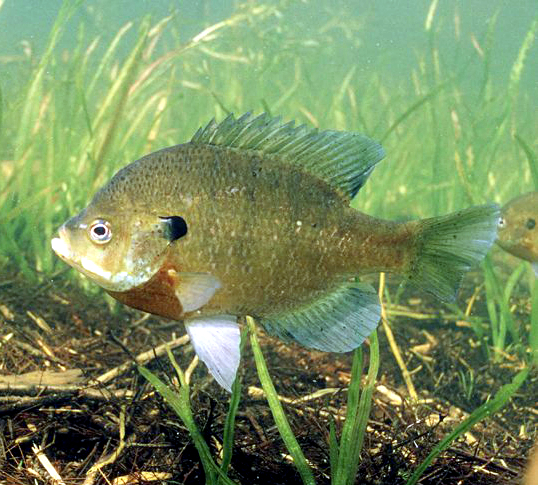
KDFWR's Fishing and Boating Guide prints the field marks as three numbered points: "Gill flap black", "Vertical bars on side", "Dark blotch at rear of soft dorsal fin." The four sunfishes most often mistaken for a bluegill, from the agency's own species pages:
- Redear sunfish ("shellcracker"). Moderately large and deep-bodied with a relatively long, pointed snout and a small mouth. The Guide's two marks: "Gill flap black with orange or red margin" and "No dark blotch at rear of soft dorsal fin." The species page adds that adults lack the bluegill's evenly spaced bars, and that adults can reach 15 inches and 4 pounds but usually run 8 to 11 inches, about a pound. It occurs sporadically statewide, is stocked in many ponds and reservoirs, and is commonly found near stumps, logs, brush and aquatic plants. KDFWR's sunfish family page notes that adult males have a red margin on the gill cover flap and females a light orange flap.
- Longear sunfish. Moderately small, with the long gill flap, the "ear", and wavy blue lines on the cheek and gill cover, short rounded pectoral fins, and bright red-orange and iridescent blue color, especially in breeding males. Adults can reach 9 inches but are usually under 6. KDFWR calls it the most common sunfish in Kentucky streams and rivers.
- Green sunfish. "A large, robust sunfish with a large mouth": the upper jaw reaches about mid-eye, and like the bluegill it carries a large black spot at the rear of the soft dorsal fin, but its soft dorsal, anal and tail fins have yellow to orange margins and its pectoral fins are short and rounded. To 12 inches and 2 pounds, usually 8 to 10 inches. Tolerant of extremes in turbidity, temperature, dissolved oxygen and flow; most abundant in small sluggish streams and ponds, usually where few other sunfish occur.
- Warmouth. "A medium-sized, robust sunfish with a large head and mouth," the upper jaw reaching to or beyond the middle of the eye, told from the rock bass and the other sunfishes by dark red-brown lines radiating from the back of the eye and a patch of small teeth on the tongue. To 12 inches and 2.5 pounds, most under 10. Throughout most of the state except the Big Sandy drainage, commonest from the lower Green River west, in oxbows, sloughs, wetlands and clear, quiet reservoir water over soft bottoms and dense vegetation. One naming trap from the forecast itself: at Elmer Davis Lake, KDFWR notes warmouth are "Locally known as 'redeye' or 'rockbass'." Rock bass are a sport fish with their own 15-fish limit (below); warmouth are not. Identify the fish before you count it.
The short version for the bank, assembled from those marks: a bluegill has the dark blotch on the back of the soft dorsal fin and a plain black gill flap; a redear has the red or orange edge on the flap and no blotch; a green sunfish has the blotch but a big mouth and yellow-edged fins; a longear has the long flap and the wavy blue lines; a warmouth has the big mouth and the dark lines running back from the eye.
Basis: official (KDFWR Bluegill, Redear Sunfish, Longear Sunfish, Green Sunfish and Warmouth species pages; Sunfish family page; 2026-27 Fishing and Boating Guide identification panel; 2026 Fishing Forecast, Elmer Davis Lake)
The rules
Bluegill: no statewide limit. The statewide limits in 301 KAR 1:201 Section 2(1) name one sunfish only, at paragraph (j): "Redear sunfish daily limit, twenty (20); no size limit." Bluegill, longear, green sunfish and warmouth are not on the list. The reason sits in a second regulation, 301 KAR 1:060, which lists the "designated sport fishes": redear sunfish and rock bass are on it, bluegill, warmouth, green sunfish and longear are not, and everything off the list is a rough fish. KDFWR's limits page prints redear at 20 daily, 40 in possession, no minimum, and says: "There are no size or creel limits for rough fish unless special regulations apply." The Guide's live-bait section names "bluegills" among the native rough fish that may be used for live bait, and says it is illegal to use sport fish for bait "except for redear sunfish less than 6 inches long." Rock bass, the sunfish-family cousin, are under Section 2(1)(b): "Rock bass daily limit, fifteen (15); no size limit," 30 in possession.
Where sunfish limits change. Section 3 of 301 KAR 1:201, current text effective 3 September 2026, sets a sunfish rule on five named waters, quoted:
| Water | The rule, as written | Regulation |
|---|---|---|
| Beech Fork Reservoir, Powell County | "Bluegill daily limit, fifteen (15)." | 301 KAR 1:201 §3(5)(b) |
| Carnico Lake, Nicholas County | "Sunfish daily limit, fifteen (15)." | §3(11)(b) |
| Greenbo Lake, Greenup County | "Bluegill and sunfish daily limit, fifteen (15) fish." | §3(33)(b) |
| Rockcastle River WMA, all ponds collectively, Pulaski County | "Bluegill and sunfish daily limit, ten (10)." | §3(61)(b) |
| Willisburg Park Pond, Washington County | "Sunfish daily limit, fifteen (15)." | §3(69)(c) |
Section 7 adds a rule for every water on KDFWR's "List of Special Lakes and Ponds", which the regulation incorporates by reference: "Sunfish or bream daily limit, fifteen (15);". The Guide prints the same 15 for the Fishing in Neighborhoods (FINs) lakes, and KDFWR's FINs page lists "Bluegill/Other Sunfish" at 15 daily with no minimum. The Guide's "New this year" box also records that the 15-fish sunfish limit at the Kentucky River WMA Boone Tract lakes in Henry County was removed; those lakes are now under statewide regulations for all species.
None of the waters this site covers has a sunfish rule of its own: none appears in Section 3 with one, and none has a sunfish line in the Guide's special-regulation entries. Kentucky Lake, Lake Barkley, Barren River Lake, Herrington Lake, Cave Run Lake, Green River Lake, Lake Cumberland, Taylorsville Lake, Nolin River Lake, Rough River Lake and Dale Hollow Lake are all statewide: no bluegill limit, 20 redear.
Four more rules a panfish angler meets. Private water: the Guide says statewide limits "apply to all Kentucky waters, public and private," and that "Some privately owned waters may have special size and daily limits as posted by signs"; Section 1 of 301 KAR 1:201 exempts a bona fide owner who is a Kentucky resident from the limits on the owner's own private lake or pond, and lets the owner extend that privilege in writing or electronically to a licensed angler, who must be able to show the permission to a game warden. Measuring, from the Guide: tip of the closed lower jaw to the tip of the tail, fish laid flat on the rule, tail lobes squeezed together. Trophy Fish award: the Master Angler program lists bluegill, redear sunfish, redbreast sunfish and rock bass each at a 10-inch minimum; the Guide asks for a clear, identifiable side-view photograph submitted through My Profile within 60 days of the catch. Cleaning on the water: the Guide says anglers shall not remove any part of the head or tail of any fish with a size or daily limit until finished fishing and off the water, which covers redear and, on the waters above, bluegill.
Basis: official (301 KAR 1:201 current text, Sections 1, 2, 3 and 7, history line ending "eff. 9-3-2026"; 301 KAR 1:060 Section 1 sport fish list; KDFWR Statewide Size and Daily Limits page; 2026-27 Fishing and Boating Guide, "New this year", pages 5 to 14 and 27; KDFWR Fishing in Neighborhoods page)
State records
The bluegill record is 4.19 pounds, caught by Phil Conyers of Madisonville in a strip mine lake in Hopkins County. The date is Status pending: KDFWR's online record page prints 07/08/1983 and the 2026-27 Guide prints 08/05/80 for the same fish. Both are KDFWR's own documents, so we print neither until one is corrected. Two of the other sunfish records carry the same kind of disagreement; the redear and warmouth records agree in both places.
| Species | Weight | Angler and water | Date |
|---|---|---|---|
| Bluegill | 4.19 lb | Phil Conyers; strip mine lake, Hopkins Co. | Status pending |
| Redear sunfish | 3.06 lb | Betty Truax; farm pond, Shelby Co. | 24 May 1982 |
| Green sunfish | 1.59 lb | David Gibson; farm pond, Hancock Co. | Status pending |
| Longear sunfish | 0.83 lb | Anthony Lynch; strip mine pond, Magoffin Co. | Status pending |
| Warmouth | 1.39 lb | Jon Hoover; private pond, Jefferson Co. | 21 July 2003 |
All five came from a pond or a strip mine lake, not a reservoir. That is our observation about five record entries, not an agency finding or a forecast. The Guide's record rules: rod and reel or pole and line only, a scale certified for legal trade, three witnesses who sign the application, and the intact fish identified in person by a KDFWR fishery biologist or the manager of Wolf Creek National Fish Hatchery.
Basis: official (KDFWR State Record Fishes and Awards page; 2026-27 Fishing and Boating Guide, pages 28-29)
Where they are: KDFWR's 2026 forecast
KDFWR's 2026 Fishing Forecast says it is based on "2025 fish population surveys, creel surveys, fish stockings, and historical knowledge of the fisheries." Its cheat sheet marks the waters rated 4 stars or better for each species. Bluegill: Barren River Lake, Boltz Lake, Briggs Lake, Clear Creek Lake, Corinth Lake, Elmer Davis Lake, Herrington Lake, Kentucky Lake, Lake Barkley, Lake Reba, McNeely Lake and Pennyrile Lake. Redear sunfish: Beaver Lake, Briggs Lake, Carr Creek Lake, Corinth Lake, Elmer Davis Lake, Fagan Branch Lake, Kentucky Lake, Lake Barkley, Lake Reba, Marion County Lake, McNeely Lake, Pennyrile Lake, Spurlington Lake and West Fork Drakes Reservoir. The only 5-star bluegill water is Elmer Davis Lake in Owen County ("Excellent numbers of fish between 6-8 inches"); the 5-star redear waters are Briggs, Elmer Davis, Kentucky Lake and Barkley. Its "New Up-and-Comers" list leads with "Bluegill at Kentucky Lake."
For the waters this site covers:
| Water | Rating (of 5) | The forecast's line, in short |
|---|---|---|
| Kentucky Lake | Bluegill 4; redear 5 | High numbers of 6- to 8-inch bluegill; best in May but caught year round; crickets and worms under a cork during the spawn; later, stake beds or deep (6- to 10-foot) brush piles, mayfly hatches along the shoreline, deeper rocky points with pieces of nightcrawler. Redear best late April and early May on gravel, in flooded yellow mustard flowers in the backs of embayments and in pondweed clumps, fished on or near the bottom |
| Lake Barkley | Bluegill 4; redear 5 | Bluegill to 9 inches, best in May on sand or gravel spawning beds, small plastic jigs or worms under a bobber, deeper as the water warms. Redear: "Good numbers of 9- to 11-inch fish with trophies up to 12 inches," late April and May, gravel and woody cover; "If you're looking for trophy Redear, Lake Barkley is your destination" |
| Barren River Lake | Bluegill (sunfish) 4 | "Good numbers of 6- to 8-inch fish"; stump beds and backs of coves in spring and fall, deeper in summer near cove mouths and bluff walls by laydowns or standing timber; oxygen too low below 15 feet mid-June through September |
| Herrington Lake | Bluegill 4 | "Stable numbers of fish up to 8 inches; fish ≥8 inches possible" |
| Cave Run Lake | Sunfish 3.5 | Widespread and common but most 7 inches or less; bluegill in the backs of coves and quickly warming shallows in spring, on department-placed or natural brush later; a growing redear population, fished deeper than bluegill and around vegetation |
| Green River Lake | Bluegill 3 | Large population with occasional 7- to 8-inch fish; stump beds and coves in spring, deep brush, standing timber and structure in summer; oxygen too low below 17 to 20 feet mid-June to mid-October |
| Lake Cumberland | Bluegill 3 | Good numbers with fish over 8 inches available; coves and cuts with crickets, nightcrawlers or redworms |
| Taylorsville Lake | Bluegill 3 | "Good numbers of 6- to 7-inch fish" |
| Nolin River Lake, Rough River Lake, Dale Hollow Lake | none | The 2026 forecast carries no bluegill or redear line for these lakes |
Two redear notes from the same document. Redear will be stocked for the first time in Cranks Creek Lake in Harlan County in 2026, but "the fish will be small, so give it a couple years." And Carr Creek Lake's redear, stocked from 2018 to 2025, "are showing an established population," with fish to 11 inches.
Basis: official (2026 Fishing Forecast and Tips; star ratings read from the forecast's page images and checked against the cheat sheet)
The neighborhood lakes: what KDFWR's sampling found
The Fishing in Neighborhoods program began in 2006 and now covers 45 lakes in 28 counties. KDFWR's urban fisheries report for April 2025 to March 2026 is the fullest sunfish data the agency published in the period we read, because it samples bluegill and redear directly: electrofishing at 23 FINs lakes in May 2025, with the sunfish netted and measured.
Stocking. 13,500 bluegill of 5 to 10 inches went into FINs lakes in June 2025, in lakes with "poor sunfish populations, heavy fishing pressure, or free fishing weekend events." The report explains the switch from hybrid sunfish to bluegill in 2022: the hybrid stockings "worked well for improving short-term angling success" but "did not improve sunfish angling opportunities over an extended period as most fish were quickly harvested." Twenty thousand bluegill a year are in the production plan; the bluegill in production for 2025 and 2026 were lost when Elkhorn Creek flooded the Pfeiffer hatchery in April 2025.
How the agency grades a sunfish fishery. KDFWR uses proportional stock density: the share of fish over a minimum "stock" length that are also of "quality" length. For bluegill those lengths are 3 and 6 inches; for redear, 4 and 7. The report reads sunfish and bass scores together: a high sunfish score with a low bass score means, in its chart's words, "Too many big sunfish with low recruitment, bass population stunted"; the reverse means "Few adult sunfish, too many big bass with low recruitment."
What the 2025 samples showed, from the report's own lake notes:
- Anderson County Community Park Lake: the catch rate of 6.0- to 7.9-inch bluegill was "the highest observed since sampling began," with bluegill over 6 inches up substantially since a 2013 gizzard shad removal.
- Lake Pollywog (Grant County): bluegill catch near the long-term mean, but 6.0- to 7.9-inch fish at nearly three times the long-term rate; "The bass and sunfish populations have fully rebounded" from a fall 2018 fish kill.
- Fisherman's Park Lake #4 (Jefferson County): bluegill catch nearly double the long-term mean and redear nearly three times it.
- Whitehall Park Lake (Madison County): redear catch nearly double the long-term mean; "Chinese mystery snails are present in the lake and likely contribute to the abundant redear sunfish."
- Jacobson Park Lake (Fayette County): "a crowded bluegill population with stunted growth," most fish 3.0 to 5.9 inches, a pattern the report calls "typical of a small impoundment with gizzard shad present."
The report draws one general lesson worth knowing for any small lake: "In observing other lakes where shad have been introduced, the bluegill fishery tends to be more negatively affected compared to the redear sunfish population." The forecast's FINs cheat sheet marks which neighborhood lakes forecast good or excellent bluegill and redear fishing; Lake Pollywog and Leary Lake in Grant County are listed with "Exceptional number of Bluegill" in the 6- to 8-inch and 6- to 9-inch ranges.
Basis: official (KDFWR Annual Performance Report F-40 Segment 48, Reservoir and Urban Fisheries Research Branch, 1 April 2025 - 31 March 2026; KDFWR Fishing in Neighborhoods page; 2026 Fishing Forecast FINs cheat sheet)
The fish through the year
KDFWR publishes no spawning temperature for bluegill that we found, and we do not invent one. For redear, two of the agency's own Kentucky Afield columns give figures, and they frame it differently: the April 2020 column puts ideal water for redear at roughly 65 to 68 degrees, and the May 2021 column says redear typically begin spawning when the water climbs into the 70s. Neither is presented here as a rule. What the agency publishes on timing is enough to build a calendar:
| Season | What KDFWR says |
|---|---|
| Late winter to early spring | Forecast: "In March, fish activity begins in the smaller bodies of water such as farm ponds and smaller public lakes as water temperatures reach the 50's," because small, shallow water warms faster than reservoirs. Redear come shallow early in some small lakes: Marion County Lake late March to early or mid April, Shanty Hollow mid-March through mid-April, Martins Fork mid-March through April. KDFWR's farm pond column points bluegill anglers at farm ponds and small lakes in early spring. |
| Late April into June | The spawn. Redear first: the 2020 column puts redear spawning usually in the last week of April into the first week of May; the forecast says late April and early May at Kentucky Lake, late April and May at Barkley, late April to the end of May at Carr Creek. Bluegill: May is the forecast's month at Kentucky Lake, Barkley and Yatesville; beds in May and June at Fishtrap. The 2021 column says redear colonize like bluegill but nest in deeper water; the Kentucky Lake line adds they spawn "in smaller colonies." KDFWR's bluegill column says to look for freshly swept depressions on the bottom of Kentucky Lake coves in May. |
| Summer | Deeper. Barkley: "Fish move deeper as the water warms in summer." Kentucky Lake: stake beds and 6- to 10-foot brush piles, mayfly hatches along the shoreline, deeper rocky points. Barren and Green River Lake: deep brush and timber, but no fish below 15 feet (Barren) or 17 to 20 feet (Green River Lake) through the summer oxygen low. Shanty Hollow: 8 to 10 feet on brush and rock. Redear at Briggs, Marion County and Shanty Hollow move out to thermocline depth. |
| Fall and winter | Barren River Lake: back to stump beds and the backs of coves. Fishpond Lake: stump beds and brush piles in late spring and fall. The forecast is otherwise thin on fall and winter sunfish; Washburn Lake's line, live bait under a float near overhead cover "summer through winter," is the only winter instruction in it. |
Basis: official (2026 Fishing Forecast; KDFWR columns "Redear sunfish spawn upon us" 30 April 2020, "May is a Great Time for Redear Sunfish" 7 May 2021, "bluegill offer great late spring fishing" undated, "Farm Ponds and Small Lakes" undated)
What KDFWR says catches them
The agency's own baits and rigs, from the forecast lines and the Kentucky Afield columns:
- A worm under a bobber. The bluegill column's standard: a wiggling redworm on a size 6 Aberdeen hook under a bobber. Crickets and worms under a cork during the spawn at Kentucky Lake; crickets, wax worms or red worms under a cork by shallow brush piles and tree roots at Yatesville; red worms, wax worms and nightcrawler bites under a float on deeper brush edges and offshore humps through summer at Carpenter Lake.
- A tipped feather jig. A 1/32-ounce yellow feather jig fished near cover under a bobber (farm pond column); feather jigs tipped with a wax worm or cricket under a bobber (bluegill column); small plastic jigs under a bobber on Barkley's beds.
- On the bottom for redear. Kentucky Lake: "These fish primarily feed on the bottom, searching for bugs, snails, and small mussels; hence you need to fish near or on the bottom." The 2020 column's rig: a size 6 or 8 Aberdeen-style hook with a quarter-inch piece of red worm or nightcrawler and a BB-sized split shot about a foot above it; or a 1/32-ounce yellow or black feather jig, the popeye jig, tipped with pieces of nightcrawler, wax worm or mealworm and hung just off bottom under a bobber. Both columns add "bluegill bugs", soft plastic grubs tipped with wax worms and fished on the bottom under slip bobbers, and the 2021 column describes a drop-shot, the hook tied a few inches above a 3/16-ounce weight and crawled along the bottom. Pennyrile Lake's line: "a small piece of nightcrawler near the bottom."
- Murky versus clear water. From the farm pond column: in murky water, small in-line spinners or 1-inch white or yellow curly-tail grubs near any cover, covering water until a fish hits; in clear water, redworms near cover, on the bottom or under a bobber. Bottom fishing "works best on bright days."
- Flies. The bluegill column points fly anglers at Herrington Lake's rocky bluffs with sponge spiders or small cork poppers.
- Light line. Both redear columns call for ultralight spinning tackle with 4- or 6-pound monofilament; the 2020 column specifies rods under 6 feet in open water and 6-foot light-power rods with 6- or 8-pound line in weedy lakes.
- Stay put when you find them. Barkley's line, said of both species: they spawn in groups, "so if you catch one fish keep fishing the same area." And for redear, from the 2021 column: find bluegill bedding against the bank, then fish a little deeper and farther out.
For rigging, the slip-float and poppers-and-topwater-flies pages on this site are still being written: Slip float is the natural bobber page and Poppers and topwater flies the fly one. The knot page is Palomar; improved clinch is also still being written. And line systems covers building a main line and leader. For the other panfish, see Crappie.
Basis: official (2026 Fishing Forecast; KDFWR columns cited above)
Taking a family
This is the fish the agency itself points families at. In its bluegill column, Central Fisheries District biologist David Baker says late spring is when "A lot of your bigger male bluegill are moving up into the shallows," adding: "It is an excellent time to take kids out and get them excited and hooked on fishing." KDFWR's Kentucky Afield calendar copy for the FINs lakes says "you shouldn't have to drive 2-3 hours just to find a spot to fish with your family," and the forecast calls Pennyrile Lake's bluegill water "Perfect for bank anglers and kayakers." The urban report records large bluegill stocked at one FINs pond each June from 2022 to 2025 partly to provide angling opportunities for a kids' fishing event.
The rules that matter on a family trip, from the Guide: residents and nonresidents "ages 15 and younger" need no fishing license, and on Free Fishing Days, the first Saturday and Sunday in June (6-7 June in 2026), nobody does, though "All other fishing regulations still apply." Persons under 12 must wear a life jacket while in the open part of a boat that is under way. On the FINs lakes, the sunfish limit is 15. And on eating them: Kentucky's statewide fish consumption advisory puts bluegill in the "panfish" group, with general-population guidance of no more than one meal a week and, for the sensitive population (women of childbearing age, children 6 years of age or younger, pregnant and nursing women, and women who plan to become pregnant), no more than one meal a month. Some individual waters carry stricter advisories; check the Guide's table. KDFWR's farm pond column says that because bluegill are prolific breeders, keeping and eating them benefits a pond or small lake.
Basis: official (KDFWR bluegill column; KDFWR urban fisheries report 2025-26, Figure 3 and Easy Walker Park Pond; 2026 Fishing Forecast, Pennyrile Lake; 2026-27 Fishing and Boating Guide, pages 3, 6, 18-19 and 31; KDFWR Farm Ponds and Small Lakes column)
What we don't know yet
- The bluegill record's date. The Guide says 1980, the web page 1983, for the same fish. The green sunfish and longear records disagree the same way. Status pending until KDFWR reconciles them.
- A bluegill spawning temperature. No KDFWR page we read gives one. The redear figures above are from two columns that frame it differently.
- Reservoir survey and creel data for bluegill. KDFWR's 2025 Lake and Tailwater Fishery Survey report was not read for this page, so whatever it says about bluegill or redear at Kentucky Lake, Barkley, Barren, Herrington and the other big lakes is not here. That is a gap in what we read, not a finding that the agency has no data.
- The List of Special Lakes and Ponds. Section 7's 15-sunfish rule applies to the waters on that list, which the regulation incorporates by reference. We did not read the list itself; the Guide's FINs table and the FINs page carry the same 15-fish limit.
- Diet and spawning habits from the species pages. KDFWR's five sunfish pages carry identification, size, range and habitat only.
- Two columns' dates. The bluegill column and the farm pond column we quote show no date; the bluegill column cites the 2019 Fishing Forecast.
- Spots. Nothing here names a bed, a brush pile or a cove, and nothing should be read as one. KDFWR publishes GPS coordinates for its placed habitat on its own site.
Regulations and official information
Sunfish rules are in the current KDFWR Fishing and Boating Guide and in the regulations themselves, 301 KAR 1:201 and 301 KAR 1:060. Statewide limits: KDFWR Statewide Size and Daily Limits. Species pages: Bluegill, Redear Sunfish, Longear Sunfish, Green Sunfish, Warmouth. Neighborhood lakes: Fishing in Neighborhoods. Forecast and surveys: 2026 Fishing Forecast and the annual fish sampling reports.
Basis: official
Sources and how confident we are
| Section | Basis |
|---|---|
| Overview and identification | Official (KDFWR species pages; Guide ID panel; forecast) |
| The rules | Official (301 KAR 1:201 and 1:060 current texts; limits page; Guide; FINs page). Special Lakes and Ponds list not read |
| State records | Official (record page; Guide). Three record dates: Status pending |
| Where they are | Official (2026 Fishing Forecast; ratings read from page images) |
| The neighborhood lakes | Official (KDFWR urban fisheries report 2025-26) |
| The fish through the year | Official (forecast; KDFWR columns); no agency bluegill spawning temperature |
| What KDFWR says catches them | Official (forecast; KDFWR columns) |
| Taking a family | Official (KDFWR column; urban report; Guide) |
Sources
- 301 KAR 1:201, Taking of fish by traditional fishing methods - Kentucky Legislative Research Commission - Section 1 private-pond owner exemption; Section 2(1)(b) rock bass and 2(1)(j) redear; the five Section 3 sunfish provisions; Section 7 "Sunfish or bream daily limit, fifteen (15)" for the List of Special Lakes and Ponds; history line ending "eff. 9-3-2026".
- 301 KAR 1:060 - Kentucky Legislative Research Commission - the designated sport fish list (redear sunfish and rock bass on it, bluegill, warmouth, green and longear sunfish not).
- Statewide Size and Daily Limits - KDFWR - redear and rock bass rows; the rough-fish statement.
- Kentucky Fishing and Boating Guide, March 2026 - February 2027, updated September 2026 (PDF) - KDFWR - license exemptions and Free Fishing Days; statewide table; measuring rule; FINs limits; special-regulation water entries; "New this year" box; live-bait rules; cleaning on the water; consumption advisory; identification panel; boating age rules; Trophy Fish minimums; state record rules and table.
- State Record Fishes and Awards - KDFWR - sunfish record rows and dates.
- Bluegill, Redear Sunfish, Longear Sunfish, Green Sunfish, Warmouth and the Sunfish family page - KDFWR - identification, size, distribution and habitat.
- 2026 Fishing Forecast and Tips (PDF) - KDFWR - basis statement, Up-and-Comers, new fisheries, late-winter paragraph, both cheat sheets, every lake's bluegill, sunfish and redear line and rating.
- Fishing in Neighborhoods - KDFWR - program start, 45 lakes, FINs limits, youth license exemption.
- Annual Performance Report F-40 Segment 48, Reservoir and Urban Fisheries Research Branch, April 2025 - March 2026 (PDF) - KDFWR - FINs lake and county count, bluegill stocking, the hybrid-to-bluegill change, PSD definitions, the 2025 lake notes, the Kentucky Afield calendar text.
- Redear sunfish spawn upon us - KDFWR (Lee McClellan, 30 April 2020), May is a Great Time for Redear Sunfish - KDFWR (Lee McClellan, 7 May 2021), bluegill offer great late spring fishing - KDFWR (Lee McClellan, undated) and Farm Ponds and Small Lakes - KDFWR (Lee McClellan, undated) - the agency's own timing, temperature statements, baits, rigs and family advice quoted above.