Overview and identification
KDFWR's species page describes the white bass as "a silvery, medium-sized fish with a deep body that is thin from side to side and strongly arched behind the head," blue-gray to dark green on the back, silver-white on the sides, with dark horizontal stripes and an eye with a yellow or gold tint. Adults grow to 18 inches and 5.5 pounds, but most are 10 to 15 inches and 1 to 2 pounds. The agency puts them in the main channels of rivers and most major reservoirs across the state, and names spring spawning runs as common in some rivers, the Salt, the Dix and the Big South Fork of the Cumberland among them, where large numbers gather in flowing water over rocky bottoms.
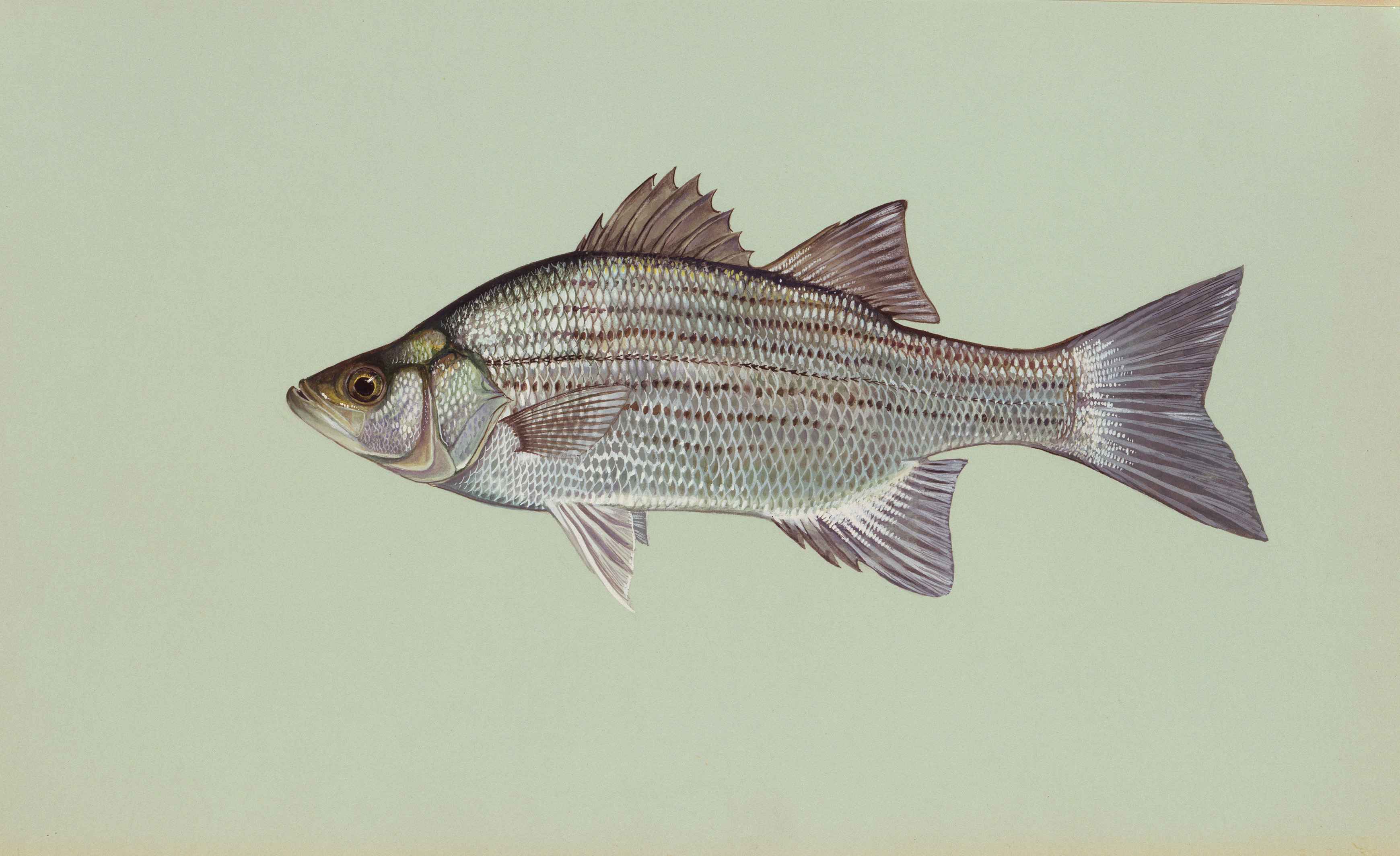
Kentucky has three relatives that get mistaken for a white bass, and the difference is not academic: one of them sits under a different limit. KDFWR's species pages and its Kentucky Fishes booklet give the tests in these words.
- Hybrid striped bass (striped bass x white bass): told from a white bass "by usually having broken and poorly aligned stripes along the side." Juveniles 6 inches or less carry parr marks, elliptical blotches on the side, "that are absent in White Bass." Told from a striped bass by "a deeper body that is more arched behind the head (similar to White Bass)." Adults seldom pass 15 pounds.
- Striped bass: "more slender than both White Bass and Hybrid Striped Bass," with horizontal lines "more intense than on White Bass" that usually run unbroken along the body. The tooth test is on this page: "The base of the tongue usually has two patches of teeth (vs. a single patch in White Bass)." Adults of 5 to 20 pounds are common and they can pass 50.
- Yellow bass: "a brassy yellow color (vs. silver-white) on the sides," "dark stripes that are broken and offset on the lower side in front of the anal fin," and "two dorsal fins connected by a membrane (vs. separate)." The smallest of the three, 12 to 15 inches at most and under 2 pounds.
KDFWR does not print a tongue-patch description for the hybrid on either page we read, so the agency's hybrid test is the stripes and the body shape, not the teeth. Its creel reports add a caution of their own: "Positive ID on this genus can be difficult for anglers, so it is possible that some released fish were mis-identified."
Where each lives, from the same pages: hybrids are stocked in Herrington, Barren River, Rough River, Guist Creek, Taylorsville, Linville, Paintsville and Fishtrap lakes and in the Ohio, Kentucky, Green and Barren rivers, and escapees have produced fishable populations in several other rivers. Striped bass are stocked only in the Ohio River and Lake Cumberland, and Ohio River fish often run up the major tributaries. Yellow bass live mainly in the main channels of the lower Cumberland and lower Tennessee, Kentucky and Barkley lakes included, and in the Mississippi and lower Ohio, with populations also in Lake Beshear, Guist Creek Lake and Barren River Lake.
The state record is a tie. KDFWR's record table lists two white bass at 5.00 pounds: Lorne Eli of Dawson Springs, Kentucky Lake, 11 July 1943, and B. B. Hardin of Mt. Eden, Herrington Lake, 3 June 1957. For the relatives, the same table lists the hybrid striped bass at 20.50 pounds (Mark Wilson of Louisville, Barren River, 27 April 1991), the striped bass at 58.25 pounds (Roger Foster of Somerset, Lake Cumberland, 11 December 1985) and the yellow bass at 1.40 pounds (William Hinton of Central City, Cumberland River, Lake Barkley tailwaters, 19 March 2009).
Basis: official (KDFWR White Bass, Hybrid Striped Bass, Striped Bass and Yellow Bass pages; Kentucky Fishes booklet; KDFWR state record table; KDFWR Lake and Tailwater Fishery Surveys report 2025)
The rules
Statewide, under 301 KAR 1:201 Section 2(1)(f): "White bass and hybrid striped bass daily limit, singly or in combination, fifteen (15); size limit, no more than five (5) fish in a daily limit or ten (10) fish in a possession limit shall be fifteen (15) inches or longer." Section 2(2) sets the possession limit at twice the daily limit. So the white bass and the hybrid share one count: fifteen fish of either or both, of which no more than five may be 15 inches or longer. There is no minimum length; the 15 inches is a cap on how many big fish you keep.
The striped bass is not in that count. Section 2(1)(g): "Striped bass daily limit, five (5); size limit, fifteen (15) inches." That is a true minimum, which is why the identification above matters: a 14-inch hybrid is a legal fish in the 15, and a 14-inch striped bass is not.
Two waters change the rule, quoted from the regulation's current text (history line ending "eff. 9-3-2026", read 24 October 2026):
| Water | Rule | Regulation |
|---|---|---|
| Ohio River (at Louisville) | "White bass, striped bass, and any hybrid thereof, daily limit, thirty (30); no more than four (4) in the daily limit shall be fifteen (15) inches or greater." | §3(56)(a) |
| Lake Cumberland | "Striped bass size limit, twenty-two (22) inches; daily limit, two (2)." | §3(44)(a)3 |
On the Ohio River, all three fish go into one count of thirty, with four over 15 inches. Lake Cumberland's line covers striped bass only, so white bass and hybrids there are under the statewide 15; the regulation extends the lake up the Cumberland River to Cumberland Falls, the Big South Fork to Devil's Jump, the Rockcastle to The Narrows and the Laurel to Laurel River Dam.
The Kentucky Lake (§3(40)) and Lake Barkley (§3(42)) entries carry bass and crappie lines and nothing on white bass, hybrids or striped bass, and KDFWR's own Kentucky Lake page reads "Statewide Regulations Apply" for both white bass and striped bass. The Cumberland River below Wolf Creek Dam (§3(19)) has trout, permit and chumming provisions and no line for these fish; its chumming ban runs from the dam to the Tennessee line, Hatchery Creek included.
Yellow bass: the statewide list in Section 2, as we read it, has no yellow bass line, and KDFWR's forecast says of them at Barkley: "There is no size or creel limit and harvest is encouraged."
Basis: official (301 KAR 1:201 current text, eff. 3 September 2026, read 24 October 2026; KDFWR Kentucky Lake waterbody page; 2026 Fishing Forecast)
Where they are: KDFWR's 2026 forecast
KDFWR's 2026 Fishing Forecast says it is "based on 2025 fish population surveys, planned fish stockings, and projections for 2026." Its statewide spring paragraph is the short version of this whole page: "Excellent White Bass fishing can be found during the early spring in the upper sections of reservoirs such as Barkley, Cave Run, Nolin River, Taylorsville, Herrington, and Fishtrap lakes. The Kentucky, Green, and Ohio rivers offer excellent spring White Bass fishing."
The forecast's star ratings and its 4-star cheat sheet are printed as graphics that did not come through in the text we could read, so this page does not print a star rating for white bass on any water. The lines themselves, for the waters this site covers:
| Water | The forecast's white bass line, in short |
|---|---|
| Nolin River Lake | "Large number of 11- to 14-inch White Bass." Bacon Creek upstream during the April run with lead-head jigs and plastics, small crankbaits or live bait; longer main-lake points or jumps in summer; at night under lights near the main channel with jigging spoons or live minnows |
| Nolin tailwater | "High number of White Bass in spring from mid-March to mid-April, but catches can be sporadic." Hybrids present year-round, also sporadic |
| Taylorsville Lake | "Good numbers due to good spawns in 2024 and 2025." Most under 12 inches, some larger |
| Herrington Lake | "Good numbers of fish in the 12- to 16-inch range; larger fish possible." |
| Cave Run Lake | "Fantastic population with the potential for widespread jumps in the summer months." |
| Kentucky Lake | "White Bass fishing hasn't been this good since the 1980's." Main lake in summer, schooling along secondary creek channels near the main river channel; main channel points and bends, and near the canal |
| Kentucky Dam tailwater | "Good numbers," along with yellow bass; small curly-tail jigs or in-line spinners from bank or boat |
| Lake Barkley and its tailwater | "Like Striped Bass, better fishing generally occurs in the tailwaters." Schools of shad breaking the surface in summer and fall; trolling the ledges with lighter-colored crankbaits |
| Barren River Lake | "Moderate numbers." Best during the run, late March to mid-April, with in-line spinners and small jigs; the river above the lake still has runs of white, yellow and hybrid bass |
| Green River Lake | "Fair number >12 inches." Headwaters mid-March to early April; troll flats and fish under floating lights in summer |
| Lake Cumberland | "Low density population concentrated in the upper half of the lake." Headwaters in early spring |
| Cumberland River tailwater | "Low density population." Lower tailwater near creek mouths in winter and early spring |
| Ohio River | Tailwaters in winter and spring, creek mouths in fall |
Beyond this site's waters, the forecast names Fishtrap Lake (moderate numbers of 12 to 14 inch fish, up the Levisa Fork above the Lick Creek ramp in spring), Dewey Lake (John's Creek, March and April, "look for Redbud trees in bloom"), the Kentucky River (many 10 to 12 inch fish below dams), the lower Green River (tributary mouths in spring, below the dams from mid-spring through fall, the Pond River mouth late March through April), Laurel River Lake (low density, up the Laurel River arm) and Bullock Pen Lake (a very small population with fish of 14 to 17 inches possible).
Its Kentucky and Barkley tips put the summer fishing in one line: "Fish the jumps from July – September with slab spoons or white roostertails."
Basis: official (KDFWR 2026 Fishing Forecast and Tips, read as extracted text; star ratings Status pending)
The spring run
White bass leave the lakes and run up the headwater rivers to spawn, and KDFWR has written about it most springs in its Spring Fishing Frenzy columns. The columns and the forecast together give the map:
| Run | Where KDFWR sends you | When, in KDFWR's words |
|---|---|---|
| Nolin River above Nolin River Lake | From the Cane Run area ("Three Fingers") and Bacon Creek up to Broad Ford at the KY 1214 bridge; later in the season, Broad Run | "the April spawning run" (forecast); "arguably the best in Kentucky" (2021 column) |
| Salt River above Taylorsville Lake | Upstream from the Van Buren ramp by boat; River Road inside Taylorsville Lake WMA, the KY 248 bridge and Palmer Road by bank | "one of the strongest spring runs in Kentucky" (2021) |
| Dix River above Herrington Lake | Upstream from Bryant's Camp ramp to the rocky pool and riffle; Rankin Bottoms public access at the end of Rankin Road off KY 52 | Herrington "is likely best for big white bass" (biologist David Baker, 2022) |
| Barren River above Barren River Lake | The river above the lake, with small crankbaits and in-line spinners | "late March to mid-April" (forecast) |
| Green River Lake headwaters | Headwater areas | "mid-March to early-April" (forecast) |
| Levisa Fork above Fishtrap Lake | Above the Lick Creek ramp to the first few riffles | Spring (forecast) |
| Tailwaters and the big rivers | Kentucky Dam and Barkley Dam tailwaters; below the locks and dams on the Kentucky and lower Green rivers; the Pond River mouth | Lower Green "March through May" (2021 column) |
Taylorsville and Herrington differ the way the district biologist put it in 2022: "Taylorsville is the best for numbers in our district," and Herrington for big fish; in 2020 he said Herrington's run had many fish up to 14 inches and Taylorsville produced more, smaller ones. The 2021 column passed on a suggestion from Chase Wininger, executive producer of KDFWR's Kentucky Afield television show, to follow the runs in sequence: Nolin first, the Salt about a week later, then the Dix.
When it starts. KDFWR publishes no single spawning temperature for white bass that we found, and we do not supply one. What its columns say: in 2022 the district biologist said the runs "usually start about the second or third week of March," and the column put the start at water temperatures reaching the mid-50s and high water dropping, while warning that "the runs can start at any time." In 2020, with air temperatures near 80 and water in the mid to high 50s, the column reported the Taylorsville headwaters running sporadically. The 2021 column called April the usual peak and quoted an air-temperature rule of thumb from Chace Wallen, KDFWR's information center supervisor: "When night time lows stay above 50 degrees consistently for three or four days, that is when we've done best," and "There is no science to it."
How it unfolds, from the 2020 column: males arrive first, usually of similar size, often caught on consecutive casts; females arrive by early April, and the biologist called that stretch "the best fishing of the spring runs." A 2023 column adds that a hybrid can turn up in the headwaters of Taylorsville, Herrington and Fishtrap while you are fishing for white bass, which is the moment the stripe test above earns its place.
The run is bank fishing as much as boat fishing, and the access in the columns is public: Broad Ford and Bacon Creek at Nolin, Rankin Bottoms on the Dix, River Road and Palmer Road on the Salt, the piers and walkways below Kentucky and Barkley dams. Two cautions from the same columns. The Nolin above Bacon Creek has rocks, riffles and shallow shoals, so boaters go carefully. And River Road on Taylorsville Lake WMA closes to vehicles for the spring turkey season (the dates change each year; the 2023 column gave 15 April to 7 May), with walk-in access from the gravel lots at Palmer and River roads while it is closed. Check the current WMA dates before you drive in.
Basis: official (KDFWR White Bass page; 2026 Fishing Forecast; KDFWR columns 25 March 2020, 1 April 2021, 16 March 2022, 14 April 2023)
Summer schooling and the jumps
After the spawn the fish go back to the lakes and to open water, and the agency's language changes from rivers to schools. KDFWR's summer tips: "In reservoirs, white bass can be found in schools at the surface early and late in the day busting baitfish," with heavy cloud extending that surface bite; at other times the schools are deeper, on main-lake creek channels, points and ledges with structure, and a depth-finder is how you find the bait and the fish. They are also in the tailwaters and on current breaks on the Ohio and other rivers.
The forecast's lake lines say the same thing water by water. At Kentucky Lake, schooling along secondary creek channels near the main river channel, trolling to locate them, "Also look for jumps; when groups of White Bass chase shad minnows near the water's surface." At Barkley, schools of shad breaking the surface in summer and fall. At Cave Run, the potential for widespread jumps. At Nolin, longer main-lake points or jumps, and at night under lights near the main channel. At Green River Lake, trolling flats and floating lights. The Kentucky and Barkley tips put the jumps in July through September.
The same behavior shows in spring. The 2021 column describes white bass on the runs churning the surface in "jumps," gorging on baitfish, where a lure cast into the froth is "immediately crushed."
Into fall and winter the record thins. The forecast sends you to Dewey's larger coves for better-quality fish in September and October, to Ohio River creek mouths in fall, and to the Cumberland tailwater's creek mouths and the Ohio River tailwaters in winter.
Basis: official (KDFWR Summer Fishing Tips; 2026 Fishing Forecast; KDFWR column 1 April 2021)
What KDFWR's nets and creel clerks found
KDFWR samples white bass and hybrids with experimental gill nets in the fall on the lakes where it manages them, and scores each population on a rating scale that runs from Poor upward. These are the agency's results from its Lake and Tailwater Fishery Surveys report for April 2025 to March 2026.
Taylorsville Lake is the fullest record. October 2025 gill nets took 178 white bass in 16 net-nights, 11.1 per net-night. The report says white bass "average over 10.0 in by age 2," body condition was higher than average (relative weight 98), and the population rated Fair, "an average rating for White Bass at Taylorsville Lake." The 2025 creel counted 10,989 white bass caught and 4,646 kept, 3,179 pounds in all, against 5,721 caught and 4,209 kept in 2020; harvested fish averaged 11.7 inches, the same as in 2020. Trips for the white bass and hybrid group fell from 1,723 in 2020 to 1,249, but the harvest rate rose from 0.44 to 0.79 fish an hour and success from 38 to 44 percent. The same nets took 57 hybrids (3.6 per net-night), which reach 15 inches between age 1 and age 2 and rated Fair; 61,148 hybrid fingerlings went in in June 2025, and the creel counted 1,428 hybrids caught and 880 kept, averaging 17.8 inches.
Kentucky Dam and Barkley Dam tailwaters had roving bank creel surveys from 1 February to 26 August 2025. Below Kentucky Dam, anglers fishing for the white bass family made 11 percent of trips, 1,686 of them, and caught 1.24 fish an hour, about the long-term average since 2006; 65 percent of what they caught was white bass, 28 percent striped bass, 4 percent hybrids and 2 percent yellow bass, and 72 percent of those asked were satisfied. Below Barkley Dam, the same group made 9 percent of trips, 978 of them, at 0.99 fish an hour, about the long-term average since 2000; white bass were 44 percent of the catch, yellow bass 28 percent and striped bass 24 percent, and 82 percent were satisfied. The sample of anglers asked about satisfaction was small in both (36 and 34), and the misidentification caution quoted above comes from these two surveys.
Green River Lake: November 2025 gill nets found white bass recruitment "hit and miss," with age-0 fish dominating the sample; the population rated Fair, with good body condition (relative weights 93 to 103).
Nolin River Lake: white bass were "not directly assessed in 2025"; experimental gill nets are planned for fall 2026.
The hybrid lakes nearby. Rough River's October 2025 nets took 314 hybrids in 12 net-nights; the report calls the population "relatively stable and thriving" but notes its assessment score declined and the oldest fish was age 5. Herrington was stocked with 96,320 hybrid fingerlings in June 2025 and Fishtrap with 23,088.
Kentucky Lake's fall trap nets counted white bass and yellow bass alongside crappie, and the report says yellow bass catch rates have been higher in 2023 to 2025 than historically, while noting it is not known whether trap nets measure yellow bass well. It gives no white bass figures from those nets in what we read.
Basis: official (KDFWR Lake and Tailwater Fishery Surveys, annual performance report April 2025 to March 2026, Western, Northwestern, Southwestern and Central districts)
What KDFWR says catches them
The agency's own recipes, from the forecast and its columns:
- A curly-tail grub on a light lead head. The 2021 column's "most reliable" bait: a white 3-inch curly-tail grub on a 1/8-ounce lead head, worked near the surface first, then allowed to sink a few feet. The 2020 column used a 2-inch white grub on 1/8 ounce, heavier from the bank for distance; the 2023 column, 2.5 to 3 inch swimbaits or grubs in pearl, pearl and chartreuse, or pink on 1/16 to 1/4 ounce ball heads, kept "near the bottom, not on the bottom." The jig page covers lead heads.
- A feather jig under a bobber. A 1/32 or 1/16 ounce feather jig hung under a small pear-shaped bobber, cast into the current and drifted; the 2020 column hung it 18 to 24 inches deep, the 2022 column says to adjust the depth until the bobber disappears. Colors across the columns: white, black and white, chartreuse and white, pink, pink and chartreuse, white and red, yellow.
- In-line spinners. White, chartreuse, gray or silver, 1/16 to 1/4 ounce, in the deeper flowing holes on the runs; the forecast's choice for Kentucky Lake and the Kentucky Dam tailwater, and "white roostertails" for the summer jumps.
- Spoons. Silver casting spoons on the tailwaters, where distance counts, worked hard because they sink fast; slab and jigging spoons for the summer jumps and deeper schools.
- Small topwaters. Shad-colored propeller baits, chuggers and poppers when fish are breaking the surface; the 2020 column adds that subsurface baits are more consistent even at the peak of the run.
- Live bait. A live crappie minnow on a size 4 baitholder hook, which the 2023 column ranked its top option, or under the same bobber as the feather jig, which the 2022 column suggested for beginners and young anglers.
- Trolling crankbaits. To find summer schools at Kentucky Lake, and lighter-colored crankbaits on the Barkley ledges, which the forecast calls "a lot of fun, especially for children and inexperienced anglers."
- Lights at night. Floating lights at Green River Lake and lights near the main channel at Nolin in summer, with jigging spoons or live minnows.
Chad Miles, host of Kentucky Afield, put the run in one line in the 2023 column: "White bass fishing is all about finding the migration pattern," and locating the fish and using the right weight matter more than the lure. The 2022 column says the same about current: let its strength choose the lure's weight. A Palomar ties any of these on; line systems covers what goes on the reel.
Basis: official (2026 Fishing Forecast; KDFWR Summer Fishing Tips; KDFWR columns 2020 to 2023)
What we don't know yet
- Star ratings. The forecast's star ratings and 4-star cheat sheet are graphics that did not come through in the text we read. Status pending until they are read from the page images.
- A spawning temperature. KDFWR gives no single figure. The columns' mid-50s, the dates and the nighttime-lows rule above are what the agency has published, and they are dated observations, not a threshold.
- Survey numbers for most lakes. We found white bass assessments for Taylorsville and Green River Lake in the 2025 report and creel figures for the Kentucky and Barkley tailwaters. Herrington, Cave Run, Barren and the Kentucky Lake and Barkley main lakes have no white bass figures in what we read; Nolin's survey is due in fall 2026. Earlier years' reports we did not open. These are gaps, not findings.
- A hybrid tooth test. KDFWR's pages describe the single tongue patch of the white bass and the double patch of the striped bass, but give no tooth description for the hybrid.
- Diet. The species page has no food text; beyond the shad in the forecast lines, the agency record we read is silent.
- The Ohio River's reach. We quoted the §3(56)(a) rule but did not read the Ohio River entry's boundary text or the Fishing and Boating Guide's Ohio River page in this run. Status pending; read both before you fish it.
- Spots. Nothing here names a hole, a hump or a point, and the public access sites above are named because KDFWR names them.
Regulations and official information
White bass rules are in the current KDFWR Fishing and Boating Guide and the regulation itself, 301 KAR 1:201. Species pages: White Bass, Hybrid Striped Bass, Striped Bass and Yellow Bass. Forecast and surveys: 2026 Fishing Forecast and the annual fish sampling reports. WMA road closures and turkey-season dates: KDFWR's own WMA pages for the year you fish.
Basis: official
Sources and how confident we are
| Section | Basis |
|---|---|
| Overview and identification | Official (KDFWR species pages, Kentucky Fishes, record table) |
| The rules | Official (301 KAR 1:201 current text; KDFWR Kentucky Lake page; forecast for yellow bass) |
| Where they are | Official (2026 Fishing Forecast text). Star ratings: Status pending |
| The spring run | Official (forecast; KDFWR columns 2020 to 2023, dated in the text) |
| Summer schooling and the jumps | Official (Summer Fishing Tips; forecast; 2021 column) |
| What the nets and clerks found | Official (Lake and Tailwater Fishery Surveys report 2025) |
| What KDFWR says catches them | Official (forecast; columns; Summer Fishing Tips) |
Sources
- 301 KAR 1:201, Taking of fish by traditional fishing methods - Kentucky Legislative Research Commission - §2(1)(f) white bass and hybrid rule, §2(1)(g) striped bass, §2(2) possession limit, §3(56)(a) Ohio River, §3(44) Lake Cumberland and its boundaries, §3(40), §3(42) and §3(19); history line ending "eff. 9-3-2026".
- White Bass - KDFWR - description, size, distribution, spring runs.
- Hybrid Striped Bass - KDFWR, Striped Bass - KDFWR and Yellow Bass - KDFWR - the identification tests, sizes, stocked and native waters.
- Kentucky Fishes (PDF) - KDFWR (Matthew R. Thomas, 2011; third edition 2021) - the temperate bass entries, matching the species pages.
- State Record Fishes and Awards - KDFWR - white bass, hybrid, striped bass and yellow bass records.
- Kentucky Lake waterbody page - KDFWR - "Statewide Regulations Apply" for white bass and striped bass.
- 2026 Fishing Forecast and Tips (PDF) - KDFWR - basis statement, statewide spring paragraph, every water's white bass, hybrid, striped bass and yellow bass line quoted above, the Kentucky and Barkley tips.
- Lake and Tailwater Fishery Surveys, annual performance report for April 2025 - March 2026 (PDF) - KDFWR - Taylorsville gill nets and creel, Green River Lake gill nets, Nolin note, Kentucky and Barkley tailwater creels, Rough River, Herrington and Fishtrap hybrids, Kentucky Lake trap-net note.
- Summer Fishing Tips - KDFWR - white bass and hybrid summer schooling and baits.
- White bass spawning runs beginning - KDFWR (Lee McClellan, 25 March 2020), White Bass Runs Upon Us - KDFWR (1 April 2021), The white bass runs provide a bonanza of bank fishing - KDFWR (16 March 2022) and White bass fishing is an old Kentucky tradition - KDFWR (14 April 2023) - the runs, timing, access, and the agency's lure and bait advice quoted above.