Overview and identification
Three fish in the same genus get mixed up on Kentucky water, and the regulation does not treat them alike, so identification comes first. KDFWR's species pages give the marks.
- Striped bass: a large, slender fish, olive-green to blue-gray on the back and silver-white on the sides, with horizontal stripes more distinct than a white bass's that usually run the full length of the body. The tooth test is on the same page: two patches of teeth on the tongue, where the white bass has one. Adults of 5 to 20 pounds are common, and some pass 50.
- Hybrid striped bass (striped bass x white bass): a deeper body, more arched behind the head, like a white bass, with stripes that are usually broken and poorly aligned. Juveniles of 6 inches or less carry elliptical parr marks on the side that white bass lack. KDFWR says adults "seldom grow larger than 15 lbs."
- White bass: the fish the other two are measured against. The hybrid page compares the hybrid's body to it, and the striped bass page gives it a single tongue patch. The white bass guide covers it, and the yellow bass, in full.
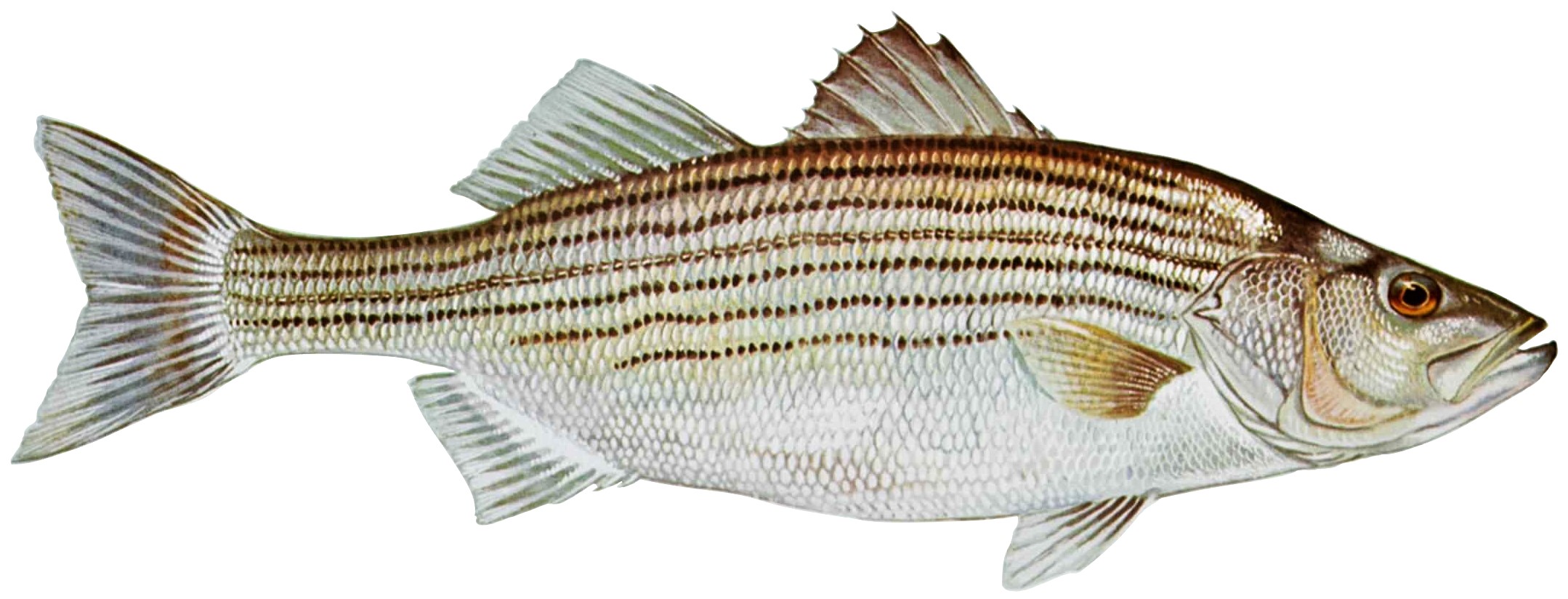
So the order of tests is: body shape first (slender is a striper; deep and arched is a hybrid or a white bass), then the stripes (broken and offset points to a hybrid, clean and continuous to a white bass or striper), then the tongue if you still are not sure. KDFWR's hybrid page gives no tongue-patch description for the hybrid, so we do not offer one. Its tailwater creel reports add a caution: "Positive ID on this genus can be difficult for anglers, so it is possible that some released fish were mis-identified."
Where they come from. The striped bass page says the species is native to Atlantic and Gulf coastal drainages, lives in salt water and runs up freshwater rivers to spawn, and that landlocked populations can survive and grow in impounded rivers. In Kentucky, in KDFWR's words, striped bass are maintained only through stocking, in the Ohio River and Lake Cumberland, and Ohio River fish often move up the Tennessee and Cumberland rivers below Kentucky and Barkley dams. The hybrid page lists hybrids stocked in reservoirs including Herrington, Barren River, Rough River, Taylorsville and Fishtrap lakes and in the Ohio, Kentucky, Green and Barren rivers, and says escapees from the reservoir stockings have produced fishable populations in other rivers. Neither page gives a food or spawning section; the striped bass page calls them open-water predators that chase smaller forage fish into shallow shoreline water and the heads of embayments.
The state records. KDFWR's record table lists the striped bass ("Rockfish") at 58.25 pounds, Roger Foster of Somerset, Lake Cumberland, 11 December 1985, and the hybrid striped bass at 20.50 pounds, Mark Wilson of Louisville, Barren River, 27 April 1991. The record page lists no Trophy Fish minimum for either; it links to the program page, which we did not read.
Basis: official (KDFWR Striped Bass and Hybrid Striped Bass pages; KDFWR state record table; KDFWR Lake and Tailwater Fishery Surveys report 2025)
The rules
Statewide, under 301 KAR 1:201, the two fish are in different counts.
- Hybrids, Section 2(1)(f): "White bass and hybrid striped bass daily limit, singly or in combination, fifteen (15); size limit, no more than five (5) fish in a daily limit or ten (10) fish in a possession limit shall be fifteen (15) inches or longer." No minimum length; fifteen fish of either or both, no more than five of them 15 inches or over.
- Striped bass, Section 2(1)(g): "Striped bass daily limit, five (5); size limit, fifteen (15) inches."
- Possession, Section 2(2): "The possession limit shall be two (2) times the daily limit," except where the regulation sets one itself.
That is why the identification matters. A 14-inch hybrid is a legal fish in the white bass count; a 14-inch striped bass goes back. Two waters change the rule, quoted from the current text (history line ending "eff. 9-3-2026", read 25 October 2026):
| Water | Rule | Regulation |
|---|---|---|
| Lake Cumberland | "Striped bass size limit, twenty-two (22) inches; daily limit, two (2)." | §3(44)(a)3 |
| Ohio River (at Louisville) | "White bass, striped bass, and any hybrid thereof, daily limit, thirty (30); no more than four (4) in the daily limit shall be fifteen (15) inches or greater." | §3(56)(a) |
Lake Cumberland's reach. The regulation extends the lake up "The Cumberland River to Cumberland Falls," "The Big South Fork to Devil's Jump," "The Rockcastle River to The Narrows" and "The Laurel River to Laurel River Dam." The line quoted names striped bass only, and we found no Lake Cumberland line for hybrids or white bass, which leaves them under the statewide 15. KDFWR's 2026 forecast repeats it: "Note: 22-inch size limit, 2 fish daily limit remains in effect."
Below Wolf Creek Dam the lake rule stops. The regulation's entry for the Cumberland River below Wolf Creek Dam, §3(19), runs "from Wolf Creek Dam downstream to the Kentucky-Tennessee state line and tributaries" and has trout lines and no striped bass line, and KDFWR's waterbody page for the tailwater reads "Statewide Regulations Apply" for striped bass. So a tailwater striper is under the statewide five fish and 15 inches. Two lines in the same entry reach every angler there, striper fishermen included: §3(19)(d), "A trout permit shall be required in order to fish the Cumberland River below Wolf Creek Dam" to the Tennessee line, Hatchery Creek and the other tributaries up to the first riffle included; and §3(19)(e), "Chumming shall not be permitted in the Cumberland River below Wolf Creek Dam," over the same reach.
The other big waters are statewide. KDFWR's waterbody pages read "Statewide Regulations Apply" for striped bass on Kentucky Lake and for hybrid striped bass on Barren River Lake. We did not read the Lake Barkley waterbody page in this run.
Basis: official (301 KAR 1:201 current text, eff. 3 September 2026, read 25 October 2026; KDFWR waterbody pages for the Lake Cumberland tailwater, Kentucky Lake and Barren River Lake; 2026 Fishing Forecast)
Stocking: what the hatchery put out in 2025
KDFWR's striped bass and hybrids come out of Minor Clark Fish Hatchery. Its 2025 sport fish production table in the survey report lists, for each water, the planned number and size and what actually went out. The actual figures, with average length in inches:
| Water | Fish | Stocked, 2025 | Inches |
|---|---|---|---|
| Lake Cumberland | Striped bass | 500,076 | 1.6 |
| Kentucky Lake tailwater | Striped bass | 40,535 | 1.4 |
| Barkley Lake tailwater | Striped bass | 40,906 | 1.4 |
| Barren River Lake | Hybrid | 200,235 | 1.4 |
| Rough River Lake | Hybrid | 102,123 | 1.4 |
| Herrington Lake | Hybrid | 96,320 | 1.4 |
| Taylorsville Lake | Hybrid | 61,148 | 1.6 |
| Fishtrap Lake | Hybrid | 23,088 | 1.5 |
| Grayson Lake | Hybrid | 15,043 | 2.1 |
| Guist Creek Lake | Hybrid | 9,547 | 1.7 |
| Lake Linville | Hybrid | 7,238 | 1.7 |
| Kentucky River, Pools 4, 5, 6, 8 and 9 | Hybrid | 20,070 in all | 1.4 |
| Ohio River, six pools | Hybrid | 540,990 in all | 1.2 to 1.5 |
The Ohio River hybrids went into the Markland (104,634), McAlpine (79,582), Cannelton (102,117), Newburgh (69,062), J.T. Myers (83,916) and Smithland (101,679) pools. The table's totals are 581,517 striped bass against 600,000 planned and 1,075,802 hybrids against 1,080,900 planned. The district reports put the timing on several of them: Lake Cumberland's stripers in late June and early July, and the hybrids at Taylorsville (20.0 fish per acre), Herrington (40.0 per acre), Guist Creek (30.1 per acre) and Fishtrap in June. The reports call the Taylorsville, Herrington and Guist Creek fish "reciprocal-cross" hybrids.
Two things in that table are worth reading closely. First, the striped bass rows are Lake Cumberland and the two tailwaters below Kentucky and Barkley dams, and the three add up to the striper total, so no Ohio River pool got striped bass from this table in 2025; the species page still says the Ohio River and Lake Cumberland are where they are stocked, and KDFWR's summer tips page calls Lake Cumberland "the only reservoir in Kentucky that KDFWR stocks with striped bass." We print all three as the agency wrote them. Second, the forecast puts Barren River Lake's normal hybrid stocking at 200,000 a year, with "higher numbers (300-400,000) stocked in 2015, 2016, and 2018," and says hybrids at Paintsville Lake were stocked in 2015 and 2020 and that "Stocking was discontinued in 2022."
Lake Cumberland's stocking history. An undated Kentucky Afield Outdoors release on the lake's stripers gives the background in KDFWR's words: "We used to stock 350,000 stripers in the lake every year, then increase the number to 500,000 every third year. Now, we plan to stock at least 500,000 striped bass in the lake every year." It lists 132,000 fingerlings in 2019, then 500,751 in 2020, 524,972 in 2021 and 600,000 in 2022, says the 2018 and 2019 year classes "did not do as well as expected" and that crews found no stripers from the 2018 stocking in their sampling, and gives the growth: "Stocked fish usually reach the 22-inch minimum size limit in three years," and "It takes about 11 years for a striped bass to reach 30 inches in Lake Cumberland."
Basis: official (Minor Clark Fish Hatchery 2025 Sport Fish Production table and district sections, KDFWR Lake and Tailwater Fishery Surveys report 2025; 2026 Fishing Forecast; KDFWR Striped Bass page; KDFWR Summer Fishing Tips; Kentucky Afield Outdoors Lake Cumberland Striped Bass Update, undated)
Where they are: KDFWR's 2026 forecast
KDFWR says its 2026 Fishing Forecast is "based on 2025 fish population surveys, creel surveys, fish stockings, and historical knowledge." The forecast's star ratings and its cheat sheets carry striped bass and hybrid columns, but they are printed as graphics that did not come through in the text we could read, so this page prints no star rating. The lines themselves:
| Water | Fish | The forecast's line, in short |
|---|---|---|
| Lake Cumberland | Striped bass | "Good mix of sizes available in the population." The 2023 and 2024 year classes "remain strong"; growth strong and fish healthy heading into 2026 |
| Cumberland River tailwater | Striped bass | "Fish 20 pounds plus available." Best below Burkesville; throughout the tailwater mid-October through April |
| Kentucky Lake | Striped bass and hybrids | Caught from the lake while fishing for white bass; trolling deep divers and fishing the jumps in spring and summer, "The larger fish will often be deeper in those jumps." |
| Kentucky Dam tailwater | Striped bass | "Better fishing is available below Kentucky Dam in the tailwater," with fish gathering during discharge through the generator section |
| Lake Barkley and its tailwater | Striped bass | "The tailwater produces better, more consistent catches, but the lake produces a few fish as well." |
| Barren River Lake | Hybrids | "Overall numbers are excellent with large fish (25-inch plus) available." |
| Barren River below the dam | Hybrids | The tailwater area is best, "especially during or following periods of heavy lake discharge"; fair below the instream dam at Bowling Green |
| Rough River Lake | Hybrids | "Excellent population of hybrid striped bass. Large number over 16 inches and many over 20 inches and up to 10+ pounds." The tailwater "good to excellent," hybrids best in April |
| Herrington Lake | Hybrids | "Number of fish is increasing slightly and 2- to 5-pound fish are present; fish over 25 inches possible." |
| Taylorsville Lake | Hybrids | Numbers "remain stable with most fish greater than 15 inches long and some fish sampled up to 25 inches." |
| Nolin tailwater | Hybrids | "Hybrids present year-round, but sporadic." |
| Ohio River | Both | Hybrids "up to 6 pounds in and around tailwaters"; stripers "Mid-summer to late-fall good for 6- to 10-pound fish. More common in lower pools." |
Beyond this site's waters, the forecast names Fishtrap Lake (good numbers in the lower lake in late summer and at winter pool, fish up to 22 inches with some larger, up the shallow headwaters in April during the white bass spawn, jumps from May to July), Paintsville Lake (low density, fish "up to 14 pounds have been caught recently. Eight pound fish are not uncommon"), Guist Creek Lake (limited, most 16 to 22 inches), Grayson Lake (a stocked population; jumps infrequent, best in summer in the lower lake), the Kentucky River ("Sporadic catches of 15- to 20-inch fish below dams") and the lower Green River, where "Stripers and hybrids congregate below dams late spring through early fall" and success is "highly dependent on weather and flow."
Basis: official (KDFWR 2026 Fishing Forecast and Tips, read as extracted text; star ratings Status pending)
What KDFWR's nets and creel clerks found
KDFWR samples these fish with gill nets in the fall and early winter and scores each population. The results below are from its Lake and Tailwater Fishery Surveys report for April 2025 to March 2026.
Lake Cumberland
Twenty gill-net nights in early December 2025, in Beaver Creek and the Wolf and Lily creek area, caught 65 striped bass, 3.3 per net-night. They ran 9.0 to 30.0 inches, the most common inch class 23 inches. Six year classes were in the catch, the 2023 fish (age 2) the biggest share at 40 percent. Fish of age 2+ averaged 23.0 inches at capture against the management objective of more than 21.0, and the catch of fish over 24 inches, 1.1 per net-night, met its objective of more than 1.0. The other two objectives were missed: fish age 1 and older at 3.2 per net-night against more than 4.0, and age-1 fish at 0.9 against more than 2.0. The assessment score was 8, rated Fair, with an annual mortality estimate of 44.8 percent. Relative weights were 86 for 12 to 19.9 inch fish, 84 for 20 to 29.9 and 78 over 30 inches.
The report is straight about the disagreement between its nets and the anglers: catch rates in the 2023 and 2025 samples were low, but "angler reports the last few years have indicated that Striped Bass numbers were abundant." Its conclusion: "Consistent stocking rates should help sustain the Striped Bass fishery going forward."
Taylorsville, Rough River, Guist Creek and Grayson
Taylorsville Lake, October 2025: 57 hybrids in 16 net-nights, 3.6 per net-night. The report says they "continue to show good growth, reaching 15.0 in between age 1 and age 2," relative weight 87 against a historic average of 86, rated Fair. Earlier ratings in its table: Good in 2016, 2017, 2018 and 2020, Fair in 2019 and 2021, Poor in 2023. The 2025 creel counted 1,428 hybrids caught and 880 kept, 881 pounds, against 2,030 caught and 265 kept in 2020; kept fish averaged 17.8 inches (18.3 in 2020) and 3.95 pounds.
Rough River Lake, October 2025: 314 hybrids in 12 net-nights, 26.2 per net-night, the highest catch rate on this page, though "a good portion of the catch was age-0 fish" and the adult catch was down, which the report thinks "seems to be a sampling anomaly." Its verdict: "The hybrid Striped Bass population continues to be relatively stable and thriving despite the poor summer water quality," with gizzard shad abundant all year. Two cautions in the same section: the oldest fish was age 5 where age 7-plus fish usually turn up, and the assessment score declined, "but is not seen as troublesome unless the trend continues for multiple years." The assessment table scores 2025 at 11, Good. The forecast's summer note for the lake explains the water-quality remark: "Water quality typically keeps fish less than 18 feet deep June through September."
Guist Creek Lake, October 2025: 13 hybrids in 8 net-nights, 1.6 per net-night, reaching 15 inches between ages 1 and 2 and 20 inches between ages 2 and 3, rated Poor. Grayson Lake: 70 hybrids from 7.0 to 27.0 inches, growth good, most under 15 inches and younger than 2, relative weights in the low 80s, rated Fair on a lake-specific scale.
The Kentucky and Barkley dam tailwaters
Roving bank creel surveys ran from 1 February to 26 August 2025. Below Kentucky Dam, of the white bass family's catch, striped bass were 28 percent and hybrids 4 percent; the survey's table, as extracted, puts the mean length of the striped bass caught at 12.6 inches and 0.85 pounds and of the hybrids at 16.0 inches and 2.08 pounds. Below Barkley Dam, striped bass were 24 percent of the family's catch and no hybrid share appears in the text we read. Those are catch figures, kept and released together, and the misidentification caution above comes from these two surveys. The white bass guide carries the trips, catch rates and satisfaction for the whole group.
What is missing
No hybrid survey for Barren River Lake or Herrington Lake, and no striped bass sampling or creel for the Cumberland tailwater, appears in the 2025 report as we read it. The report's Cumberland tailwater section covers trout only.
Basis: official (KDFWR Lake and Tailwater Fishery Surveys, annual performance report April 2025 to March 2026, Southeastern, Central, Northwestern, Northeastern and Western districts; 2026 Fishing Forecast)
The Cumberland: Lake Cumberland and the tailwater
KDFWR's 2019 column on the river below Wolf Creek Dam puts the case plainly: "The Cumberland tailwater is arguably the best place in Kentucky to catch a large striped bass," because the river "provides abundant forage with cool water year-round," and "Anglers fishing large shad-colored soft plastic swimbaits can catch a striped bass over 30 pounds in the river." The 2026 forecast says fish of 20 pounds plus are there, that they "can be found throughout the tailwater from mid-October through April," and that it is "Best below Burkesville using live bait or trolling shad or trout-colored crankbaits or swimbaits during summer." KDFWR's tailwater page lists public access including the Burkesville Ramp, Cloyds Landing and Winfreys Ferry.
The rules there, again, because they catch people out: statewide five fish at 15 inches for stripers, a trout permit to fish the river at all, and no chumming from the dam to the state line. The same 2019 column tells tailwater anglers to "consult the U.S. Army Corps of Engineers website" for the water release and generation schedule; check it before you put a boat or your feet in the river.
The lake through the year. The Kentucky Afield Outdoors release on Lake Cumberland's stripers explains the summer squeeze. Cool water stored over winter "has plenty of dissolved oxygen in the depths," and "This winter-stored water is the primary habitat of striped bass in Lake Cumberland." Through summer that layer is used up, and "August and September are the toughest months for striped bass in Lake Cumberland." In late summer and early fall the fish "can locate in 60 feet of water or more." For August the release recommends bottom fishing with alewives, threadfin shad or shiners on points at the mouths of major creek arms, from daybreak until 9 a.m. The fall turnover eases the stress, fishing improves as the fish move into the major creeks where they spend the winter, and bottom fishing with live bait "still works well in November and into December": "Try points in the lower creek arm nearest the main lake," and after about 30 minutes without a bite, move to the next point up the arm. In spring, KDFWR's April 2019 column found stripers in the major creek arms, mid to three-quarters of the way back where the water is a little warmer, from 15 feet deep to the surface, with surface temperatures that week of 64 to 68 degrees; it calls April through late May the time when "stripers rip through spawning schools of threadfin shad and alewives at night."
The oxygen system. The 2025 survey report says the oxygen injection system in the Wolf Creek Dam forebay became operational in October 2025. Its stated purpose is to improve oxygen levels in the tailwater during the late summer and early fall, and the report adds that "it will also create a refuge for Striped Bass in the lake when oxygen levels start to decline in the hypolimnion." Dissolved oxygen is to be monitored in 2026. What it does for the fishing is not yet in the record.
Basis: official (KDFWR column, Lee McClellan, 31 October 2019; KDFWR column, Lee McClellan, April 2019; Kentucky Afield Outdoors Lake Cumberland Striped Bass Update, undated; 2026 Fishing Forecast; KDFWR Lake Cumberland Tailwater waterbody page; 301 KAR 1:201 §3(19); KDFWR Lake and Tailwater Fishery Surveys report 2025)
What KDFWR says catches them
The agency's own recipes, from the forecast, its summer tips and its columns. Where a column quotes an angler, the advice is that angler's, and we say so.
- Live bait. The forecast's Kentucky and Barkley tailwater tips: "Best time is from April-June using live bait (skipjack herring)," with the bait caught in the tailwater by cast net or a skipjack rod; below Kentucky Dam, "Live herring is the preferred bait." The summer tips page: most Lake Cumberland anglers use live bait "either directly below the boat or drifted/trolled," and in the tailwaters "Drifting live shad or skipjack herring is also very effective." For hybrids, live and cut bait, and, the page says, "Surprisingly, chicken liver fished on the bottom or suspended is also a great bait."
- Big soft swimbaits on a heavy head. The tailwater tips' alternative to live bait: 4-inch sassy shad baits on a 1- to 2-ounce head, heavier as the current requires, bumped along the bottom, in pearl or chartreuse; below Kentucky Dam from the bank, "4-inch sassy shad type baits" off the two fishing piers near the dam. On the Cumberland tailwater, large shad-colored soft plastic swimbaits for the big fish. The jig page covers lead heads.
- Trolling. Deep-diving minnow imitations at Kentucky Lake; crankbaits along Barkley's deep main channel ledges near bridges and other places with current; shad or trout-colored crankbaits or swimbaits below Burkesville in summer; main-lake points and underwater features at Rough River in summer; trolling spoons and crankbaits for deep summer hybrids.
- Big jigs, vertical. Barkley's line: "fishing vertically with large jigs." The summer tips: "Hair jigs work well" at Lake Cumberland, and jigging spoons for deeper hybrids.
- The jumps. The summer tips page has hybrid schools at the surface early and late in the day, with heavy cloud extending the bite: "Topwater and shallow-running baits work well for fish on the surface." The forecast sends you to the jumps at Kentucky Lake in spring and summer and at Rough River in summer, and says the larger Kentucky Lake fish "will often be deeper in those jumps."
- Spring rivers for hybrids. Barren River Lake's upper lake "at 1st and 2nd riffle areas with spinners, crank baits, and curly tailed jigs"; "Bigger swimbaits and spinners for hybrids" in the river above the lake; Rough River's Eveleigh area and upstream in spring. In summer at Barren, the main lake around islands in the mid to lower lake or the dam area at night, where "The wee hours of early morning have produced best in recent years."
- Below the dams in current. On the lower Green, "Cast top water plugs or lead head jigs with plastic bodies into boils below dams." Below Kentucky Dam, fish gather "during periods of discharge through the generator section of dam," and a boat is best.
Lake Cumberland in spring, as two anglers fish it. KDFWR's April 2019 column passes on two anglers' methods. Jeff Bardroff runs five planer boards a side with 3/8- to 1/2-ounce weights, two downlines off the front on 12-foot rods with 3 or 4 ounces, and two lines off the back under striper-sized bobbers, baited with cast-netted shad or alewives or with large shiners; his line is 20-pound monofilament with a 15-pound fluorocarbon leader and a 2/0 circle hook. For bottom fishing he spreads baits at several depths and gives a spot half an hour before moving. At night, Rapala Slivers running 9 to 11 feet in red and white or silver, and Redfins or Jointed Thundersticks as the water warms; Major Shane Carrier fishes main-lake points and the points in the major creek arms. The column's tackle advice: "Medium-heavy to heavy baitcasting gear and lines of at least 17-pound test," or light medium-heavy inshore saltwater spinning gear, and on the strike, "Avoid setting the hook until you feel the weight of the fish." Its warning is the one to take: they "can pull the rod from your hands."
For rigging: a Palomar ties on a jig or a swimbait head; monofilament, fluorocarbon and braid compares the three materials, and line systems and the Alberto knot cover a braid main line to a fluorocarbon leader. The KDFWR sources we read say nothing about catching these fish on a fly; the streamer fishing page covers streamer lines, leaders and retrieves for trout and smallmouth, and what carries over to a striper is your call.
Basis: official (2026 Fishing Forecast and its Kentucky and Barkley tailwater tips; KDFWR Summer Fishing Tips; KDFWR columns April 2019 and 31 October 2019; the April column's methods are two named anglers', attributed in the text)
What we don't know yet
- Star ratings. The forecast's ratings and cheat sheets for striped bass and hybrids are graphics that did not come through in the text we read. Status pending until they are read from the page images.
- Barren River Lake and Herrington Lake surveys. The forecast gives both lakes hybrid lines, but the 2025 survey report as we read it has no hybrid sampling for either. Earlier reports we did not open. These are gaps, not findings.
- The Cumberland tailwater's stripers in numbers. No striped bass sampling or creel for the tailwater was in the 2025 report; the 20-pound and 30-pound figures above are the forecast's and a 2019 column's, not survey data.
- Where Ohio River stripers come from now. The species page says the Ohio River is stocked; the 2025 hatchery table has striped bass only for Lake Cumberland and the Kentucky and Barkley tailwaters. Whether Ohio River striper stocking is now done by another state or simply skipped a year is not in what we read.
- The undated Lake Cumberland release. Its stocking list ends with "502,796 this year" after 2022's figure, and it mentions a 40-inch fish caught "this year." With no date on the page, we print neither as a year.
- Spawning, temperature and food. KDFWR's species pages carry no spawning temperature and no diet text. The 64 to 68 degrees above is one week's surface reading in one column, not a threshold.
- Tennessee water. Kentucky Lake, Lake Barkley and the Cumberland tailwater all cross into Tennessee. We read Kentucky's rules only; on the Tennessee side, read Tennessee's.
- Trophy Fish minimums for either fish: Status pending; we did not read the program page.
- Spots. Nothing here names a hump, a point or a ledge beyond the creek arms, ramps and dams KDFWR itself names.
Regulations and official information
Rules are in the current KDFWR Fishing and Boating Guide and the regulation itself, 301 KAR 1:201. Species pages: Striped Bass and Hybrid Striped Bass. Forecast and surveys: 2026 Fishing Forecast and the annual fish sampling reports. Release and generation schedules for Wolf Creek, Kentucky and Barkley dams: the U.S. Army Corps of Engineers.
Basis: official
Sources and how confident we are
| Section | Basis |
|---|---|
| Overview and identification | Official (KDFWR species pages, record table, survey report caution) |
| The rules | Official (301 KAR 1:201 current text; KDFWR waterbody pages; forecast) |
| Stocking | Official (Minor Clark 2025 production table and district text; forecast; undated KDFWR release) |
| Where they are | Official (2026 Fishing Forecast text). Star ratings: Status pending |
| What the nets and clerks found | Official (Lake and Tailwater Fishery Surveys report 2025; tailwater lengths read from an extracted table) |
| The Cumberland | Official (KDFWR columns 2019; undated release; forecast; survey report; regulation) |
| What KDFWR says catches them | Official (forecast; Summer Fishing Tips; KDFWR columns, two anglers' methods attributed by name) |
Sources
- 301 KAR 1:201, Taking of fish by traditional fishing methods - Kentucky Legislative Research Commission - §2(1)(f), §2(1)(g) and §2(2); §3(44) Lake Cumberland and its boundaries; §3(56)(a) Ohio River; §3(19) Cumberland River below Wolf Creek Dam, its trout permit and chumming lines; history line ending "eff. 9-3-2026".
- Striped Bass - KDFWR and Hybrid Striped Bass - KDFWR - identification, size, origin, stocked waters.
- State Record Fishes and Awards - KDFWR - the striped bass and hybrid records.
- Lake Cumberland Tailwater waterbody page - KDFWR, Kentucky Lake waterbody page - KDFWR and Barren River Lake waterbody page - KDFWR - "Statewide Regulations Apply" lines; tailwater access sites.
- 2026 Fishing Forecast and Tips (PDF) - KDFWR - basis statement, every striped bass and hybrid line quoted above, Barren and Paintsville stocking notes, the Kentucky and Barkley tailwater tips.
- Lake and Tailwater Fishery Surveys, annual performance report for April 2025 - March 2026 (PDF) - KDFWR - Lake Cumberland gill nets and the Wolf Creek oxygen system; Taylorsville, Rough River, Guist Creek and Grayson hybrids; Kentucky and Barkley tailwater creels; Minor Clark 2025 production table.
- Summer Fishing Tips - KDFWR - striped bass and hybrid locations and baits.
- Kentucky Afield Outdoors Lake Cumberland Striped Bass Update - KDFWR (undated) - stocking history, growth, the summer habitat squeeze, late-summer and fall locations.
- Lake Cumberland striped bass heating up - KDFWR (Lee McClellan, April 2019) - spring locations, two anglers' methods, tackle advice.
- Fishing remains productive during deer season - KDFWR (Lee McClellan, 31 October 2019) - the Cumberland tailwater striper fishery and the generation-schedule advice.