Overview and identification
On most Kentucky water a rainbow trout is a fish that was stocked recently, so the useful questions are where, when and what the rules are. KDFWR manages put-and-take, put-grow-take and catch-and-release trout water, and the state's trout river is the Cumberland below Wolf Creek Dam, where a 15 to 20 inch protected slot applies and everyone needs a trout permit. Elsewhere, anglers who intend to keep trout must have the permit unless license exempt. Below are the stocking, the rules, the tailwater and what KDFWR says catches them. The rainbow is not a Kentucky native: KDFWR's species page says it is native to Pacific Coast drainages and is stocked as a sport fish in the coolest creeks, streams, rivers and reservoirs across the state. The same page gives the field marks: a streamlined body, an adipose fin, a large mouth whose upper jaw reaches just past the rear of the eye, many small black spots on the tail fin and on the back and sides, and, in adults, a broad pink-to-red stripe along the side. The page names the small black spots on the tail fin as what separates the rainbow from the brown and the brook trout. KDFWR's Fisheries Bulletin 112 uses the scientific name Oncorhynchus mykiss.
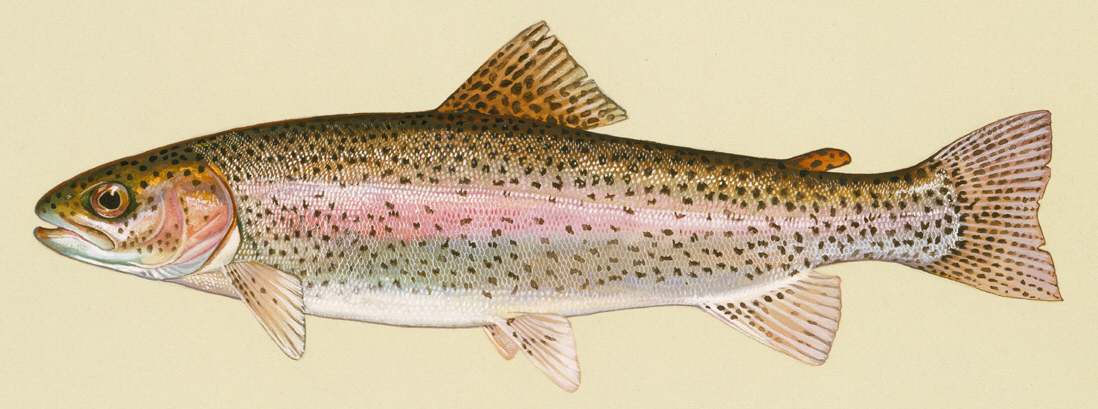
Size, from the species page: most rainbows in small and medium streams run about 12 to 14 inches and under a pound; fish in rivers and reservoir tailwaters "may attain larger sizes (over 10 lbs.)."
The state record is a tailwater fish. KDFWR's record table lists the rainbow trout at 14.38 pounds, caught by Jim Mattingly of Somerset on the Cumberland River on 10 September 1972. The brown trout record (21.00 pounds, 2000) and the brook trout record (3.65 pounds, 2015) came from the same river. The table lists no cutthroat record.
KDFWR's Trophy Fish award program sets the rainbow trout minimum at 20 inches, and the program excludes fish from pay lakes and hatcheries.
Basis: official (KDFWR Rainbow Trout species page; KDFWR State Record Fishes and Awards; KDFWR Trophy Fish Program page; KDFWR Fisheries Bulletin 112)
A stocking fishery
KDFWR's trout program document for 2026, Trout Streams Program in Kentucky, is plain about how the fishery works. It manages three kinds of trout water. "Put-and-take fisheries can be established in any waterbody in the state during the spring, winter, and fall when water temperatures are suitable." "Tailwaters and streams that provide suitable habitat year-round are managed for put-grow-take fisheries." A few waters are catch-and-release only. The document counts 291.3 miles of trout water: 45 streams (197.7 miles) and 14 tailwaters (93.6 miles).
The program is old. The same document says rainbow trout were first stocked as catchable-size fish into the Lake Cumberland and Herrington Lake tailwaters in 1952. A 2020 KDFWR column has its assistant fisheries director explaining the calendar in one line: "Because water temperatures generally become too warm to support trout in summer, we haven't stocked a lot of these places since spring."
What that means for you: on most Kentucky water a rainbow trout is a fish that was stocked recently, and the useful questions are where, when and how many. The temperature classes that decide which waters hold fish through the summer are laid out in our fall trout stocking article; this page does not repeat them.
Basis: official (KDFWR Trout Streams Program in Kentucky for 2026; KDFWR column 28 October 2020)
The rules
The permit
Under 301 KAR 1:201 Section 2(11): "A person shall release all caught trout unless the person: (a) Has a valid trout permit; (b) Is exempted from trout permit requirements pursuant to KRS 150.170(2); or (c) Is fishing in a licensed pay lake stocked with trout by the lake operator." The 2026–27 Fishing and Boating Guide puts it in one sentence: "Unless license exempt, anglers who intend to keep trout must have a trout permit." The permit is included in the resident sportsman's license and the resident senior/disabled sportsman's license.
The price: the Guide (March 2026 to February 2027) prints the trout permit at $10.57. The fee regulation, 301 KAR 5:022 Section 2(1)(e), effective 6 November 2025, reads "Trout permit: ten (10) dollars." KDFWR's release of 27 February 2026 says 2026–27 license and permit fees "will remain the same" as the year before. Neither document explains the 57 cents, and we do not guess at it; pay what the license system charges.
One water breaks the "intend to keep" rule. On the Cumberland River below Wolf Creek Dam, everyone needs the permit (see below).
Statewide
301 KAR 1:201 Section 2(1)(i), current text effective 3 September 2026:
- "No culling statewide."
- "Rainbow trout daily limit, eight (8); no size limit."
- "Brown trout daily limit, one (1); size limit, sixteen (16) inches."
- "Brook trout, catch and release only."
- "Cutthroat trout daily limit, one (1); size limit, twenty (20) inches."
The Guide's limits table adds the rainbow possession limit, 16. KDFWR's program document dates the pieces: culling of all trout species prohibited statewide since 2015; the 8-fish rainbow limit and the 16-inch, 1-fish brown trout rule since 2018; the cutthroat rule since 2020. No culling means a trout counts toward your limit once you keep it; you cannot swap it later for a bigger one.
Water by water
Every trout provision in the regulation that changes the statewide rule for rainbows, quoted from the current text:
| Water | Rainbow trout rule | Regulation |
|---|---|---|
| Cumberland River, Wolf Creek Dam to the Tennessee line, and tributaries | 15 to 20 inch protected slot; 5 a day, no more than 1 over 20 inches; permit for everyone; no chumming | 301 KAR 1:201 §3(19) |
| Hatchery Creek, upper section, Russell County | Rainbow, brown and brook trout: no size limit; 5 a day combined | §3(36) |
| Hatchery Creek, lower section | Artificial bait only; release all trout | §3(37) |
| Dale Hollow Lake | Rainbow and brown trout: no size limit; 7 a day combined | §3(21)(d) |
| Trammel Creek, Allen County | 5 a day | §3(68) |
| Waters on the regulation's List of Special Lakes and Ponds | 5 a day (the Guide prints the same 5 for FINs lakes) | §7(4) |
The Cumberland text verbatim, because it is the one people get wrong: "(c) Rainbow trout. There shall be a slot limit between fifteen (15) and twenty (20) inches; daily limit, five (5), which shall not include more than one (1) fish greater than twenty (20) inches. (d) A trout permit shall be required in order to fish the Cumberland River below Wolf Creek Dam to the Tennessee state line including the Hatchery Creek and all other tributaries upstream to the first riffle. (e) Chumming shall not be permitted..." over the same reach. The same subsection sets brown trout at 20 inches and 1 a day and brook trout at 15 inches and 1 a day. KDFWR's water page for the tailwater adds that fish between 15 and 20 inches must be released, and the Guide spells out the chumming rule: "Anglers may not attract or chum trout with bait, corn or other attractants."
Hatchery Creek's two sections are bounded only "as established by signs." A 2020 KDFWR column says the lower section is "delineated by a migration barrier and signage."
The seasonal catch-and-release streams
Section 5 of 301 KAR 1:201, "Seasonal Catch and Release for Trout," sets "a catch and release trout season from October 1 through March 31" on fifteen named streams, where a person shall "(a) Only use artificial bait; and (b) Release all trout." The fifteen, in the regulation's words: Bark Camp Creek (Whitley); Beaver Creek from the Highway 90 bridge upstream to the Highway 200 bridge (Wayne); Big Bone Creek within Big Bone Lick State Park (Boone); Cane Creek (Laurel); Casey Creek (Trigg); Clear Creek from the mouth upstream to the 190 bridge (Bell); East Fork of Indian Creek (Menifee); Elk Spring Creek (Wayne); Floyd's Fork from Highway 60 downstream to Bardstown Road (Jefferson); Gunpowder Creek (Boone); Left Fork of Beaver Creek from the Highway 122 bridge to the headwater (Floyd); Otter Creek on the Fort Knox Reservation and Otter Creek Park (Meade); Rock Creek from the Bell Farm Bridge to the Tennessee line (McCreary); Trammel Creek (Allen); and Swift Camp Creek (Wolfe).
The Guide defines artificial bait as lures or flies "made of wood, metal, plastic" and similar inert materials. KDFWR's 2020 column spells out what is out: "Organic baits such as PowerBait, corn, cheese or salmon eggs, and live baits like worms or minnows may not be used."
KDFWR's own program document counts fourteen streams and 86.8 miles with seasonal catch-and-release sections, one fewer than the regulation lists; the document does not say which one it leaves out. The regulation is the rule. Note also that 301 KAR 1:201 has no "delayed harvest" category: what other states call delayed harvest, Kentucky writes as this October-to-March season.
Basis: official (301 KAR 1:201 current text, history line ending "eff. 9-3-2026"; 301 KAR 5:022; 2026–27 Fishing and Boating Guide; KDFWR release 27 February 2026; KDFWR Lake Cumberland Tailwater water page; Trout Streams Program in Kentucky for 2026; KDFWR column 28 October 2020)
Where the fish come from: Wolf Creek National Fish Hatchery
The U.S. Fish and Wildlife Service's page for the hatchery places it "below Wolf Creek Dam, just off of U.S. 127 in Jamestown, Kentucky," raising rainbow, brook and brown trout. Its figures: "An estimated 1,000,000 trout weighing 275,000 pounds are produced each year," stocked "in coordination with the Kentucky Department of Fish and Wildlife Resources in over 125 public fishing waters." Visitors may tour the hatchery and fish the creek below it, which is Hatchery Creek.
KDFWR's 2026 program document prints the hatchery's production for the year "based on current production needs":
| Species | Size | Number | Pounds |
|---|---|---|---|
| Rainbow | 9 in | 483,600 | 152,000 |
| Rainbow | 10 in | 120,750 | 49,300 |
| Rainbow | 12 in | 12,325 | 8,500 |
| Rainbow | 15 in | 15,000 | 20,550 |
| Brown | 8 in | 57,150 | 11,925 |
| Brown | 12 in | 12,000 | 8,300 |
| Brook | 9 in | 15,000 | 4,600 |
By our arithmetic, not a KDFWR figure, that is 631,675 rainbows, nearly all of them 9 or 10 inches. The two agencies' totals differ (about a million trout a year on the federal page, about 716,000 fish in KDFWR's 2026 table by our sum), and neither page explains the gap, so we print both and reconcile neither. A KDFWR column from 2020 puts the stocked fish at "about 10 inches long and about a half a pound."
The hatchery runs on the lake's water. KDFWR's program document: "Trout production at WCNFH is highly dependent on the quality of water being drawn from Lake Cumberland." It also records two 2025–26 changes at the hatchery's main water: cutthroat stocking in the Lake Cumberland tailwater was discontinued in 2025, citing production limitations at the hatchery, and "In 2026, stocking of sterile Rainbow Trout in the Lake Cumberland tailwater was discontinued." Those 8- to 12-inch sterile rainbows had been stocked annually since 2010.
Basis: official (USFWS Wolf Creek National Fish Hatchery page; KDFWR Trout Streams Program in Kentucky for 2026; KDFWR column 28 October 2020)
The stocking schedule
KDFWR posts trout stockings month by month on its Trout Stocking Schedule page; there is no annual schedule PDF. Read on 14 October 2026, the page showed October 2026: eleven stocking dates from 6 to 28 October across creeks, tailwaters, state park lakes and city park lakes, single stockings from 250 to 5,500 fish, totalling 74,450 by our count, with the Nolin Lake tailwater stocking of 13 October "Postponed Due to High Water Temperature." The page gives numbers but not species or sizes, and shows no last-updated date. This fall's dates, waters and the September stockings before them are the job of our fall trout stocking article.
Two things on the schedule page matter for every month. First, the public notice: stocking dates for streams on federal property "are not announced ahead of time": Bark Camp Creek, Cane Creek, Chimney Top Creek, Craney Creek, East Fork Indian Creek, Middle Fork Red River, North Fork Triplett Creek, Rock Creek, Swift Camp Creek, War Fork and Hatchery Creek, and the Cumberland tailwater dates are not announced either. KDFWR's tailwater page says the same: "Trout Stocking Dates will no longer be announced."
Second, the months. KDFWR's 2026 Fishing Forecast gives the stocking calendar for a number of waters, and it is the closest thing to an annual plan the agency publishes:
| Water | Forecast's stocking line |
|---|---|
| Nolin River Lake tailwater | "Rainbows stocked monthly (April-November) except for August"; holdovers to 16 inches; most trout in the first 3.5 miles |
| Dix River below Herrington Lake | 4,500 rainbows stocked annually; "Low numbers of holdover fish expected due to poor water conditions" |
| Fishpond Lake | January, April, May and October, 4,000 total |
| Beulah Lake; Bert Combs Lake | January, April, May and October |
| Wood Creek Lake | February and October; most fish 10 to 13 inches |
| Cannon Creek Lake | February and October |
| Pikeville City Lake | March and November, 2,500 total |
| Metcalfe County Lake | 500 in March, put-and-take; too warm by mid-May |
| Paintsville Lake | February stocking; occasional 15-inch-plus fish |
Basis: official (KDFWR Trout Stocking Schedule page, read 14 October 2026; KDFWR Lake Cumberland Tailwater water page; 2026 Fishing Forecast)
The Cumberland River below Wolf Creek Dam
This is the state's trout river. KDFWR's program document lists the Lake Cumberland tailwater at 75.2 miles, Class IB, "managed for a put-grow-and-take fishery." The water stays cold all year: in 2025, the tailwater survey report recorded zero days with a daily average at or above 72 F, a highest daily average of 64.4 F between June and September and 56.9 F in June, from USGS stations. The report describes it as "currently managed as both a put-and-take and put-grow-take fishery for Rainbow Trout." A 2023 KDFWR column: "The water is cold enough for trout to thrive in the river year-round."
What goes in. The trout stocking tables in KDFWR's two most recent Lake and Tailwater Fishery Survey reports list 198,200 rainbows of 9 to 16 inches for the Lake Cumberland tailwater in the April 2024 to March 2025 report and 192,925 of 9 to 16 inches in the April 2025 to March 2026 report, with 31,700 and 30,050 rainbows of 9 to 17 inches for Hatchery Creek. The tables do not state the stocking year themselves. The 2023 column says KDFWR "schedules the stockings of more than a quarter-million trout in the tailwater" and stocks "rainbow trout up to 15 inches long."
The slot, and what it did. The 15 to 20 inch protected slot and 5-fish limit took effect in March 2004. KDFWR's Fisheries Bulletin 112 (David Dreves, March 2014) evaluated it. In 2006 KDFWR's sampling catch rate of rainbows 15 inches and longer hit an all-time high of 33.9 fish per hour, against a pre-regulation high of 27.2, and the total rainbow catch rate rose to 219.7 fish per hour, 63.8 percent above 2002. "No change was seen in the catch rate of ≥20 in rainbow trout." Anglers' catch rate rose from 0.65 to 0.71 fish per hour, and fish of 15 inches and up went from 8.7 to 12.7 percent of the catch. Growth and condition did not fall. Then the study stopped: the bulletin says "the rainbow trout population in the tailwater was highly negatively affected by the Wolf Creek Dam rehabilitation project," which began in 2007. Its first recommendation was that the size and creel limits "should remain" once the rehabilitation was finished and flows returned to normal. They have.
The 2026 forecast's lines for the tailwater's rainbows: "Increased numbers of fish over 18 inches were observed during fall sampling." "Good numbers of stock-size fish (9-11 inches) available year-round and some trout over 20 inches present." For the other trout: brown trout numbers "were lower during 2025 sampling," with "Some keeper fish (>20 inches) present but numbers are low"; brook trout a "Low density population with most fish in the 10- to 12-inch range"; cutthroat "have not been stocked in the tailwater since 2024." The forecast's opening pages point anglers to the Cumberland tailwater and Hatchery Creek in late winter and early spring, and add: "Trout bite willingly in cold water."
The survey record. KDFWR's Rivers and Streams branch report for 2025 says "Trout samples are conducted annually in November by the Southeast Fisheries District." The district's sections we read in the 2024 and 2025 Lake and Tailwater reports carry the tailwater's temperature and management summary but no rainbow catch rates or length data; the forecast's sampling line above is the only 2025 population result we found in print. The water page, with access and the map, is Cumberland River tailwater.
Generation. KDFWR's 2023 column: "One must know the electrical generation schedule from Wolf Creek Dam before fishing the Cumberland River," and "Anglers should be mindful of sudden current surges that indicate unexpected generation from Wolf Creek Dam." John Hast, KDFWR's bear and elk program coordinator and a fly angler, quoted there: "One generator running is great for catching fish. This release level allows for wading while providing current that can make the fish feed a bit more." The column's safety line is the agency's, not ours: "Unless you are experienced with boating on this tricky river, wade fishing is the safest option," with neoprene waders and insulated clothes in winter, and no wading "beyond their capabilities."
Basis: official (Trout Streams Program in Kentucky for 2026; KDFWR Lake and Tailwater Fishery Surveys 2024 and 2025, Southeastern District trout section and trout stocking tables; KDFWR Rivers and Streams Fisheries Research Branch report 2025; KDFWR Fisheries Bulletin 112; 2026 Fishing Forecast; KDFWR column 26 December 2023)
Hatchery Creek
The creek below the hatchery is two fisheries. KDFWR's program document: "In 2016, the construction of Lower Hatchery Creek, a completely man-made stream was completed." The lower section, about a mile, "is managed under a no harvest, artificial bait only regulation for trout"; the upper section "is managed under a 5-fish daily limit of all trout species in aggregate." Its water comes from the hatchery: the 2025 survey report, using Wolf Creek National Fish Hatchery data, recorded zero days at or above 72 F, a highest daily average of 63.0 F from June through September and 56.0 F in June. KDFWR's 2020 column: "Rainbow, brown and brook trout are utilizing the creek." The Cumberland permit and no-chumming rules cover all of it.
Basis: official (Trout Streams Program in Kentucky for 2026; KDFWR Lake and Tailwater Fishery Surveys 2025; KDFWR column 28 October 2020; USFWS hatchery page)
What KDFWR says catches them
The agency's own advice, from its biologists' columns and the forecast:
- Spinning gear. "In general, small in-line spinners and crankbaits fished with spinning gear on 4-pound line are good bets for trout in flowing waters" (2020 column).
- Nymphs under an indicator on the Cumberland. "As far as the Cumberland tailwater, the Hare's Ear nymph and Copper John are the gold standard. Some anglers run a zebra midge off those under a strike indicator" (KDFWR biologist John Hast, 2020). The 2023 column adds Prince Nymphs, Copper Johns and Hare's Ears in sizes 16 to 18, a Dally's tailwater jig in swifter current, tungsten heads to get down, small foam indicators, and the rule that matters most: "Your fly needs to be near the bottom to have any luck on the Cumberland River."
- Woolly Buggers in winter. Beadhead Woolly Buggers in olive, brown and orange and black, weighted with lead wire, "best fished near the bottom in winter since they imitate both crayfish and baitfish," on slow strips just over bottom (2023).
- Hast's rig, as printed. A 4-weight for nymphs and a 6-weight for Woolly Buggers; for nymphs, a 12-foot 5X tapered leader with about 3 feet of tippet added; for streamers, a 4-foot polyleader and 18 to 24 inches of 4X fluorocarbon (2023). That is one angler's setup on one river, not a rule.
- Fall flies elsewhere. "Fly anglers should consider carrying smaller streamers and midge patterns as well as stonefly and egg imitations"; on the Dix River below Herrington, "a zebra midge beneath a strike indicator" (2020).
- Timing on stocked lakes. Mill Creek Lake: "Best time to fish is within the first few days after stocking." Paintsville Lake: "Best fishing in shallow water during winter to early spring after the February stocking," with "Some fish present in summer at depth of 20-25 feet" (2026 forecast).
- Where in a river. "The flowing holes with hides in the form of rocks or undercut banks make the best places to fish nymphs and Woolly Buggers in winter" (2023).
On a seasonal catch-and-release stream from October through March, only the artificial half of that list is legal. For the rigs: indicator nymphing (our guide is planned), dry-dropper, streamer fishing and, for bait on a put-and-take lake, slip float. Leaders and tippet sizes are in leaders and tippet; an improved clinch ties the fly, a double surgeon's adds tippet, and loop-to-loop joins leader to fly line or polyleader.
Releasing them. KDFWR's assistant fisheries director, in 2020: "Try to avoid doing anything that might wipe off their protective slime," unhook the fish in the water, handle it with wet hands or a soft mesh net if it must come out, and "Use a heavy enough tippet that you can land the fish in a reasonable amount of time." Every 15- to 20-inch rainbow on the Cumberland and every trout on a seasonal stream from October through March goes back.
Basis: official (KDFWR columns 28 October 2020 and 26 December 2023; 2026 Fishing Forecast)
What we don't know yet
- The tailwater's survey numbers. KDFWR samples the Cumberland tailwater's trout every November, and the forecast reports more rainbows over 18 inches in fall 2025, but the catch rates and length data behind that line were not in the reports we read. Status pending.
- The tailwater's forecast rating. The forecast marks 4-star waters in colour on its cheat sheets, and the text we could read does not show the colour. Status pending.
- The permit's 57 cents. The Guide prints $10.57; the fee regulation says ten dollars. Status pending until KDFWR says what the difference is.
- The fourteen-or-fifteen stream count. The regulation lists fifteen seasonal catch-and-release streams; the program document counts fourteen. The regulation governs.
- Natural reproduction. No KDFWR document we read describes rainbow trout spawning or a self-sustaining rainbow population in Kentucky. That is a gap in what we found, not a finding that none exists.
- Diet and spawning habits. The species page carries neither.
- The two hatchery totals. About a million trout a year on the USFWS page, about 716,000 in KDFWR's 2026 table by our sum. Neither explains the difference.
- Spots. Nothing here names a hole or a run. The access sites are on KDFWR's tailwater page and our water page.
Regulations and official information
Trout rules are in the regulation, 301 KAR 1:201, and the current KDFWR Fishing and Boating Guide. The permit fee is in 301 KAR 5:022. Stockings: KDFWR Trout Stocking Schedule. The program: Trout Streams Program in Kentucky. The tailwater: KDFWR Lake Cumberland Tailwater page. Check the Wolf Creek Dam generation schedule before you go, and verify regulations before you travel.
Basis: official
Sources and how confident we are
| Section | Basis |
|---|---|
| Overview and identification | Official (KDFWR species page, record table, Trophy Fish page) |
| A stocking fishery | Official (Trout Streams Program 2026; KDFWR column) |
| The rules | Official (301 KAR 1:201 and 5:022 current texts; Guide 2026–27; KDFWR tailwater page). Permit price difference: Status pending |
| Wolf Creek hatchery | Official (USFWS hatchery page; KDFWR program document). Totals differ, unreconciled |
| The stocking schedule | Official (KDFWR schedule page read 14 October 2026; 2026 Forecast); October total is our count |
| Cumberland River | Official (program document; survey reports; Bulletin 112; Forecast; KDFWR column). Fall sampling data and rating: Status pending |
| Hatchery Creek | Official (program document; survey report; KDFWR column) |
| What catches them | Official (KDFWR columns 2020 and 2023; Forecast) |
Sources
- 301 KAR 1:201, Taking of fish by traditional fishing methods — Kentucky Legislative Research Commission — Section 2(1)(i) statewide trout limits; Section 2(11) trout release and permit rule; Section 3(19), (21)(d), (36), (37) and (68); Section 5 seasonal catch-and-release streams; Section 7(4); history line ending "eff. 9-3-2026".
- 301 KAR 5:022, License, tag, and permit fees — LRC — Section 2(1)(e) "Trout permit: ten (10) dollars"; effective 6 November 2025.
- Kentucky Fishing and Boating Guide, March 2026 – February 2027 (PDF) — KDFWR — trout permit $10.57 and who needs it; licenses that include it; artificial bait definition; rainbow limits 8 and 16; Cumberland permit and chumming text; Dale Hollow and FINs trout lines.
- 2026-2027 Kentucky fishing and hunting licenses available — KDFWR, 27 February 2026 — fees unchanged from the previous license year.
- Rainbow Trout — KDFWR — identification, size, native range, Kentucky stocking.
- State Record Fishes and Awards — KDFWR — rainbow, brown and brook trout records.
- Trophy Fish Program and Master Angler Award — KDFWR — 20-inch rainbow trout minimum; hatchery and pay-lake exclusion.
- Trout Streams Program in Kentucky for 2026 (PDF) — KDFWR — fishery types, program miles, 1952 first stocking, regulation history, Hatchery Creek, Lake Cumberland tailwater class and miles, 2026 Wolf Creek production table, 2025 and 2026 changes.
- Wolf Creek National Fish Hatchery — U.S. Fish and Wildlife Service — location, species, annual production estimate, waters stocked, Hatchery Creek.
- Trout Stocking Schedule — KDFWR — October 2026 stockings, federal-property notice, the Nolin postponement; read 14 October 2026.
- Lake Cumberland Tailwater — KDFWR fisheries app — species regulations, permit, chumming, unannounced stocking, access sites.
- 2026 Fishing Forecast and Tips (PDF) — KDFWR — Lake Cumberland tailwater trout lines; stocking months and lines for Nolin tailwater, Dix River, Fishpond, Beulah, Bert Combs, Wood Creek, Cannon Creek, Pikeville City, Metcalfe County, Paintsville and Mill Creek lakes.
- Lake and Tailwater Fishery Surveys, April 2025 – March 2026 (PDF) — KDFWR and April 2024 – March 2025 (PDF) — Southeastern District Cumberland tailwater and Hatchery Creek temperature and management sections; trout stocking number tables.
- Rivers and Streams Fisheries Research Branch, 2025 annual report (PDF) — KDFWR — November trout sampling by the Southeast district.
- Evaluation of Restrictive Regulations on Rainbow Trout and the Performance of Two Strains in the Lake Cumberland Tailwater — KDFWR Fisheries Bulletin 112 (Dreves, 2014) — the 2004 slot, its results to 2006, the dam rehabilitation, recommendations.
- Fall for trout all over again — KDFWR (Lee McClellan, 28 October 2020) and Fall Fishing Festival: Fly fishing the Cumberland tailwater — KDFWR (Lee McClellan, 26 December 2023) — stocked fish size, catch-and-release bait rules, Hatchery Creek, lures, flies, rigs, generation and wading, handling.